The police encounter and bulldozer culture are not merely a law-and-order problem in one state. It is a template being consciously replicated. Several states have adopted similar “bulldozer action.” The political messaging is deliberate: that the strong State acts swiftly against criminals where courts are slow, writes former IAS officer V.S.Pandey
In a constitutional democracy governed by the rule of law, the state derives its legitimacy from its commitment to due process, equal protection, and the sanctity of individual rights. When the machinery of the state begins to bypass courts, demolish homes without legal authority, and celebrate extrajudicial killings as governance, something fundamental has collapsed. This breaking point has been on brazen display in many states, including Uttar Pradesh and the silence of constitutional watchdogs has worsened the crisis.
As per data available in the public domain, since March 2017, Uttar Pradesh has recorded over 10,000 police encounters, resulting in more than 180 deaths and thousands of injuries to alleged criminals. Senior police officers have been publicly felicitated for encounter killings. The Chief Minister himself has repeatedly endorsed this approach, famously declaring that criminals would be sent to jail, or to the “next world.” Are these the assertions of an administrator committed to due process?
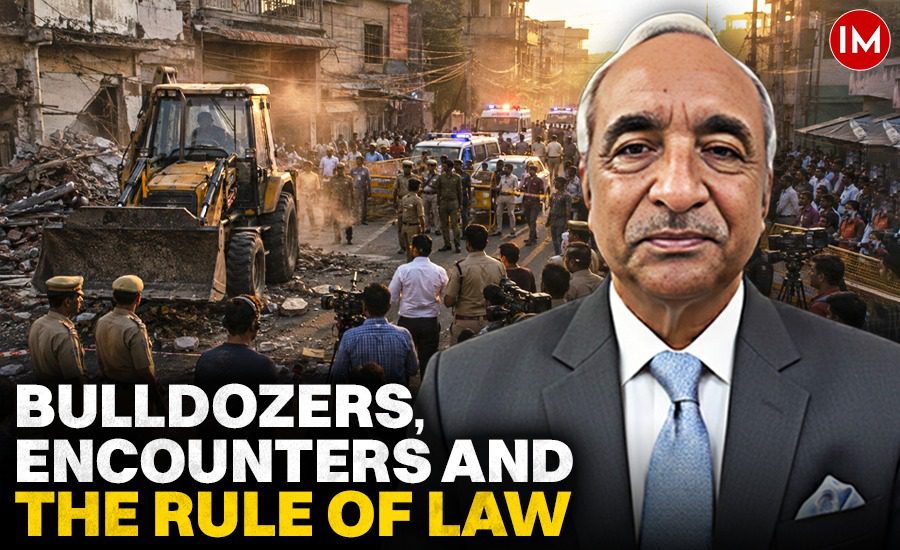
The “bulldozer justice” that accompanies this culture of impunity is equally alarming. Since 2022 in particular, authorities in UP — and now in several other states, following UP’s template — have demolished homes, shops, and properties of individuals accused of crimes, often within hours of their names surfacing in FIRs. No trial. No conviction. No court order in many cases. Just a bulldozer and a crowd!
The Indian Constitution is unambiguous on these matters. Article 21 guarantees that no person shall be deprived of life or personal liberty except according to procedures established by law. An encounter killing, where a person is shot dead without arrest, trial, or judicial determination of guilt, cannot by any stretch of constitutional imagination qualify as “procedure established by law.”
Article 14 guarantees equality before the law. Demolishing the home of an accused person — whose guilt has not been established — while leaving intact the properties of others violates this guarantee directly. The Constitution envisions a system where guilt is determined by courts, not by the State executing its own judgement on the street.
The true constitutional crisis is not merely the conduct of several state governments — it is the institutional passivity that surrounds it. The Supreme Court and high courts have the power under Articles 32 and 226 to intervene in cases of systematic constitutional violations. While there have been occasional judicial observations expressing concern, there has been no sustained, structural judicial intervention to halt the encounter culture or the bulldozer demolitions.
The Central Government, which has concurrent jurisdiction over law and order matters and the power to issue directives under Article 256, has remained conspicuously silent — perhaps because it pays dividends politically- saliently targeting the Other . Encounter killings poll well. Bulldozers are popular symbols of “tough governance.”
This political calculus, however, does not alter constitutional obligations. When governments use fear as a policy instrument and garb extrajudicial violence in the language of crime control, the courts must speak out and act .Their silence is not neutrality.
The contrast with established democracies is instructive. In the United Kingdom, the shooting of Jean Charles de Menezes by police officers in 2005 — a case of mistaken identity – led to a full independent inquiry, a landmark IPCC investigation, a conviction of the Metropolitan Police for health and safety violations, and a £100,000 compensation to the family. No officer was celebrated. The institution was held accountable.
In the United States, despite its own serious and documented problems with police violence, the legal architecture provides for federal civil rights investigations, Department of Justice pattern-or-practice lawsuits against police departments, and civil liability for officers who violate constitutional rights. Courts have imposed structural reforms, consent decrees, and independent monitors on police departments that engage in systematic misconduct.
In Germany, the rule of proportionality is a constitutional principle that requires police force to be the minimum necessary, and courts enforce it rigorously. The idea of a politician publicly celebrating a police killing would trigger immediate constitutional court proceedings.
The lesson is clear: in mature constitutional democracies, no arm of government — not even the most popular one — is permitted to operate above the law. The legitimacy of the state depends precisely on this constraint.
The police encounter and bulldozer culture is not merely a law-and-order problem in one state. It is a template being consciously replicated. Several states have adopted similar “bulldozer action.” The political messaging is deliberate: that the strong State acts swiftly against criminals where courts are slow. This messaging, left unchallenged, normalises the idea that the State may bypass law whenever it is inconvenient — a principle that, once accepted, will not be confined to criminals alone. It will eventually be used against dissidents, minorities, journalists, and anyone the State finds ‘inconvenient.’
The founders of the Indian Constitution, many of whom had experienced the arbitrary power of colonial administration, designed every provision of Articles 14, 19, 20, 21, and 22 precisely to prevent the State from becoming an instrument of executive lawlessness. The Constitution was a solemn promise that independent India would not replicate the coercive architecture of its colonisers.
Most urgently, the political culture that celebrates the execution of accused persons — without trial, without evidence, without any semblance of due process — must be confronted for what it is: not strength, but the abandonment of the civilisational compact that separates a constitutional republic from a police state.
India’s Constitution does not permit a convenient exception to the rule of law for those labelled criminals. It cannot. Because the moment we permit the State to be judge, jury, and executioner, we have not built a safer or just society. We have only built a more dangerous State.
(Vijay Shankar Pandey is former Secretary Government of India.)