DATA, KNOWLEDGE & CAPABILITY SOVEREIGNTY – RUDRA SERIES
A tariff can change overnight. A digital dependency built over twenty years cannot. That is why the built environment now belongs inside the wider conversation about strategic autonomy.
In September 2026, the United States signed legislation expanding statutory sanctions and tariff powers connected with Russia and Iran. Earlier in the year, the World Trade Organization’s long-running moratorium on customs duties on electronic transmissions lapsed after members failed to agree an extension at their March ministerial conference. Neither development means that architecture or engineering software is about to be switched off in India. But together they make one point harder to ignore: the commercial and geopolitical rules surrounding digital services are not fixed.
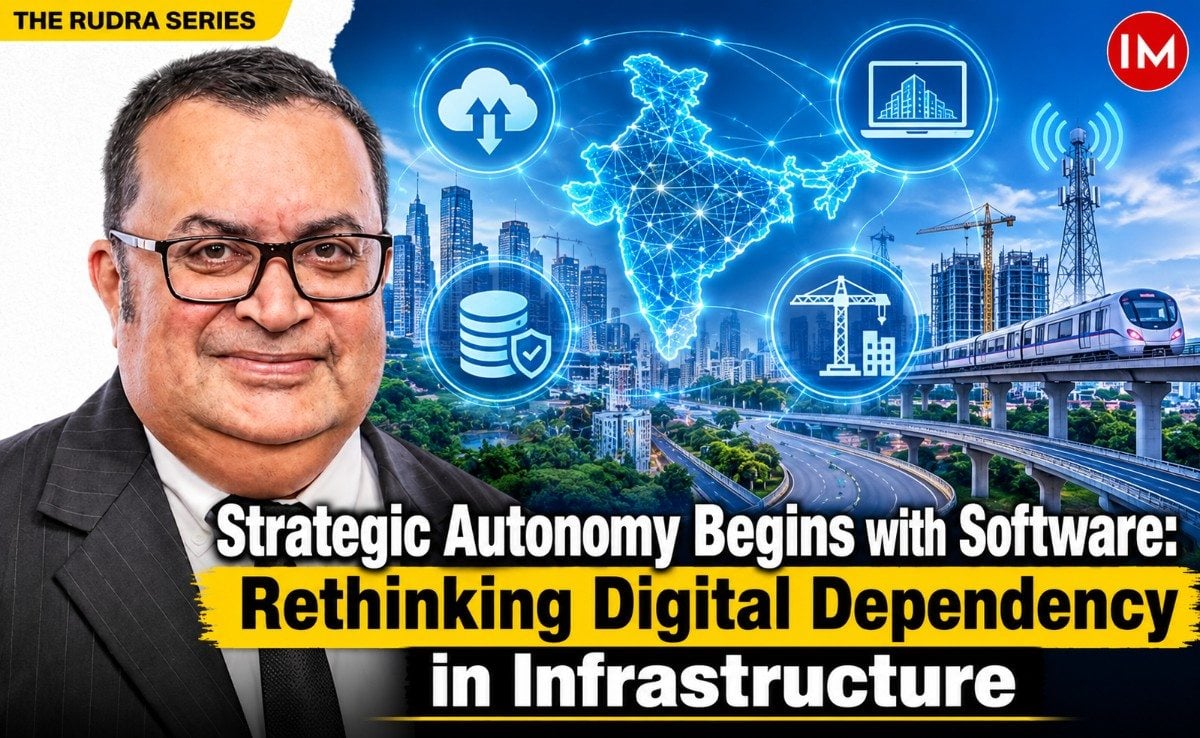
Buildings, airports, hospitals, metros, industrial facilities and data centres are increasingly designed, coordinated, approved and operated through software environments owned and governed across jurisdictions. The question is therefore no longer only whether the software is good. Much of it is excellent.
The question is what happens when access, price, licensing, cloud terms, export rules or cross-border commercial conditions change.
Software is not an ordinary import
The built environment has become deeply dependent on digital tools that do more than produce drawings. Authoring platforms contain models. Common data environments hold decisions and issue histories. Cloud collaboration services coordinate teams spread across cities and countries. Specialist applications perform energy, structural, geospatial, cost and operational analysis. Increasingly, APIs and artificial intelligence services connect these environments to one another.
A practice can change a printer or replace a vehicle without losing the meaning of years of professional work. Changing a mature digital production environment can be much harder. That is because dependency does not sit only in the licence.
It sits in templates, libraries, workflows, automation, training, file histories, contractual deliverables, staff capability and the accumulated knowledge of how a team works. A software platform can become part of the organisation’s operating memory.
For a private practice that is a business-continuity issue. For a public agency or major infrastructure owner, it can become a governance issue.
Sovereignty is not self-isolation
The wrong response would be to turn digital sovereignty into a slogan for technological isolation.
India benefits from global competition. Architects and engineers should be able to use the best tools available. International platforms bring decades of development, research, interoperability work and specialist functionality that cannot be reproduced sensibly through procurement preference alone. The objective should therefore not be to replace every foreign platform with an Indian copy. A stronger definition of sovereignty is the ability to choose.
Can an organisation move its information without destroying its meaning? Can another supplier take over? Can an Indian application connect to the data? Can an asset owner continue operating if the original platform changes its commercial model? Can professionals work across more than one ecosystem without starting again? Those are resilience questions, not nationalist ones.
A digitally sovereign built environment remains connected to the world, but is not captive to one pathway through it.
The project owner needs more than possession of files
Ownership language can also create false comfort.
A client may contractually own project information and still depend heavily on the software environment that makes the information useful. A model may be downloadable but difficult to reuse elsewhere. A database may be legally the owner’s but practically readable only through a particular platform. An archive may contain every file yet still fail to preserve the relationships, classifications and decision history that gave those files meaning.
The deeper asset is therefore not the file alone. It is the continuing ability to interpret and reuse what the project has created. This is particularly important for long-life assets. A metro, hospital, airport or public campus may operate for decades. Software contracts, platforms and vendors will change several times during the life of the asset.
Digital delivery should therefore be judged not only by how efficiently information enters the project, but by how well knowledge can survive beyond the commercial life of the system that first held it.
Procurement should test exit as seriously as entry
Most technology procurement naturally asks what a platform can do. Does it support coordination? Can teams collaborate? Does it integrate with existing software? Is it secure? What does it cost? How quickly can it be deployed? For strategically important projects, another family of questions deserves equal weight. What happens when we leave?
That does not require a prescriptive national software stack. It requires a governance expectation: information critical to a public asset or major programme should remain sufficiently portable, intelligible and reusable for future systems to take over.
Open standards are part of that answer. Documented information requirements are part of it. Internal professional capability is part of it. So is avoiding the assumption that a proprietary representation should become the only authoritative memory of the asset.
None of these principles prevent commercial platforms from competing. In fact, credible portability can make competition healthier because clients retain the freedom to move.
The Indian opportunity is industrial, not defensive
There is also an economic opportunity in reducing dependency. India has demonstrated global strength in software services, engineering, data and professional outsourcing. The next step need not be a retreat from those global markets. It can be a move upward in the value chain.
Built-environment technology creates room for Indian capability in standards implementation, information management, automation, compliance tools, digital twins, asset analytics, specialist applications and the professional services that surround them. The value lies not in attaching an Indian label to every product. It lies in building enough domestic competence that Indian firms can create, integrate, challenge and replace technology rather than only consume it.
That strengthens bargaining power even when global platforms remain dominant. A client with strong internal information capability can negotiate more intelligently with vendors. A professional ecosystem familiar with open standards can change tools with less disruption. A domestic technology sector capable of building connectors, validators and specialist applications reduces the cost of choice. Resilience therefore becomes an industrial strategy rather than an emergency measure.
Internal capability is part of the digital stack
Technology dependency is often described as a procurement problem, but organisations can become captive even when the contract is favourable. If only the vendor understands the information structure, dependency remains. If all automation has been written by one external consultant, dependency remains.
If staff know which buttons to press but cannot explain how information moves through the workflow, dependency remains. For major owners and public institutions, digital capability therefore has to exist partly inside the organisation. That does not mean employing every specialist directly. It means retaining enough informed authority to understand the architecture, specify requirements, test portability, challenge suppliers and manage transition.
The strongest digital strategy is not the one with the most sophisticated platform. It is the one in which the organisation remains capable of making a different choice later.
The readiness question
India has already demonstrated that it can build digital public infrastructure at enormous scale. The built environment now needs to ask a related but different question. How much of the digital capability used to design and operate physical infrastructure is genuinely resilient to commercial, technological and geopolitical change? This is not an argument for panic. It is an argument for visibility.
An organisation cannot manage a dependency it has never identified. The sensible objective is therefore not independence from every external platform. It is freedom from unexamined dependency on any one of them. For every major owner, developer, public agency or delivery organisation, the practical test is simple: If access to a critical platform, cloud service or vendor changed tomorrow, which parts of your delivery capability would continue – and which would stop?