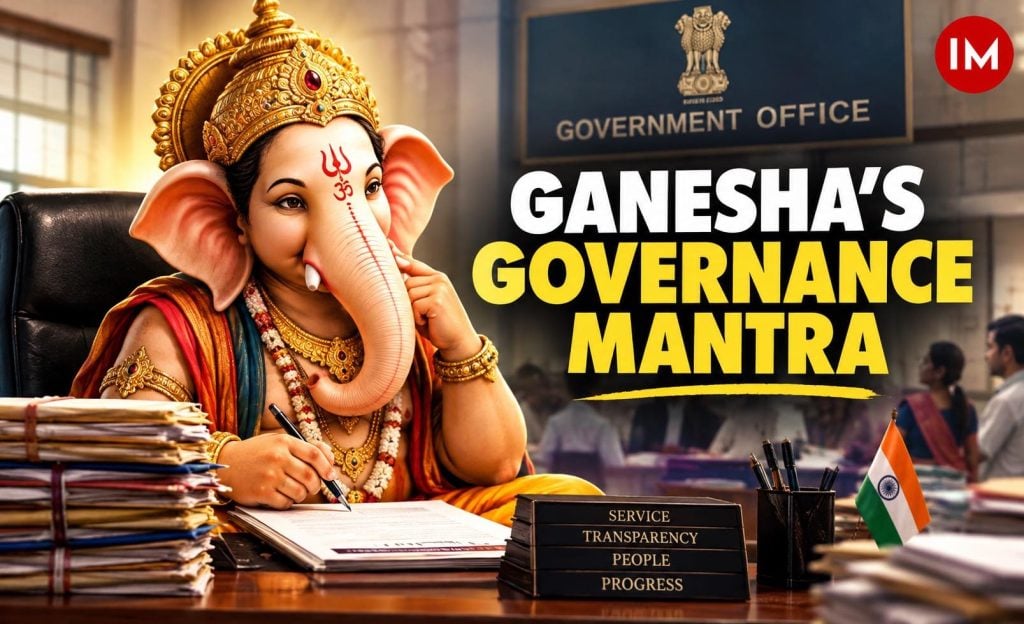
On Ganesh Chaturthi, Lord Ganesha enters homes, public spaces and, increasingly, workplaces across India. He is welcomed with devotion, celebrated with music and colour, and invoked before new beginnings.
But imagine, for a moment, Ganesha sitting in a government office. There are files waiting for clearance. A citizen has been making rounds for weeks. A welfare scheme is not reaching its intended beneficiaries. Two departments are blaming each other. A district is facing a sudden crisis. A new project is stuck because of an old procedure. What would Ganesha do?

The question may sound whimsical, but look closely at the familiar image of the deity and it begins to offer some surprisingly practical lessons for governance. Ganesha is traditionally associated with wisdom, intellect, learning, auspicious beginnings and the removal of obstacles. He is not traditionally called the “God of Management”; that is a modern description. Yet his symbolism can provide a fascinating framework for thinking about the qualities required of a good administrator.
Listen to the Citizen
The first thing one notices about Ganesha, apart from his elephant head, is his enormous ears. For a civil servant, these may be the most important features of all. Government produces policies, schemes, guidelines and regulations. But the ultimate test of governance is what happens to an ordinary citizen trying to access them.
The person standing outside a tehsil office may know more about the practical problems of a scheme than the official who drafted its guidelines. A farmer knows where an irrigation project is failing. A woman in a village knows why a welfare benefit is not reaching her. A student knows what is wrong with a scholarship system. A small entrepreneur knows exactly which government procedure is making life difficult.
Good administration therefore begins with listening. The large ears of Ganesha offer a wonderfully simple message to the bureaucracy: before speaking for the people, listen to them.
Think Big
Ganesha’s large head symbolises wisdom and intellect. For an administrator, this can translate into the ability to see beyond an individual file. A district magistrate dealing with a school building is not merely dealing with bricks, cement and a tender. The building may determine whether children attend school. A road is not merely a road; it can determine whether a farmer reaches a market on time or whether a pregnant woman reaches a hospital.
Good governance requires officials to understand the larger consequence of seemingly small decisions. At the same time, the administrator must not become so obsessed with the big picture that the individual citizen disappears from view. The best bureaucrat can see both—the policy and the person affected by it.
Focus on What Matters
Ganesha’s small eyes are traditionally associated with concentration. This too has an obvious administrative lesson. Government has no shortage of priorities. Every department has targets, meetings, reviews, committees, reports and dashboards. The danger is that administration can become an exercise in measuring activity rather than outcomes.
How many meetings were held? How many files were processed? How many letters were issued? The citizen asks a different question: Did the problem get solved? A focused administrator learns to distinguish between activity and impact.
Sometimes the most important achievement of a district administration may not produce an impressive presentation. It may simply be that a widow received her pension on time, a village finally got drinking water, or a hospital began functioning properly. Small eyes remind us to keep looking at the thing that actually matters.
Learn to Bend
If there is one part of Ganesha’s body that could have been designed for modern administration, it is his trunk. It is powerful enough to uproot a tree and delicate enough to pick up something tiny. Governance requires the same combination.
An administrator must sometimes be firm—especially when enforcing the law or dealing with corruption. At other times, the situation demands sensitivity and flexibility. Rules are necessary. But governance cannot become synonymous with mechanically applying rules without understanding circumstances.
This does not mean ignoring the law. It means using the discretion available within the law intelligently and humanely. The ability to be firm without becoming rigid is one of the most valuable qualities an administrator can possess.
Remove the Obstacles
Ganesha is popularly known as Vighnaharta—the remover of obstacles. This has perhaps the most direct relevance to public administration. A citizen approaches government because he or she needs something: a certificate, a licence, a pension, a land record, a benefit, a road, a hospital service or some other public service.
Every additional unnecessary form, signature, visit or delay becomes an obstacle. And sometimes the greatest obstacle is not the rule itself but the way the system interprets it. The administrator’s job should therefore be to ask: What is preventing this service from reaching the citizen?
A good civil servant removes that obstacle. A bad system creates another one. This distinction lies at the heart of citizen-centric governance.
Never Underestimate Small Problems
And then there is Ganesha’s most unlikely companion – the tiny mouse. The contrast between the enormous elephant-headed deity and the tiny creature beneath him is striking. For an administrator, the mouse can represent the small problem that everyone ignores.
A leaking pipeline. A broken streetlight. A dysfunctional computer system. A minor corruption complaint. A missing name on a list. A village road that has become unusable. Individually, each may seem insignificant. But governance is ultimately experienced through such details.
A citizen may never know the name of the government’s flagship programme. But he knows whether the government office opens on time. He may not understand administrative reform. But he knows whether the official listens to him. He may not care about a department’s annual performance report. But he cares whether his pension arrives.
The mouse reminds the administrator that small things can have very large consequences.
Find a Smarter Solution
Perhaps the best lesson for today’s bureaucracy comes from the famous story of Ganesha’s race with his brother Kartikeya. The two were asked to circle the world. Kartikeya immediately set off on his peacock. Ganesha, travelling on a mouse, was clearly at a disadvantage.
Instead of trying to beat Kartikeya at his own game, he interpreted the problem differently. He circled his parents, Shiva and Parvati, explaining that they represented the world to him. He won through intelligence rather than speed. There is a lesson here for governance.
A government department may spend years trying to solve a problem through increasingly elaborate procedures. Sometimes the better answer is to ask whether the procedure itself needs to change. Can a certificate be issued online instead of requiring three visits?
Can departments share information instead of asking citizens to submit the same documents repeatedly? Can technology eliminate a layer of paperwork? Can a scheme be redesigned after listening to its beneficiaries? This is not about bypassing rules. It is about rethinking processes.
The most efficient administrator is not necessarily the one who works longest on a bad system. It is the one who has the courage to ask whether the system can be made simpler.
Know What to Abandon
Ganesha’s broken tusk has several traditional interpretations, including the famous association with writing the Mahabharata. Viewed metaphorically, however, it offers another lesson particularly relevant to bureaucracy: not everything that exists needs to continue existing.
Government departments accumulate procedures over decades. A form introduced twenty years ago survives. A register continues to be maintained because somebody once decided it was necessary. A meeting continues because it has always been held. The original reason may have disappeared, but the procedure remains.
Good governance is not merely about creating new rules. It is also about removing redundant ones. Administrative reform sometimes means building something new. Just as often, it means having the courage to throw something old away.
Absorb Criticism
Anyone who has worked in government knows that administration is rarely an exercise in universal popularity. Every decision creates someone who is unhappy.
A road project may inconvenience one group. A crackdown on encroachment may attract criticism. A new regulation may anger an industry. A welfare reform may upset those who benefited from the old system.
The large belly of Ganesha can be read, in a contemporary sense, as a symbol of the ability to absorb criticism without losing balance. A civil servant needs a thick skin—but not a closed mind. Criticism should neither destroy confidence nor be dismissed automatically.
The mature administrator listens to criticism, separates the useful from the merely political or personal, corrects mistakes when necessary and then moves ahead.
Begin well
Ganesha’s association with auspicious beginnings is particularly relevant to public projects. Every new government programme begins with enthusiasm. But implementation is where the real test begins. Before launching a new initiative, an administrator needs to ask some basic questions:
Is the objective clear? Will the citizen understand it? Does the field machinery have the capacity to implement it? Are the rules simple enough What could go wrong? How will success be measured? And most importantly – what does the citizen actually need? A thoughtful beginning can prevent enormous problems later.
Human Being Behind The File
Perhaps the most important lesson of all is not found in any single physical feature of Ganesha. It lies in the way he is perceived. For millions of Indians, Ganesha is not a distant or inaccessible deity. He is Bappa – a familiar, approachable presence invited into homes and celebrated with extraordinary affection.
There is a lesson here for public administration too. The citizen should not feel that government is a distant, intimidating machine. A government office should not make a person feel small merely because the person standing behind the desk has a higher designation.
Civil servants wield enormous institutional authority. But the finest administrators understand that authority is a responsibility, not a privilege. The file may carry a number The beneficiary has a name. The application may have a reference code The person submitting it has a life, a family and a problem that needs solving. That distinction is at the heart of humane governance.
If Ganesha sat in the Secretariat
So, if Ganesha were to walk into a government office today, perhaps his lessons would be surprisingly straightforward.
- Listen more.
- Think deeply.
- Focus on outcomes.
- Be flexible without compromising principles.
- Remove obstacles rather than creating them.
- Never ignore small problems.
- Look for smarter solutions.
- Discard unnecessary procedures.
- Absorb criticism.
- And never lose sight of the citizen behind the file.
These are not really religious lessons. They are lessons in public service.
And perhaps that is what makes the symbolism of Ganesha so enduring. His image may have been shaped centuries ago, but the qualities it evokes—wisdom, patience, adaptability, concentration, humility and the ability to overcome obstacles—remain remarkably relevant to anyone entrusted with the responsibility of governing others.
The bureaucracy may have files, rules and procedures. But at its best, it has something much more important: the power to remove an obstacle from somebody else’s life. That, perhaps, is the most meaningful way in which a modern civil servant can become a Vighnaharta.
(The author is a Lucknow-based senior journalist.)
Disclaimer—(The views and opinions expressed in this article are solely those of the author and do not necessarily reflect the views of Indian Masterminds. For feedback or queries, please write to [email protected].)