A forest cannot be protected by fencing it off from the people who live around it. In places where villages and forests share the same landscape, conservation has to begin with trust.
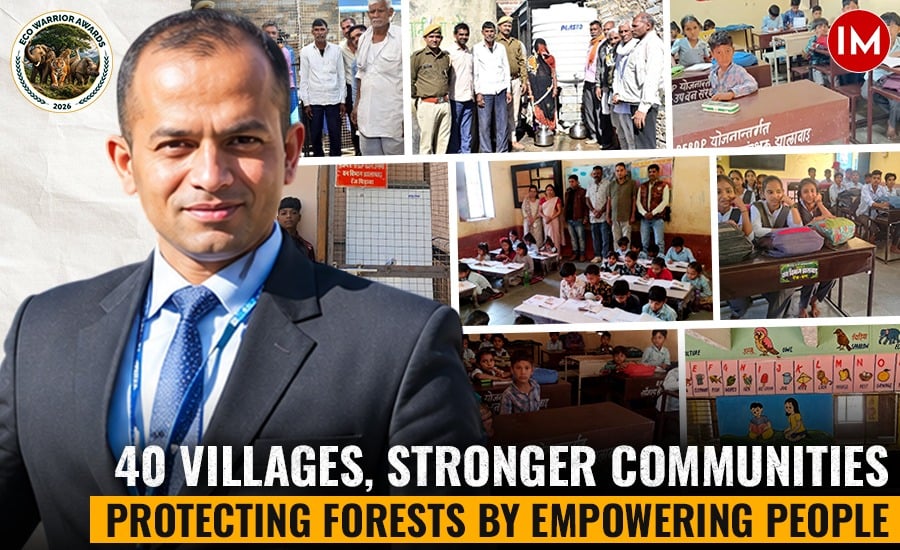
This is the lesson emerging from Jhalawar Forest Division in Rajasthan, where Pawar Sagar Popat, Indian Forest Service (IFS), 2017 batch, is working to build a stronger relationship between forests and forest-fringe communities. Currently posted as Deputy Conservator of Forests (DCF), Jhalawar, he has worked across more than 40 forest-fringe villages spread over eight ranges of the division.
The challenge has not been simple. Some communities were linked to illegal mining and encroachment. At the same time, many families depend on forests for their daily needs and livelihoods. The Forest Department therefore had to move beyond enforcement and create a sense of partnership.
BUILDING TRUST BEFORE ASKING FOR CONSERVATION
For Popat, the first step was to understand that conservation cannot succeed without local participation.
People living close to forests often see the forest as part of their everyday lives. Asking them to protect it without addressing their concerns can create distance between communities and the department.
Read Also: How Chetram Meena Took on Illegal Mining and Gave Wildlife Corridors Back to the Forest
Under the Entry Point Activities package of the RFBDP scheme, the Forest Department began supporting basic needs in more than 40 villages. Schools received facilities such as toilets, drinking-water arrangements, water coolers, benches and tin sheds.
These interventions became an important starting point for interaction.
Teachers, educated residents and other community members began taking interest in plantation activities. Range officers were invited to schools to interact with students and explain the work of the Forest Department.
“Conservation is not possible without the participation and trust of local communities. Our effort was to make people see the Forest Department not merely as an agency protecting forests, but as a partner in their overall development,” Popat told Indian Masterminds.
Regular meetings with villagers and local leaders also became part of the approach. Sarpanches and Pradhans were engaged in efforts to discourage illegal mining and encroachment.
800 HECTARES, THEN 1,300 HECTARES
Community engagement also supported one of the division’s important enforcement efforts.
The department was able to remove encroachments from approximately 800 hectares in 2024-25 and another 1,300 hectares in 2025-26. These areas were subsequently taken up for plantation.
Popat does not claim that illegal activities have disappeared completely. But there has been a significant change in the flow of information.
Villagers have increasingly started providing timely inputs about illegal mining, encroachment and other activities.
Local youth are also being brought into conservation efforts by enabling them as Van Mitras and Vriksh Mitras.
This creates a local network of people who understand the landscape and can alert the department when something unusual happens.
VFPMCS TURNING VILLAGERS INTO PARTNERS
The Village Forest Protection and Management Committees (VFPMCs) have played an important role in strengthening this connection.
Range officers ensure that the committees remain active through regular meetings. Under the RFBDP project, the PFT team of experts also visits villages, interacts with residents and understands their needs.
Based on this feedback, VFPMC members and villagers are involved in forest development activities. Employment opportunities are also provided through these interventions.
The committees have helped create goodwill between villagers and the Forest Department.
One visible outcome is the growing number of calls related to animal rescue. People have started informing officials about wildlife in distress as well as illegal capture and hunting.
Local information has also helped the department identify wildlife offenders and send them to judicial custody.
People have even begun voluntarily reporting possession of protected birds such as the Alexandrine parakeet.
“The VFPMCs have helped us build goodwill at the village level. Their members are now playing an important role in spreading awareness, reporting illegal activities and encouraging people to participate in forest protection,” Popat said.
CONNECTING FOREST LIVELIHOODS WITH NEW OPPORTUNITIES
The next challenge is to ensure that conservation also creates livelihood opportunities.
Jhalawar Forest Division is still at an early stage in linking communities with the Van Dhan Scheme and Rajivika Mission. However, efforts are underway to connect more VFPMC members with these programmes.
The Rajivika Mission already has a strong presence in the district. With the help of the PFT team under the RFBDP scheme, the Forest Department is encouraging forest-fringe communities to participate.
The Van Dhan approach also promotes scientific and non-destructive harvesting of non-timber forest products. Instead of cutting trees or overusing forest resources, gatherers can learn methods that allow natural regeneration while providing them with a regular source of income.
Volunteers are visiting villages and explaining the benefits of these programmes during VFPMC meetings.
PALASH FLOWERS TURNED INTO HERBAL GULAL
One of the more interesting examples of linking conservation with livelihoods is the promotion of Palash flower-based herbal gulal.
The initiative received a push ahead of Holi after the District Collector promoted chemical-free herbal gulal over synthetic alternatives because of concerns about their ecological and health impacts.
The Forest Department is now trying to connect VFPMC members with this value chain.
Palash flowers available from the forest can become a raw material for local enterprises. This creates a direct economic reason for communities to protect the forest canopy.
For 2026-27, 69 women’s self-help groups have been identified for support. The Forest Department is providing financial assistance to help these SHGs add value to the products they make.
The larger idea is important. If a forest product can generate income without destroying the forest, conservation and livelihoods begin to support each other.
FODDER SUPPORT GIVES FORESTS A CHANCE TO REGENERATE
Grazing pressure is another issue in forest-fringe areas.
Uncontrolled cattle grazing can damage young plants, disturb the soil and prevent natural regeneration. To address this, organised fodder support has been introduced in some villages.
The results have been encouraging.
With cattle grazing diverted away from forests, natural regeneration and survival of indigenous trees, shrubs and grasses have improved. Reduced cattle movement has also helped prevent soil compaction.
Healthier and looser topsoil absorbs water better, reducing erosion during the monsoon and creating better conditions for seeds to germinate.
Managed fodder support has also helped native perennial grasses recover. This can improve the carrying capacity of the habitat and reduce the spread of unpalatable weeds such as Lantana camara and Parthenium.
However, the impact on human-wildlife interactions has not yet been formally measured. The division has also not observed any significant change in this area, partly because negative human-wildlife interactions were already relatively low.
CONSERVATION THAT STARTS WITH PEOPLE
The Jhalawar experience shows that forest protection is not only about patrols, plantations and enforcement.
It is also about schools, water facilities, local leaders, village committees, livelihoods, fodder and communication.
Popat’s approach is based on a simple principle: people living around forests should not be seen only as beneficiaries or potential threats. They can become active conservation partners.
“When communities feel that forest-related institutions are responsive to their genuine needs, it becomes easier to build cooperation for forest protection and conservation,” Popat told Indian Masterminds.
The transformation may still be a work in progress. But the growing flow of local information, increased participation in conservation activities, removal of thousands of hectares of encroachment and revival of forest regeneration point towards an important shift.
In Jhalawar, the effort is not just to protect the forest from people. It is to build a system where people have a reason to protect the forest themselves.