When IAS officer Richie Pandey (2016 batch, Bihar cadre) took charge as District Magistrate of Sitamarhi, one issue stood out clearly—landlessness among vulnerable families. While infrastructure, welfare schemes, and law and order often dominate administrative priorities, Mr Pandey chose to focus on something more fundamental: ensuring that every family has a place to call home.
Through a focused campaign, his administration worked to provide land titles (pattas) to hundreds of landless families, addressing a long-pending issue that had quietly persisted for years.
UNDERSTANDING THE GROUND REALITY
Sitamarhi, like many districts in Bihar, faces challenges linked to population pressure and limited land availability. Over time, this has led to a rise in families without legal ownership of homestead land. Many were living on roadsides, by ponds, or on encroached public land—without any security or dignity.
Also Read : How IAS Officer Dr. Preeti Yadav Built Sakhi So No Woman in Punjab Has to Beg for Help Again
In a conversation with Indian Masterminds, Mr Pandey explains the core concern simply: “It is one of the foremost responsibilities of the district administration to ensure that people who are landless are provided adequate land so that they can live with dignity.”
The issue often remained overlooked because families had already settled informally. As a result, administrative urgency around it was limited.
TURNING A GOVERNMENT INITIATIVE INTO A MISSION
The turning point came with the state government’s Dr Ambedkar Samagra Seva Abhiyan, which aimed to deliver multiple welfare services to SC, ST, and Mahadalit communities in a camp-based approach.
Recognising the opportunity, Mr Pandey integrated land rights into this initiative and expanded it into a district-wide campaign.
“We did not treat it as a routine exercise. We ran it as a focused campaign and ensured that cases were resolved in mission mode,” he says.
By June, groundwork had begun. By October, the administration had shifted into full execution mode. Around 850 applications from landless families were identified and processed.
A STRUCTURED AND INCLUSIVE APPROACH
The campaign required coordination across departments—revenue, welfare, and local administration. Circle Officers, the additional district magistrate, and welfare officials worked together to verify claims and fast-track approvals.
The approach was clear:
- Regularisation of land where possible (especially on government land)
- Relocation in cases where families occupied unsuitable spaces like ponds or roads
- Allocation of 3 to 5 dismil of land (approximately 0.03–0.05 acres) per family
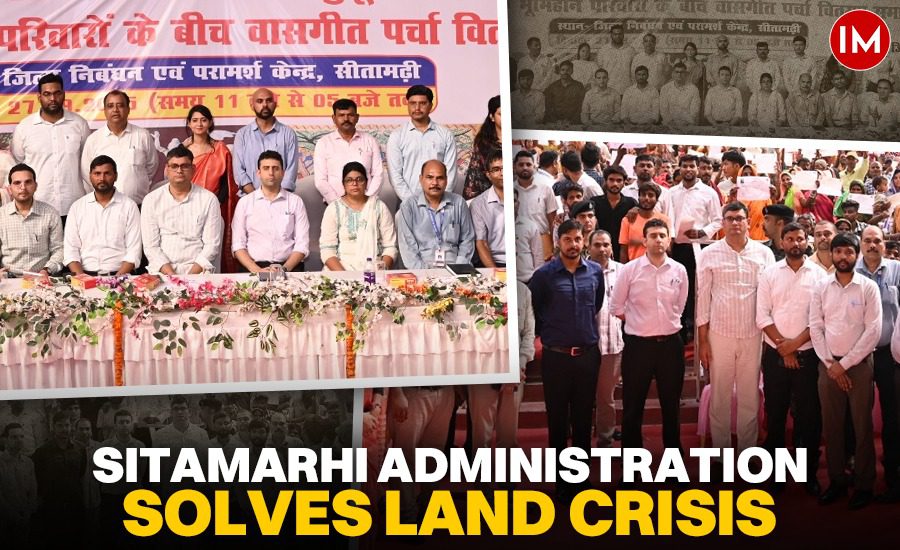
To ensure transparency and scale, a large district-level event was organised where land titles were formally distributed in the presence of public representatives and officials.
“Many times, such work gets pushed to the backburner because people are already living somewhere. But land rights are a fundamental necessity.”
To counter this, the administration ensured that files did not remain pending. Disputes and doubts were resolved on the spot through camp-based mechanisms, avoiding months of back-and-forth between offices.
“Government service does not mean working in a routine, mechanical way. We had to put in some extra effort,” IAS Richie Pandey adds.
CHALLENGES ON THE GROUND
The campaign was not without hurdles. Sitamarhi was simultaneously dealing with multiple pressures—acute water shortage, election-related responsibilities, and limited manpower.
Circle officers were engaged in by-elections, and administrative bandwidth was stretched.
Despite this, the team continued to push forward.
“We cannot keep complaining about resources. The key is to adjust and ensure that the work gets done,” Pandey says.
IMPACT AND PUBLIC RESPONSE
The results were tangible and immediate. Hundreds of families received legal ownership of land—something that directly impacts their social and economic security.
The administration also ensured that beneficiaries were treated with dignity. Transportation, seating, and basic facilities were arranged during the distribution event, making it accessible and organised.
The response was overwhelmingly positive.
“People were very happy,” Mr Pandey recalls, adding that even a year later, follow-up reviews showed that beneficiaries were settled and stable.
BEYOND LAND
While land rights formed a critical part of IAS Richie Pandey’s work, he also focused on improving Sitamarhi’s economic ecosystem—particularly through the credit-deposit ratio (CDR).
In simple terms, CDR measures how much of the money deposited in banks within a district is being lent back locally as loans.
The officer explains:
“The idea is that the deposits raised from a district should be matched by proportionate credit flow back into the district.”
A higher credit flow enables entrepreneurship, supports small businesses, and reduces dependence on subsidies.
Through schemes like PMEGP, Mudra Yojana, and Vishwakarma Yojana, the administration worked to ensure that people had access to loans that could help them build livelihoods.
A FORWARD-LOOKING DEVELOPMENT VISION
Looking ahead, Sitamarhi is also being positioned as a major religious tourism hub. Large-scale projects are underway, including the development of Punauradham Mandir and Panchpakur, both part of the Ramayan Circuit.
With improved connectivity, including links to Ayodhya and Janakpur (Nepal), the district is expected to see increased tourist inflow.
This, in turn, is likely to boost local businesses—hotels, transport services, shops, and small enterprises—creating employment and economic growth.
Additionally, over 500 acres of land have been acquired for industrial development, signalling a parallel push towards manufacturing and investment.
A MODEL OF FOCUSED GOVERNANCE
The land rights campaign in Sitamarhi highlights how administrative focus can transform outcomes. By identifying a neglected issue, aligning it with an existing government initiative, and executing it with clarity, the district administration delivered lasting impact.
For hundreds of families, this was not just about land—it was about stability, dignity, and a foundation for the future.
As IAS Richie Pandey puts it, “Land rights are something absolutely basic. That is why we gave it the highest priority.”