India has demonstrated that it can bring difficult partners into the same room. The harder task now is to make them move in directions that serve India’s long-term interests.
A summit is successful when leaders leave the room with agreements. A presidency is successful when those agreements begin changing realities outside the room.
That is the real test for India after the 18th BRICS Summit in New Delhi.
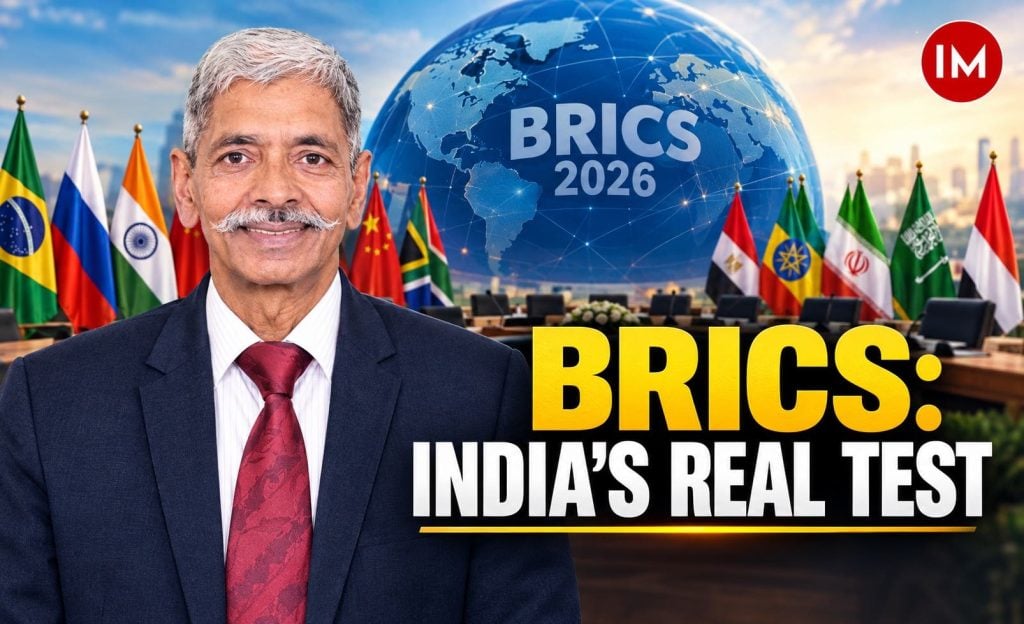
India has just completed its fourth BRICS Chairship, after 2012, 2016 and 2021. This time the challenge was considerably more complicated. BRICS is no longer the relatively compact grouping that many of us knew a decade ago. It now has 11 members, stretching across Asia, Africa, the Middle East and Latin America, along with partner countries. Its members account for nearly half of the world’s population and around 40 per cent of global GDP.
But numbers alone do not create strategic power. They create potential.
From a military perspective, I have always believed that bringing different formations together is only the beginning. The real test comes when the commander has to convert disparate capabilities, competing priorities and different operating cultures into a coherent mission.
Diplomacy is not very different.
India’s BRICS presidency was, therefore, more than a diplomatic balancing exercise. It was a test of whether New Delhi could build consensus among countries that do not necessarily share India’s strategic worldview.
Read Also: BRICS 2026: Meet These 11 Young IFS Officers Behind India’s Global Diplomatic Push
And India did have a difficult field to negotiate.
China and India remain strategic competitors. Russia has deepened its relationship with China while maintaining its longstanding strategic partnership with India. Russia, Iran and the Gulf countries bring different interests to the table. The war in West Asia has complicated energy and maritime calculations. At the same time, India continues to deepen its engagement with the United States, Europe, Japan, Australia and ASEAN.
How does a country maintain strategic autonomy in such an environment?
The answer cannot simply be balance.
It has to be influence.
India’s BRICS presidency was guided by “Building for Resilience, Innovation, Cooperation and Sustainability”. More than 350 meetings and high-level engagements were conducted across 25 Indian cities during the year. The agenda moved across political and security cooperation, economic and financial issues, technology, agriculture, health and people-to-people exchanges.
That is significant.
What happens after the photographs, declarations and handshakes?
This is where India’s next strategic challenge begins.
India has acquired considerable convening power.
It can bring Washington and Moscow into the same strategic conversation. It can engage Beijing without abandoning its security interests. It can speak to Tehran while maintaining relationships with the Gulf. It can work with ASEAN while participating in BRICS and the Quad.
This is not diplomatic ambiguity for its own sake.
It is strategic flexibility.
But flexibility has value only when it produces options.
A fighting formation does not build reserves simply to possess them. Reserves create freedom of manoeuvre. Similarly, India’s diplomatic relationships must increasingly create economic, technological and strategic choices.
That is the next stage of strategic autonomy.
Not merely saying “India will not choose sides.”
But making sure that other countries increasingly need India to achieve their objectives.
That is strategic influence.
The BRICS Trade Ministers’ meeting in Jaipur had already pointed in this direction. Members worked towards the BRICS Economic Partnership Strategy 2030, greater trade in services and more resilient and diversified global value chains. A Jaipur Consensus also focused on improving MSME access to trade finance and global markets.
This is where the diplomatic conversation must now become industrial policy.
If India wants influence, it needs factories.
It needs semiconductor capability.
It needs defence manufacturing depth.
It needs reliable energy access.
It needs critical minerals.
It needs ports, shipping and logistics networks that can withstand geopolitical shocks.
And it needs technology that other countries want to use.
That last point may eventually prove decisive.
The character of strategic competition is changing.
Earlier, control over territory, sea lanes and military platforms dominated strategic calculations. Today, those remain important. But they are increasingly connected to data, artificial intelligence, semiconductors, telecommunications, cyber systems, satellites and digital infrastructure.
The battlefield has expanded without necessarily becoming visible.
India’s BRICS agenda recognised this shift. The New Delhi declaration placed emphasis on AI cooperation, digital public infrastructure, cross-border payments and technology governance. Proposals under India’s Chairship included a BRICS digital public infrastructure repository and an India Centre for BRICS Industrial Competencies aimed at smart manufacturing.
India’s Digital Public Infrastructure experience is no longer merely a domestic governance story. It can become a diplomatic and economic instrument.
UPI is the obvious example.
The strategic value is not simply that Indians can make instant digital payments. The larger opportunity is to create interoperable systems that connect markets, businesses and consumers across partner countries.
The same thinking should apply to AI, health technology, satellite applications and cyber resilience.
Can India become a trusted technology provider to the Global South?
This is a much more consequential question than whether India can host another successful summit.
Another geopolitical lesson that has emerged-
Modern military power and economic power increasingly depend on the same industrial foundations.
Read Also: India’s Next Strategic Test: Can Diplomatic Reach Keep Pace with Capability?
Lithium. Cobalt. Graphite. Rare earths. Semiconductor materials.
These are not merely commodities anymore.
They are strategic assets.
India has already recognised the importance of critical mineral supply chains. But BRICS gives New Delhi an additional platform to build partnerships around exploration, processing, technology and supply-chain diversification.
The objective should not be simply to buy minerals.
It should be to participate in the complete value chain.
Extraction is one thing.
Processing, refining, advanced materials, battery technology and manufacturing are where strategic leverage begins to accumulate.
This is where the doctrine of Atmanirbharta must evolve.
Self-reliance cannot mean producing everything ourselves.
That would be economically unrealistic.
It should mean ensuring that no external actor can easily paralyse India’s critical capabilities.
That is a very different proposition.
The same principle applies to defence.
India’s strategic partnerships increasingly need an industrial dimension.
A defence relationship that ends with government-to-government meetings and equipment purchases has limited strategic depth.
A defence relationship involving joint production, maintenance, research, technology development, supply chains and exports is different.
It creates interdependence.
And interdependence, when carefully structured, creates influence.
India should pursue similar depth across multiple partnerships.
Not dependence on one supplier.
Not dependence on one technology ecosystem.
Multiple relationships. Multiple sources. Indian manufacturing at the centre.
That is strategic resilience.
The current geopolitical environment also reinforces another reality.
India’s prosperity remains tied to the sea.
Energy routes, container shipping, undersea cables, critical imports and exports all depend upon maritime stability. India’s discussions with Iran during the summit included freedom of navigation, commerce and the safety of seafarers.
This is not a peripheral issue.
The Indian Ocean is becoming more important precisely because global trade is becoming more vulnerable.
India therefore needs to think beyond naval platforms.
Ports, shipbuilding, maritime domain awareness, logistics, insurance, coastal infrastructure and merchant shipping capacity must become part of one integrated national strategy.
A navy cannot secure an economy by itself.
The economy must also possess the resilience to support the navy.
That is where civilian and military strategy converge.
For decades, India’s foreign policy has rightly emphasised strategic autonomy.
The next phase should be strategic influence.
The distinction is subtle but fundamental.
Strategic autonomy asks:
How do we preserve our freedom to choose?
Strategic influence asks:
How do we shape the choices available to others?
India’s BRICS presidency has demonstrated that it can convene.
The next challenge is to convert that convening power into enduring networks of technology, manufacturing, finance, energy, logistics and defence.
The country should increasingly become the partner that others cannot afford to ignore.
That will require a doctrinal shift from relationship management to capability creation.
From diplomatic presence to economic leverage.
From participation in global value chains to ownership of critical segments.
From being a market to becoming a platform.
And perhaps most importantly, from reacting to geopolitical disruption to preparing for it before it arrives.
Can India turn BRICS into markets for technology? Can it build resilient supply chains with partners? Can it become a trusted defence-industrial partner? Can it secure critical minerals before shortages become crises? Can Indian companies occupy strategic positions in the next generation of global value chains?
If the answer is yes, BRICS will have served a purpose far beyond another summit.
The fourth Indian BRICS presidency should therefore not be remembered merely for the leaders who came to New Delhi.
It should be remembered for what India built after they left.
And strategic influence begins when others start adjusting their choices because India is in the room.
That is the real prize.
And that, in my view, is the next frontier of India’s strategic autonomy.