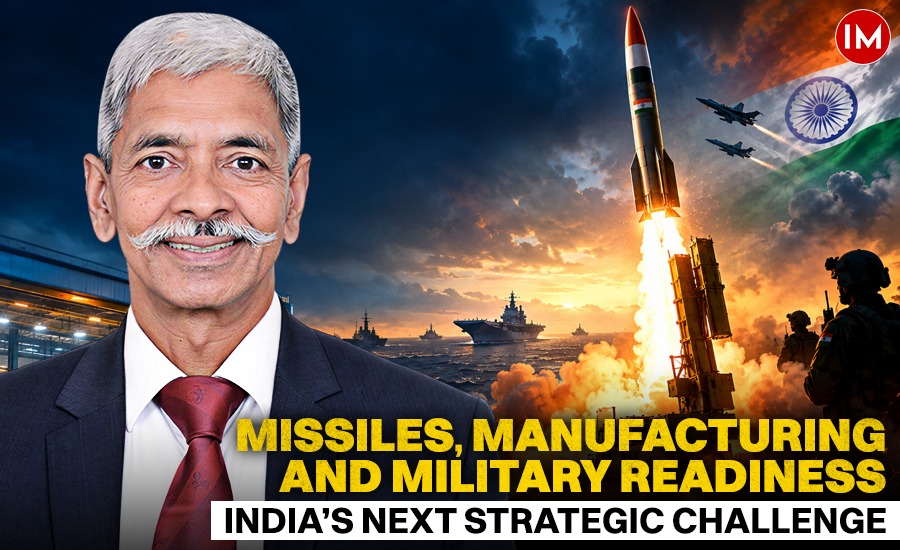
A missile sitting inside a laboratory is a technology. A missile that can be produced repeatedly, quickly and reliably when the country needs it is a military capability. The distinction end there.
The latest move to open DRDO’s conventional missile technologies to private industry could therefore be much more significant than another announcement about defence indigenisation. The reported decision involves the transfer of DRDO-developed conventional missile technologies to Indian companies for production. Uncorroborated news report that 10 to 12 tactical missile-development projects have already been distributed among two public-sector and four private-sector entities.
This is where the real story begins. For years, India’s defence-industrial debate has revolved around one repeated question: Can India design its own weapons? Can India manufacture them at scale, maintain quality, replenish stocks quickly and keep improving them once they enter service?
That is the test of a serious defence industrial base. My experience in uniform has taught me that a military formation does not fight with brochures. It fights with what is available, serviceable and sustainable when the situation turns difficult. And missiles are no exception.
Also Read – The Power of a Response: How a Simple Reply Can Bring Government Closer to People
DRDO’s role is changing
There was a time when DRDO’s success was largely measured by whether a technology had been developed and handed over for induction. That model served an important purpose. India had to build technological competence in areas where external dependence was strategically dangerous.
Today the character of warfare has changed. Precision weapons are now central to modern conflict. Stocks can be consumed quickly putting great stress on production cycles. With technology changing faster, the distinction between development and manufacturing is becoming less useful.
Thus, the reported move by the Ministry of Defence deserves special attention. The news lines indicate that the government has approved the opening of DRDO’s conventional missile technology portfolio to private industry, with the Raksha Mantri also stating that missile technologies would be transferred to the private sector for production.
This is not merely giving industry another business opportunity but it is about redesigning the relationship between the state laboratory, the armed forces and industry.
DRDO should increasingly be the technology generator, system innovator and problem solver. Industry must become the production engine. The Services, meanwhile, must remain uncompromising users and evaluators. That triangular relationship is critical. Production is where strategy gets tested
India has become considerably more comfortable talking about Atmanirbharta. The next phase must be about industrial depth. What happens after a weapon is inducted? Can production be expanded? Can a second supplier be brought in? Can components be replaced if an overseas source suddenly becomes unavailable? Can the system be upgraded without starting the entire development cycle again?
These questions rarely make headlines. Yet during a prolonged conflict, they can matter more than the original unveiling of the weapon. The wars in Russia- Ukraine and US- Iran has given the establishment a stark reminder and the need for something transformational in the form of a national production ecosystem for resilience requires redundancy.
The Services must have a stronger voice
There is another doctrinal shift that deserves attention. Defence production cannot be driven only by what technology can achieve. It must also respond to what the soldier, sailor and airman actually need. This sounds obvious. It isn’t always. The operational user must be involved much earlier in the cycle.
What is the mission? What is the likely threat? How quickly can the weapon be deployed? How easy is it to maintain? What happens when conditions deteriorate? Can the system operate with imperfect communications or degraded infrastructure? These are not laboratory questions. They are battlefield questions.
The recent conflicts around the world have demonstrated how quickly technology, tactics and countermeasures evolve. A weapon that is highly effective today may face a different threat environment tomorrow. So the production model must permit continuous adaptation.
The doctrinal shift should therefore be from “develop and induct” to “develop, produce, learn and upgrade continuously.” That is a much more demanding model. It is also the one India needs. In a crisis, time becomes a weapon. Speed will become a strategic advantage.
A country that can replenish precision munitions faster than an adversary acquires a form of strategic resilience. It does not necessarily have to possess the largest stockpile. It needs the ability to regenerate combat power. The mindset has to change when it comes defence manufacturing in today’s geopolitical environment.
Labs and factories are no longer production facilities but are a part of the national security architecture. Supply chains, skilled manpower, metallurgy, electronics, propulsion, testing infrastructure, quality assurance and private-sector finance all become strategic assets. This is where Indian industry has both an opportunity and a responsibility.
What should India watch now?
The announcement is encouraging. But announcements are not capability. The next indicators are implementation. Will technology transfer be fast? Will intellectual-property arrangements encourage genuine industrial investment? Will production orders follow?
Will private companies receive predictable demand signals? Will testing and certification become faster without compromising quality? And perhaps the most important question is -will the Services receive enough operational feedback into the development cycle? These are the metrics that will tell us whether this is a policy adjustment or a genuine transformation.
India should not build defence capacity only for today’s inventory requirement. It should build an industrial system capable of responding to tomorrow’s war.
From Atmanirbharta to Warfighting Resilience
The next stage of India’s defence indigenisation should be less about counting indigenous platforms and more about measuring indigenous warfighting resilience. The real strategic test will be when we are in a position to sustain operations, replace losses, surge production and innovate under pressure without isolating itself from global technology.
That is when technology becomes capability. And capability, ultimately, is what deterrence rests upon.
About the Author – (Mr. Colonel M V Shashidhar, Retd is a Defence & Strategic Affairs Expert, Certified Independent Director (IICA), ESG Advocate and Governance Thought Leader)
Disclaimer—(The views and opinions expressed in this article are solely those of the author and do not necessarily reflect the views of Indian Masterminds. For feedback or queries, please write to [email protected].)
Also Read – Atmanirbharta 2.0: India’s Real Defence Test Begins After the Factory Gate