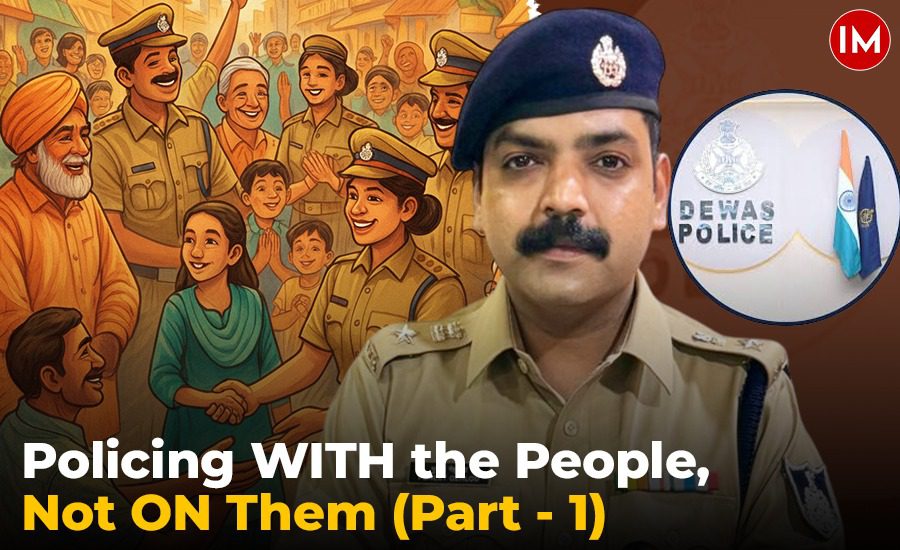
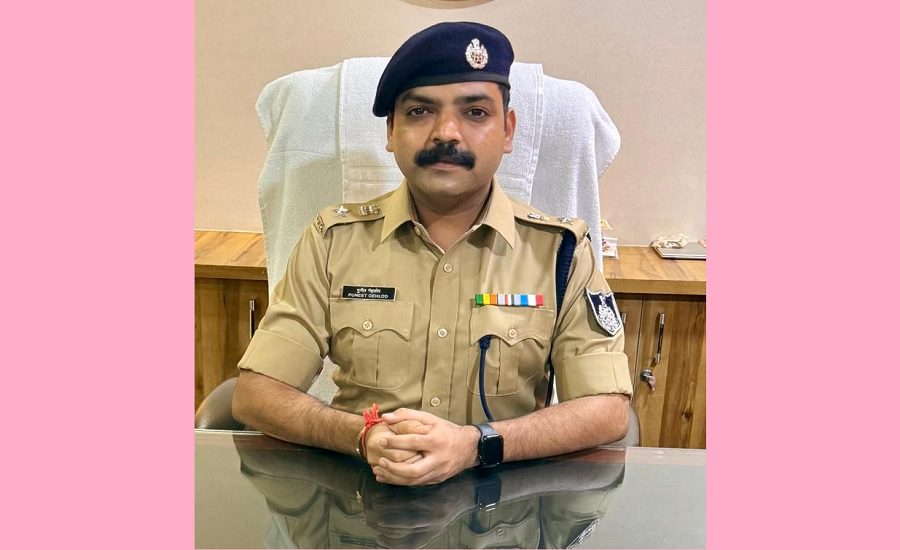
In the heart of Madhya Pradesh, the city of Dewas is witnessing a quiet yet powerful revolution in policing – one that does not begin in police stations but in the villages, markets, and wards where people live their everyday lives. The force behind this transformation is IPS Puneet Gehlot, a 2017-batch officer of the Madhya Pradesh cadre, currently serving as Superintendent of Police, Dewas.
For SP Gehlot, policing is not merely a function of law enforcement – it’s a partnership. His philosophy is simple but transformative: “Policing with the people, for the people, and by the people.”
Under his leadership, Dewas Police has shifted from being a reactive force – responding after crimes – to a proactive institution that engages continuously with its community. Through innovative initiatives like Police Chaupal, Operation Trinetram, and Digital Police Mitra, Gehlot has redefined what it means to keep a district safe in the modern age.
In an exclusive interview with Indian Masterminds, Mr Gehlot, SP, Dewas, explained his initiative and unique model of policing, which has now become a showcase example across regions, as its impact is both highly visible and remarkably positive.
The Beginning of Change: From Reactive to Proactive Policing
When IPS Gehlot took charge, he identified two foundational challenges in Indian policing: the reactive nature of operations and the low police-to-population ratio.
“Look,” he explains, “it’s basically a very simple concept. Earlier, our policing method was reactive – we used to respond after a crime occurred. We wanted to change that. The police should interact with the community even when no crime is happening. That way, we work on crime prevention.”
The second problem, he adds, is structural: “Across the country, we are understaffed. The population is rising, but the strength of the police is not. So if we want to deal with modern crimes – cyber frauds, narcotics, interstate offenses – we must harness the potential of the public.”
And thus, two philosophies became the foundation of his Dewas model –
- Transform policing from reactive to proactive, and
- Harness the public’s inherent strength to overcome manpower shortages.
Police Chaupal: The Heart of Community Policing
Launched on November 1, 2023, the Police Chaupal initiative became the practical embodiment of these philosophies.
Every evening at 5 p.m., immediately after the roll call, SHOs and ATOs leave their police stations and head into villages and city wards. Whether there’s a complaint or not, they sit with residents, listen, talk, and share updates.
“In the last one year,” says SP Gehlot, “we’ve organized over 22,000 Police Chaupals and interacted with more than 75,000 citizens. Every Chaupal has a fixed format and a purpose.”
The timing is strategic – evenings are when petty crimes like domestic disputes, fights after drinking, and harassment cases are most likely. “Between 5 and 10 p.m., most minor crimes happen. Our presence in those hours automatically prevents them,” he says.
But the Chaupal is more than a meeting. It’s a structured forum where citizens and police work together on three key agendas:
- Operation Trinetram – CCTV expansion,
- Digital Police Mitra – real-time communication via WhatsApp, and
- Cyber Awareness – spreading digital safety literacy.
Operation Trinetram: The Third Eye of Dewas
Named after Lord Shiva’s divine eye, Operation Trinetram (The Third Eye) focuses on installing CCTV cameras across villages and towns – not through government funds, but through community motivation.
“We told people – install a camera not just for your own safety, but for your neighborhood’s,” IPS Gehlot recalls. “Every person who installed one received a certificate, a garland, and recognition in the local paper. That small gesture built immense enthusiasm.”
In just one year, Dewas achieved 9,000+ camera installations across nearly 1,000 villages, worth over ₹4 crore – all funded voluntarily by the public. Each camera is geo-tagged and mapped in a central system. “If a crime happens,” he explains, “we can instantly locate all nearby cameras, access footage, and even contact the camera owners directly.”
This innovation paid off dramatically in multiple cases – from a ₹32 lakh bank robbery, solved within hours, to an acid attack case, where the accused was identified and arrested the same day.
“In one robbery,” Mr Gehlot narrates, “the footage was shared with 22,000 citizens through our digital network. Within two hours, people from nearby villages recognized the suspects. We arrested them by 8 p.m. The public helped catch the criminals they filmed – it was policing by the people, for the people.”
Digital Police Mitra: Connecting 22,000 Citizens
The second leg of the Dewas model is digital engagement. Through the Digital Police Mitra initiative, the district police created 1,100 WhatsApp groups – one for every village – connecting over 22,000 active citizens.
Each group includes 15–20 local youth active on social media, added to a larger district-wide community network. A message sent by SP Gehlot reaches every group instantly.
“The idea was simple,” he says. “If we can’t physically reach every corner, let’s make sure our message does. This digital bridge has become our real-time intelligence system.”
These groups now serve multiple purposes –
- Sharing CCTV footage of crimes for quick identification,
- Spreading alerts and official clarifications to stop rumors,
- Creating awareness about safety, cyber frauds, and road discipline.
In one case, a fatal road accident caused by a truck without reflective tape was used as a learning moment. The footage was shared with all 22,000 members, along with a message: “Reflective tape costs ₹5, but it can save a life.” By the next morning, the message had reached the entire district.
Operation Cyber: Empowering Citizens in the Digital Era
The third focus area under the Chaupal initiative is cybercrime awareness. Earlier, victims of online fraud often had no idea where to go. They were caught in what Gehlot calls the “football system”: “The bank would send them to the police, the police to the cyber cell, and the cyber cell back to the bank. By then, the money was gone.”
The solution was awareness of the national cyber helpline 1930. Through daily Police Chaupals, campaigns, and digital groups, citizens were trained to act immediately after a fraud.
The result? Reporting of cybercrime in Dewas increased fourfold, and ₹1.25 crore was refunded to victims in one year. Another ₹2.5 crore is currently on hold pending return.
“One victim even came after five years,” Gehlot smiles. “He said, ‘Sir, we didn’t know earlier, but now we see people getting their money back. Maybe mine will come too.’ That’s the kind of faith we’ve built.”
Harnessing Public Strength: A Replicable Model
Each success story strengthened public trust – from recovering stolen goats in small villages using CCTV footage, to arresting violent offenders within hours. As the system matured, public participation became self-sustaining.
“Today, people come forward themselves,” Gehlot notes. “They offer to install cameras in bus stands, markets, and schools. The trust has turned into a chain reaction.”
Other districts in Madhya Pradesh are already replicating the Dewas model, encouraged by its low cost and high impact. But SP Gehlot believes the real secret is consistency. “The model is simple — anyone can do it. But it needs constant follow-up, daily engagement, and genuine partnership with the community.”
A New Definition of Policing
Through Police Chaupal, Operation Trinetram, and Digital Police Mitra, Dewas has built a three-layered security ecosystem where technology, community, and trust reinforce one another. Crime rates have fallen sharply:
- Chain-snatching incidents dropped to just two cases in a year,
- Stabbings declined by nearly 50%, and
- Crimes against women have seen a measurable reduction.
As SP Gehlot puts it, “We’re not doing anything extraordinary. We are simply organizing and harnessing the public’s strength and capacity. The network of citizens is already very strong – we just connected the dots.”
The People’s Police
From the bustling city lanes to remote villages, Dewas is now covered by the eyes, ears, and goodwill of its people. The once clear line between “the police” and “the public” has begun to blur – and that, SP Gehlot believes, is exactly how it should be.
“We are moving toward policing that truly belongs to the people,” he says. “Of the populace, by the populace, and for the populace.”
(We’ve shared the first part of the story — to read the second part, please click the link below.)