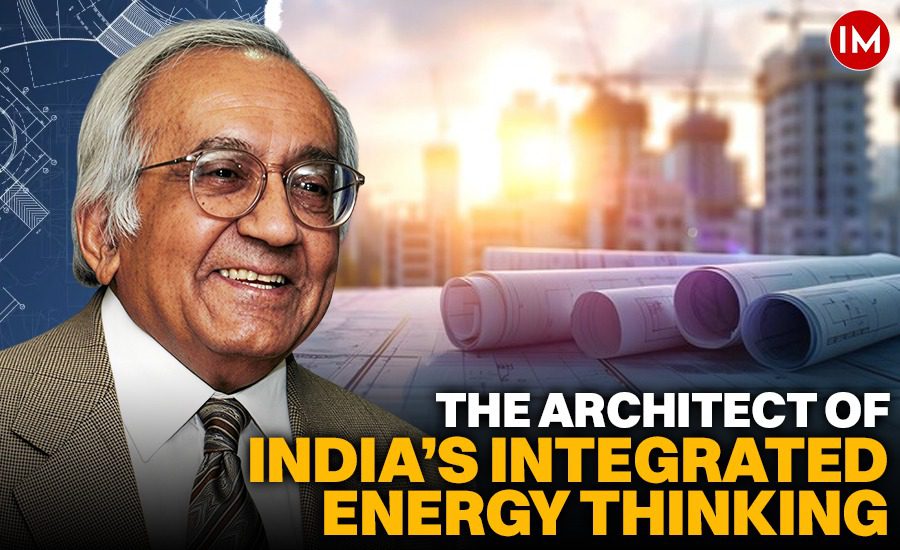
In India’s policy landscape, where short-term pressures often overshadow long-term strategy, a few minds quietly redefine how the nation approaches complex challenges. Kirit Shantilal Parikh stands out as one such figure—a systems thinker whose frameworks for energy planning, pricing, and sustainability continue to shape India’s growth trajectory decades later. Not through executive power or political drama, but by insisting that energy must be viewed as an integrated system rather than isolated silos.
Born on August 1, 1935, in Gujarat, Parikh grew up in the early years of independent India, amid debates on self-reliance and planned development. He began with a practical foundation: a B.E. in Civil Engineering from Gujarat University (1956), followed by an M.Tech. in Structures from IIT Kharagpur (1957). Drawn to deeper questions of resource allocation, he pursued advanced studies at the Massachusetts Institute of Technology (MIT), earning a Doctor of Science (Sc.D.) in Civil Engineering (1962) and a Master’s in Economics and Engineering (1963). At MIT, he honed quantitative tools—systems modeling, programming, and economic analysis—that would define his approach: an engineer’s grasp of physical infrastructure fused with an economist’s focus on efficiency and incentives.
Also Read – Digital Trails, Ground Intelligence: A New Era of Policing in Jharsuguda
This dual expertise proved transformative upon his return to India. Parikh’s career bridged academia and governance at a time when the Planning Commission anchored national strategy. He served as a Member of the Planning Commission (2004–2009), overseeing energy, water, and perspective planning, where he became the principal architect of India’s Integrated Energy Policy (IEP).
The 2006 IEP report, chaired by Parikh, marked a paradigm shift. India’s energy sector had long operated in fragments—coal, oil, gas, power, and emerging renewables treated separately. Parikh’s committee advocated a unified analytical framework that linked supply security, pricing reforms, efficiency, environmental sustainability, and long-term growth. It projected energy needs to 2031–32, explored scenarios (including coal-dominant, hydro, and nuclear pathways), emphasized energy efficiency’s potential to cut requirements by up to 17%, and stressed full realization of hydro potential alongside accelerated nuclear and renewables growth. High-priority recommendations included ensuring consistent coal quality, addressing concerns of resource-rich states, and improving payment security for private investment in power.
The report was not just a document; it taught policymakers to model trade-offs rigorously—balancing import dependence, subsidies, and low-carbon transitions—while keeping inclusive growth central. Its influence persists in subsequent strategies, even as India pursues net-zero pathways by 2070.
Parikh’s thinking extended to pricing reforms that balanced producer incentives with consumer protection. In 2010, he chaired an expert group on petroleum product pricing, recommending market-determined prices for petrol and diesel, gradual increases in PDS kerosene and domestic LPG (with targeted subsidies via smart cards/UID), and full compensation for oil marketing companies’ under-recoveries.
Later, in 2022, as head of the gas pricing committee amid volatile global prices, he proposed a pragmatic band for Administered Pricing Mechanism (APM) gas from legacy fields: a floor of $4 per MMBtu and initial ceiling of $6.5 per MMBtu (rising annually by $0.5), with full market-linked pricing (tied to ~10% of Indian crude import basket slope) recommended from January 2027. The goal: boost domestic production toward a 15% gas share in the energy mix by 2030, ensure affordable supply to priority sectors like CNG and domestic PNG, and minimize fiscal burden while providing reasonable returns to producers.
Beyond government roles, Parikh built enduring intellectual infrastructure. He founded and served as Director (and Vice-Chancellor) of the Indira Gandhi Institute of Development Research (IGIDR) in Mumbai from 1986 to 2000, transforming it into a premier center for applied development economics and policy research. IGIDR fostered rigorous modeling and non-governmental assessments, including the India Development Reports he edited. Since 2002, as Chairman of Integrated Research and Action for Development (IRADe) in New Delhi, he has continued work on energy, climate, and sustainable pathways, including low-carbon strategies for inclusive growth.
His counsel transcended regimes. Parikh served on the Economic Advisory Council to Prime Ministers Rajiv Gandhi, V.P. Singh, Chandra Shekhar, P.V. Narasimha Rao, and Atal Bihari Vajpayee, and contributed to climate policy as a review editor for IPCC reports (sharing in the 2007 Nobel Peace Prize recognition for IPCC authors). He also served as Senior Economic Adviser to the UNDP (1997–98).
A prolific author and editor of around 30 books and numerous papers on planning, energy systems, food policy, trade, general equilibrium modeling, and natural resources, Parikh emphasized evidence-based, long-view governance. His honors include the Padma Bhushan (2009) for contributions to public affairs and Fellowship of the National Academy of Sciences, India.
In an era of immediacy and fragmentation, Kirit Parikh exemplified the power of integrated thinking. He did not merely advise on energy; he taught India a grammar for it—systems-oriented, quantitative yet grounded in real-world equity and sustainability. As India navigates its energy transition, his frameworks endure not in headlines, but in the quiet logic guiding allocation, pricing, and planning.
For governance professionals, Parikh’s career offers a timeless lesson: the most profound impact often lies in shaping how decisions are framed, long after the decision-maker has stepped back.
Also Read – How Financial Crackdowns Are Helping Jhalawar Outsmart Narcotics Cartels