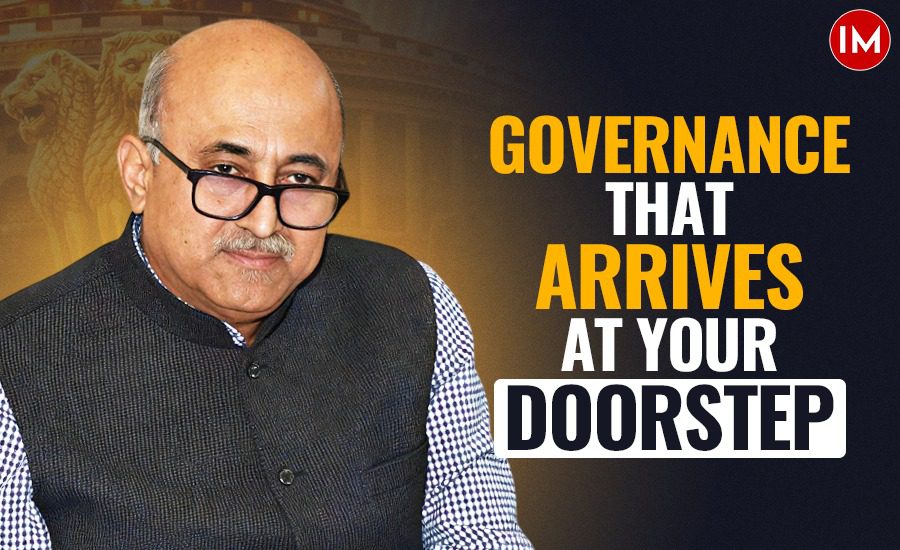
These days, governance is increasingly communicated through dashboards, video conferences, and data portals. Amid these notions of bureaucracy, IAS Officer K. B. Thakkar (retd.) has chosen to return to a simpler, more demanding idea of administration, one that begins not in offices, but in villages. As District Collector of Jamnagar, Thakkar’s work is an example of taking governance to the grassroots. His method is deliberate, consistent, and rooted in a belief that the State must be seen, heard, and felt, especially in its most distant corners.
Profile: Experience of the System, Refined in the Field
Shri K. B. Thakkar’s administrative journey shows institutional grounding and field sensitivity. A 2014-batch IAS officer of the Gujarat cadre, he entered the service through promotion from the State Civil Service, bringing with him years of on-ground administrative experience even before joining the IAS.
K.B. Thakkar holds a Bachelor of Commerce in Accountancy from Bhavnagar University. Over roughly 12 years in the higher administrative framework, he has served across sectors and districts, including a significant tenure in Porbandar and Jamnagar. His career gives a consistent administrative value, a focus on grassroots outreach, inter-departmental convergence, and accelerating the delivery of civic amenities.
Governance beyond the Collectorate
In Jamnagar, the philosophy of taking governance beyond collectorate has emerged as a sustained campaign of village visits, over 100 and counting. But unlike traditional inspections, these are not symbolic tours designed for administrative optics. They were working visits.
Each trip becomes a moving public hearing: grievances are raised, records are checked, officials are held accountable on the spot, and solutions are initiated in real time. Roads, drinking water supply, sanitation infrastructure, electricity access, and local disputes, these issues are neither deferred nor diluted.
Also Read – When the Uniform Comes Off : The Hyderabad Murder and the Fragile Reality of Retired Officers
This approach repositions the district administration from a distant authority to a responsive presence.
And perhaps more importantly, it alters citizen expectations. Governance is no longer something that happens elsewhere, it is something that arrives.
Power of Listening: Data points and the lived realities
A recurring limitation in public administration is over-reliance on reports. Data travels upward, but realities often remain fragmented. K. B. Thakkar’s model attempts to bridge this gap.
By engaging directly with village farmers, women, schoolchildren, frontline workers, he accesses layers of information that rarely make it into formal documentation. Land disputes that linger due to procedural inertia, households excluded from welfare due to minor documentation gaps, or infrastructure that exists on paper but falters in practice: these nuances surface only through conversation.
This listening-led governance does something fundamental: it restores credibility. When citizens feel heard, compliance improves, participation increases, and schemes gain traction.
Schools as Governance Barometers
Among the many sites Shri Thakkar visited, schools occupy a central place. Not merely as institutions of education, but as indicators of state capacity. Classroom conditions, attendance levels, sanitation facilities, and the quality of mid-day meals, each element shows how effectively policies turn into outcomes.
By inspecting schools personally, he transformed them into accountability checkpoints. A functioning school signals coordination between departments- education, health, nutrition, and local governance. A failing one exposes systemic gaps.
In this sense, schools become microcosms of governance itself.
Welfare to Saturation: Closing the Last-Mile Gap
India’s welfare ecosystem is expansive, with schemes designed to address health, energy access, housing, and livelihoods. Yet, the real challenge lies not in design, but in delivery.
During his posting in Jamnagar, the administration has focused on ensuring saturation, where every eligible beneficiary is covered, not just a majority.
Flagship initiatives such as Ayushman Bharat and Pradhan Mantri Ujjwala Yojana form the backbone of this effort. But instead of waiting for beneficiaries to approach the system, officials are tasked with identifying gaps proactively. Documentation hurdles are addressed, awareness gaps are bridged, and departments are coordinated to ensure seamless delivery.
This marks a significant shift, from scheme implementation to entitlement assurance.
Administrative Convergence within Departments
One of the less visible, yet critical aspects is inter-departmental coordination. At the district level, governance often suffers from fragmentation, departments operate in silos, leading to delays and inefficiencies. By synchronising efforts across departments, Shri K. B. Thakkar ensured that issues are addressed holistically.
A drinking water problem, for instance, may involve rural development, water resources, and local governance bodies. Addressing it in isolation would be inefficient; addressing it collectively accelerates resolution.
This convergence model reduces bureaucratic friction and improves service delivery timelines.
Counterpoint to Dashboard Governance
Modern governance increasingly relies on digital monitoring systems, real-time dashboards, performance indicators, and centralised reviews. While these tools improve efficiency, they also risk distancing decision-makers from ground realities.
Shri K. B. Thakkar’s model does not reject technology, it complements it. Field visits validate data. They provide context to numbers. They reveal why a scheme may show high coverage on paper but low impact on the ground. In doing so, they create a feedback loop that strengthens both digital and physical governance systems.
Larger Lesson: Presence as Policy
There is a quiet lesson embedded in Jamnagar’s administrative approach. Effective governance does not always require new schemes, additional funding, or structural overhauls. Sometimes, it requires something more fundamental: presence and trust. The presence of an administrator who listens, observes, questions, and acts. The presence of the state in spaces where it is often felt only through absence.
Repeated field engagement creates familiarity. Citizens begin to recognise the administration not as an abstract entity, but as individuals they have interacted with. This shift has tangible outcomes: grievances are reported more openly, conflicts are resolved more amicably, and local participation improves.
In many ways, trust becomes an administrative resource, one that enhances the effectiveness of every policy intervention.
Conclusion: Replicable, Human-Centred Model
The story of retd. IAS officer K. B. Thakkar is not just about a tenure in Jamnagar, but about a certain idea of public service that is increasingly rare. From entering the IAS through the State Civil Service to serving across districts and eventually retiring in March 2026 after his stint as Collector, his journey is an example of a lifetime spent within the machinery of governance, learning it from the inside, and then reshaping it on the ground.
What stands out is the consistency of his approach, stepping out of offices, visiting over a hundred villages, listening directly to citizens, and ensuring that schemes reach those who would otherwise remain invisible in official data.
Seen together, these are gestures that rebuild faith in the system. Because for many people, governance is not experienced through policies or announcements, but through moments: when an officer shows up, listens without interruption, and ensures something actually changes.
Also Read – When The Entire Film Crew Was At The Mercy of King Cobra