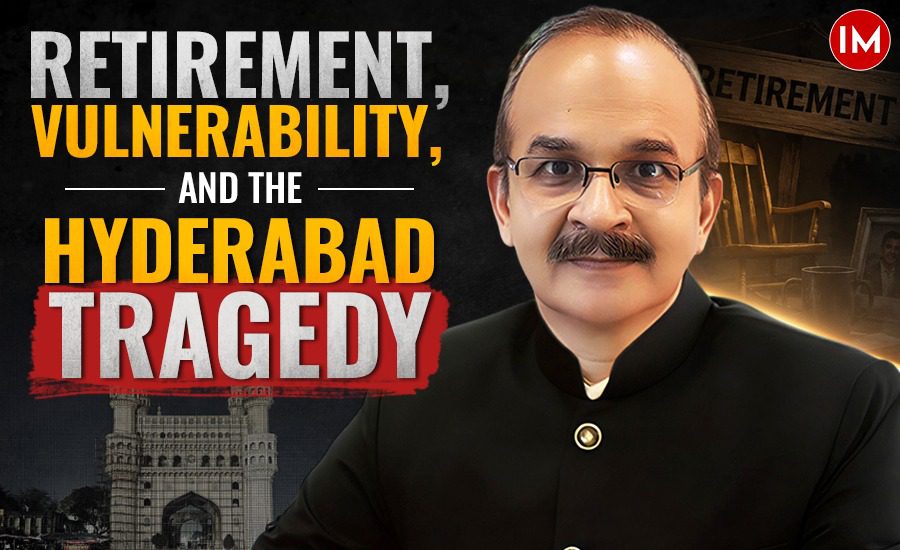
The Hyderabad murder involving the wife of retired IPS officer Vinay Ranjan Ray is not merely another crime story. It is a disturbing reminder that retirement strips away more than authority; it often strips away the illusion of safety itself.
For many within the police fraternity, the incident feels deeply personal. Ray was not just a retired officer but a colleague, a batchmate, and part of a shared professional brotherhood shaped by years of service, crises, transfers, and sacrifice. Yet what unsettles serving and retired officers most is the realisation that once the uniform comes off, the distance between a former police officer and an ordinary vulnerable citizen becomes alarmingly small.
Also Read – Rupinder Brar Beyond the Desk: Music, Mindfulness & the Many Sides of a Civil Servant
During service, officers function within an invisible ecosystem of protection. The uniform itself carries authority. Local police respond quickly, information flows faster, and criminals hesitate before targeting those linked to the force. Over time, many officers unconsciously assume this protective shield will continue indefinitely. It does not. Retirement changes realities with surprising speed. Official vehicles disappear, security personnel are withdrawn, calls slow down, and influence fades gradually and then suddenly. The officer who once supervised districts and managed law-and-order situations begins living like any ageing urban citizen, dependent on domestic staff, neighbours, technology, and chance. Power retires before people do.
The tragedy also destroys a lingering illusion many retired officers carry: the belief that the system still stands around them. In reality, vulnerability remains once authority disappears.
What makes the incident more disturbing is that it is not isolated. India has witnessed several shocking crimes involving senior officials and elderly citizens living alone. The murder of the daughter of an IRS officer had earlier exposed how fragile domestic safety had become, even within elite bureaucratic households. Similarly, the 2022 murder of Hemant Lohia, Director General of Prisons in Jammu and Kashmir, inside his own residence deeply unsettled the security establishment. If even a serving senior officer occupying one of the highest security positions could become vulnerable at home, institutional protection was clearly far more fragile than many believed.
Modern crime increasingly enters homes not through force but through familiarity and routine. Trusted drivers, domestic workers, caregivers, and temporary staff often gain intimate knowledge of household patterns and vulnerabilities. This reality must be discussed responsibly and without prejudice, because millions of domestic workers across India serve with honesty and dignity. Yet unchecked trust without proper verification can become dangerous.
The larger issue extends beyond one city or one crime. Urban India is ageing uneasily. Children move abroad or to distant metros, elderly couples live alone, neighbourhood bonds weaken, and apartment culture creates proximity without relationships. Many senior citizens now interact more with service providers than with family or community. A city can be crowded and lonely at the same time.
For retired officers, this transition is psychologically difficult. Those who spent decades protecting others often continue thinking like protectors long after they themselves have become vulnerable. The mind accepts retirement much later than official files do.
The Hyderabad tragedy should also compel introspection within policing. Many officers discover after retirement what ordinary citizens experience daily: delayed responses, procedural indifference, uncertainty, helplessness, and fear. Perhaps the standards of safety officers instinctively expect for their own families after retirement are precisely the standards every citizen deserved throughout their years in service.
India now needs a more serious conversation about ageing and urban security. Domestic worker verification systems must become technology-driven and professional. Senior citizens living alone need stronger neighbourhood support and reliable emergency response systems. Police organisations must also recognise that welfare cannot end with retirement ceremonies and pensions.
Because beneath every rank, medal, convoy, and designation lies the same fragile human reality: one day, all of us hang our boots. And when the uniform comes off, what remains is not authority, but the same vulnerability ordinary citizens live with every day.
Also Read – How Dr. Wasim Ur Rahman Cleared UPSC After Years of Setbacks and 5 Interviews