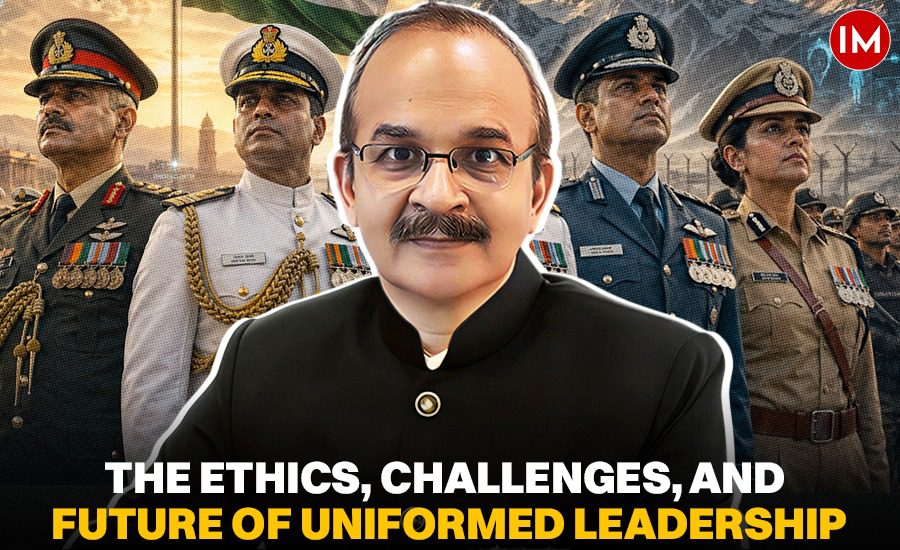
Leadership in uniform is not a modern construct. Its origins can be traced to the earliest civilisations where order, justice, and protection of society were considered sacred obligations. In ancient India, the concept of Rajadharma placed the ruler and his functionaries under a moral and cosmic duty to uphold justice. Texts such as the Arthashastra of Kautilya articulated a sophisticated system of governance where the king’s authority was inseparable from accountability, intelligence gathering, and public welfare. The emphasis was not merely on power but on disciplined, ethical administration.
Similarly, in ancient Rome, the idea of imperium carried with it the expectation of restraint, responsibility, and service to the republic. Military leaders were expected to uphold law and order, not as instruments of personal authority but as custodians of institutional stability. In China, Confucian philosophy emphasised moral leadership, where the conduct of the officer was seen as the foundation of social harmony.
Across civilisations, a common thread emerges. Leadership in uniform was never merely about command. It was about duty, restraint, and a higher sense of responsibility towards society.
The Colonial Legacy and the Evolution of Policing in India
The modern policing structure in India evolved under colonial rule, primarily designed for control rather than service. The Police Act of 1861 institutionalised a system that was hierarchical, rigid, and often distant from the people it served. Yet, post-independence, the role of the police began to transform gradually from an instrument of authority to an agency of public service.
The Constitution of India fundamentally redefined this role. Under Article 21, the right to life and personal liberty placed an obligation on the State and its agencies to act with fairness, dignity, and accountability. Leadership in uniform, therefore, transitioned from enforcing order to safeguarding constitutional values.
Also Read – From IIT to IPS: Ajay Choudhary on AI, Policing & the Future of Law Enforcement
Leadership Under Pressure: The Reality of Service
Leadership in uniform is forged not in classrooms but in the crucible of real-life situations. Law and order challenges, communal tensions, disasters, and crises test not only professional competence but also moral clarity. Decisions often have to be taken in seconds, with incomplete information, and under intense public and political scrutiny.
In such moments, leadership is defined by balance. The ability to enforce the law firmly while remaining sensitive to human dignity is perhaps the most difficult yet essential aspect of policing. Excessive force erodes legitimacy, while indecision invites disorder. The true test lies in navigating this delicate equilibrium.
Ethics and Integrity: The Core of Uniformed Leadership
Uniforms command authority, but authority without integrity is fragile. Ethical leadership is the cornerstone of public trust. The temptation to misuse power, to yield to external pressures, or to prioritise expediency over justice is ever-present.
Over the course of service, one learns that integrity is not a single decision but a continuous discipline. It is reflected in small choices, in daily conduct, and in the willingness to stand firm when it is most inconvenient. Public perception of institutions is shaped less by policy and more by the visible conduct of those who represent them.
Decision-Making and Accountability
One of the defining features of leadership in uniform is decision-making under uncertainty. Unlike many other professions, the consequences of decisions in policing are immediate and often irreversible. The use of force, the handling of sensitive cases, and the management of public order require not only legal knowledge but also sound judgment.
Accountability is integral to this process. Modern democratic systems demand transparency and justification for actions taken in authority. This has strengthened institutions but has also added layers of scrutiny. A leader must therefore combine decisiveness with responsibility, ensuring that every action withstands both legal and moral examination.
The Changing Nature of Threats
The landscape of policing has undergone a profound transformation. Traditional crimes have been supplemented by cybercrime, financial fraud, organised digital networks, and technology-driven offences. The emergence of artificial intelligence and digital platforms has created new challenges that are complex, borderless, and often invisible.
Leadership in uniform must therefore evolve. It requires continuous learning, adaptation, and the ability to integrate technology into policing without losing sight of fundamental principles. The challenge is not merely to respond to new threats but to anticipate them.
Human Element in Leadership
Despite technological advancements, the essence of policing remains human. Leadership is ultimately about people, both within the force and in society. Managing a large, diverse workforce requires empathy, communication, and the ability to inspire.
Equally important is the relationship between the police and the public. Trust cannot be commanded; it must be earned. Community engagement, transparency, and responsiveness are critical in building this trust. A uniform may symbolise authority, but it must also reflect approachability and fairness.
Institution Building: Beyond Individual Leadership
A significant lesson from years in service is that institutions outlast individuals. While individual leadership can influence outcomes, sustainable change requires strong systems. Training, accountability mechanisms, technological infrastructure, and organisational culture play a decisive role in shaping institutional effectiveness.
Institution building involves creating processes that function independently of personalities. It requires foresight, patience, and a commitment to long-term reform rather than short-term gains.
Lessons for the Future
The journey of leadership in uniform offers several enduring lessons. Authority must always be tempered with responsibility. Law enforcement must align with constitutional values. Adaptability is essential in a rapidly changing world. Above all, integrity remains non-negotiable.
The future of policing will depend not only on resources or technology but on the quality of leadership. As societies become more complex, the expectations from those in uniform will continue to rise.
Conclusion: The Uniform as a Responsibility, Not a Privilege
The uniform is often seen as a symbol of power. In reality, it is a symbol of responsibility. It represents the trust that society places in an individual to act fairly, decisively, and with integrity.
From ancient civilisations to modern democracies, the essence of leadership in uniform has remained constant. It is rooted in duty, guided by ethics, and sustained by public trust. The challenges may change, but the principles endure.
Ultimately, leadership in uniform is not about authority over people. It is about service to them.
About the Author
(Dr. Shailendra Srivastava is a retired IPS officer of the 1986 batch, Madhya Pradesh cadre, who served as Director General of Police with over 35 years of experience in law enforcement, governance, and public administration. He is also a legal professional and author, known for his work on criminal justice, cyber law, and societal issues. His writings reflect a deep engagement with constitutional values, cultural traditions, and contemporary policy challenges, bridging the domains of governance, law, and civilizational thought.)
Also Read – Tough on Crime, Gentle with Citizens: How Nirlipt Rai is Redefining Policing in Rajkot