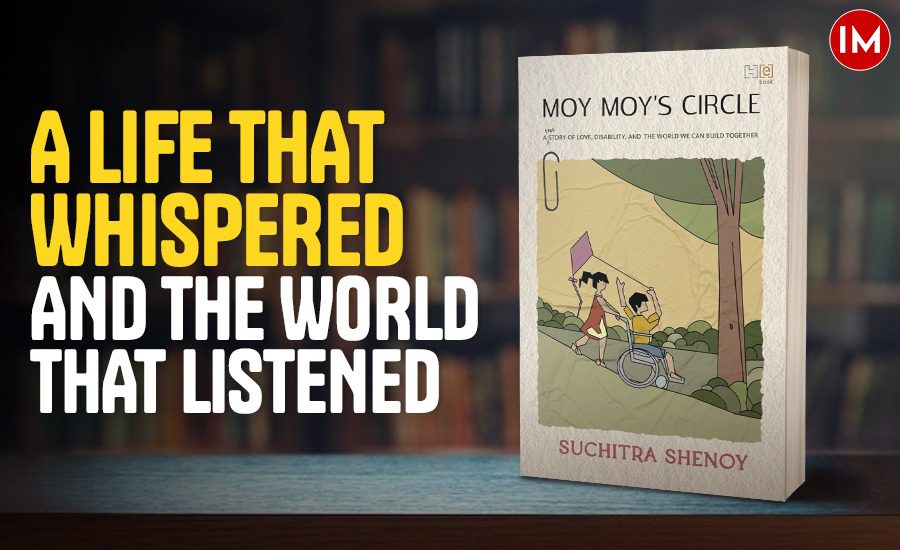
When Mary McGowan came to know of a premature baby abandoned at a government hospital in the Himalayas, she said immediately that her sister would adopt her. Her husband Tom Synan was surprised. But Mary’s conviction was correct — her elder sister Jo took one look at the infant in the hospital crib and made instant arrangements to take her to Dehradun, to her husband Ravi Chopra and little children Anand and Cathleen. The baby weighed less than a kilogram and was named Uma after the goddess Parvati, daughter of the Himalayas; affectionately, everyone called her Moy Moy in homage to her aunt Mary. Moy spoke human language for a while, then a language of laughter, and later she spoke only with her eyes and her smile.
When it became clear that Moy had different needs from her siblings (and that Dehradun did not have a school equipped to deal with those needs) Jo decided to work towards a solution. The Latika Roy Memorial Foundation, named after another pioneering teacher who had earlier pursued excellence in Dehradun education, began as a play group and is now a leading service centre for children with special needs. The best way to gauge the success of any organization is to speak with those who are at the bottom of its hierarchical structure, writes Suchitra Shenoy, and Latika is a towering example of success in this metric. From the school-van driver Ashok Mamgain to female chowkidars Anita and Nisha, the Latika culture of according dignity to all labour has fostered a remarkable vitality.
Also Read- Six Years, Thousands of Operations : How Balaghat Turned the Tide Against Naxals
Harikala “Hema” Sharma was one of Moy Moy’s primary caretakers. Having already seen a great deal of sorrow in her young life, it was Moy with whom she would share her troubles. “And Hema’s problems were not trivial. Poverty, an alcoholic father, a broken engagement she was blamed for, a brother’s suicide, opposition to her choice of husband… it is hard to fathom from Hema’s smiling face how much she has endured. Moy would listen to all this and offer, through her quiet presence, that most essential of human acts: comfort. One can picture them in a quiet corner of the garden, Moy Moy in her stroller, Hema in a colourful kurta chatting away beside her. ‘Moy would comfort me, with her eyes, with her lovely smile. And then,’ Hema says with a lovely smile of her own, ‘I would forget all my troubles.’”
Hema is one of the many “jay-birds” who have perpetuated the acorns of Latika’s oak tree expansion over the years. There are others too, like educational psychologist Nicola Tansley who designed a child-protection policy for the centre and Sumita Nanda who began as a receptionist at Latika and then rose to carry that same policy through in practice as COO Child Protection Officer. “Sumita has incorporated child protection into every part of Latika: teaching, training, recruitment, evaluations. Seasoned staffers, new recruits, interns — all get to learn it, because child protection is not just Sumita’s job, it is everyone’s job.”
Another jay-bird was bureaucrat Keshav Desiraju who supported Latika’s early intervention and assessment centre Gubbara within the premises of Doon Hospital in order to enable comprehensive (and free) reports about each special child’s particular context. The team at Latika later went on to also build an Early Intervention Centre for individualised development plans offered to parents in both Hindi and English, along with the Latika School for children between seven and fourteen with disabilities across a range of severity.
There is singing and dancing every day at Latika amidst a culture of participative joy for both staff and students. Special education teachers often go above and beyond in designing lesson plans that will ensure the steady progress of their wards. Young girls at Latika, for example, have a special menstruation class to which their mothers are also invited, so that teacher and parent can collaborate on how to proceed through this monthly biological shift with as much independence for the child as possible.
After fourteen, children from Latika can join Latika’s Centre for Vocational Training where the “hope is that love, care and practical training will help them find meaningful jobs and some degree of independence.” Whether it is supervised employment in the market or being able to help out around the home, young adults at the centre are empowered with skill-building.
But the world outside can remain a battlefield. “In India, which has millions with disabilities, only around 100,000 have found employment outside the government sector (which reserves some jobs for the disabled). It is harder for Latika because its children have multiple disabilities.” Social mingling is one of the key factors in leading a healthy life, and this usually happens for the Latika community through the various clubs at the centre itself for the children and their families.
Not everything can be done within the walls of Latika. Children live at home with their families, and those who have special needs require special attention. This is not always easy. Even in the case of the Chopras: Ravi abandoned his political dreams because they would have required too much time in Delhi, and Moy’s brother refers candidly to the difficulty which can accompany adjustment of this sort. It may not be easy — but it can be rewarding in ways otherwise impossible to experience.
One in six of us is likely to experience significant disability. There are fewer than 10 paediatric doctors per 100,000 children in India and even fewer who can work with special needs resulting from neurodevelopmental delays, autism, cerebral palsy, Down syndrome, or other learning difficulties affecting cognitive function. Because not everyone can afford to visit Dehradun where Latika provides localized care – although some of the most touching stories in the book are of parents like Savitha Purohit who brave all odds to rebuild here – the centre developed an outreach programme for rural areas with the support of ASHA workers. A collaboration with the Army Welfare Association has also opened up Latika to specialized training for various special-needs schools supported by the Indian Army.
Mention must be made here of the wonderful work now being done in Dehradun by other organizations like the Sharpe Memorial School for the Blind, the Bajaj School of Learning for the Deaf, the Cheshire Home and the Raphael Ryder-Cheshire Home for Children. There is also the Dehradun Disability Forum, through which the Latika team came to know of an intellectually disabled girl named Pooja who was raped in 2012.
The persistent efforts of Latika’s “one-man legal army” Rizwan Ali on this case led to two landmark changes in Uttarakhand: one, a cognizance on part of the state government for greater sensitivity by investigating officers (who had earlier forced the victim to share space with the criminal) and two, success in receiving financial compensation for the victim. “While pushing for her money to come through, Rizwan was able to free up not just Pooja’s compensation of two hundred thousand rupees but the compensation money of sixteen other victims.” This is just one reminder in this book of the fact that although much work remains to be done, much is also being accomplished by those who have the quiet conviction which is the foundation to real change.
Faith – in Jesus Christ and Guru Nanak and other spiritual teachers – has been an intuitive direction for Jo Chopra-McGowan. It’s what guided her decision to marry Ravi and later to adopt Moy. “Leap, and the net will appear,” is a saying she believes in. A quote which decorates the walls of the Latika office is by Shunryu Suzuki: “Light up one corner — not the whole world, just make it clear where you are.” Another principle which illuminates the way for Jo and all the others who became part of Moy Moy’s circle, who continue to be moved by her story, is the prayer spoken by the family at every meal: “May those who are hungry have food. And those who have food — hunger for peace and justice on Earth.”
(Yauvanika Chopra is the Editor and researcher deeply engaged with Indian literature and languages in translation, she has worked with Speaking Tiger Books and served as Associate Director at the New India Foundation. She holds an MA in Contemporary Literature, Culture and Theory from King’s College London, where her research examined intertextual representations of Indian women.)
Also Read- From Guns to Growth: How Balaghat Turned the Tide Against Naxalism Through Community Power