Deep inside the forests of Balaghat, where fear once travelled faster than information, the turning point did not come from a single operation. It came from a shift in thinking.
For years, this region of Madhya Pradesh remained vulnerable to Left Wing Extremism. Armed cadres moved through forested corridors, blending seamlessly into tribal communities, sustained by ideology, local support systems, and a steady stream of finances.
But something changed.
Instead of viewing the fight purely through the lens of force, the administration began to see it as a battle for trust, opportunity, and dignity.
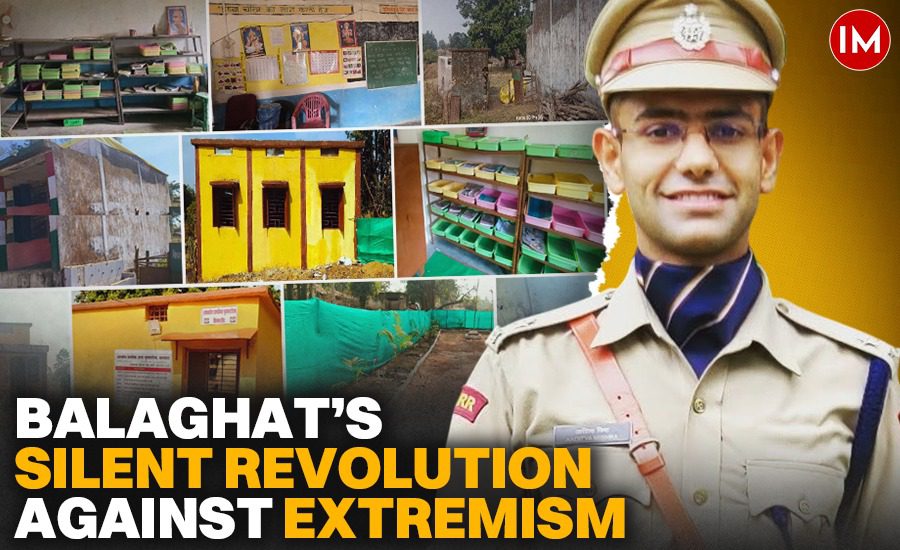
At the centre of this transformation is Aditya Mishra, Superintendent of Police, Balaghat, who, in a conversation with Indian Masterminds, outlined how community engagement became the most decisive weapon.
“You can’t win this battle only with operations. You have to give people a reason to choose the system over the gun,” Mishra says.
Understanding the Enemy Within the Crowd
The challenge in Balaghat was never just about eliminating armed insurgents—it was about identifying them.
Post-2022, Naxal groups adapted their strategy. They abandoned uniforms, moved in smaller groups, and merged into civilian populations. Women cadres were encouraged to dress like locals, further complicating identification.
Also Read – Six Years, Thousands of Operations : How Balaghat Turned the Tide Against Naxals
This made intelligence the most critical factor.
“If intelligence comes after two days, it’s only useful for study—not for operations,” Mishra explains.
Timely, actionable intelligence required one thing: community trust.
Cutting the Lifeline: Breaking the Financial Network
Behind the ideology was a robust financial backbone.
Naxal groups in Balaghat once generated over ₹2 crore annually through levies—especially from forest produce like tendu leaves and contractors working in remote areas.
The administration responded with precision:
- A strict no-cash policy in forest zones
- Multiple check-posts to track money movement
- Voucher-based monitoring of transactions
- Mandatory bank transfers—even for small wage payments
This financial chokehold disrupted the ecosystem that sustained insurgency.
But money was only one part of the puzzle.
Ekal Suvidha Kendra: Bringing the System to the People
The real breakthrough came with the Ekal Suvidha Kendra, a grassroots initiative designed to bridge the gap between governance and remote communities.
Instead of expecting tribal youth to navigate bureaucracy, the administration simplified access:
- Aadhaar, PAN, caste certificates—all facilitated locally
- A database of over 12,000 youth created for employment mapping
- Skill identification and targeted training pathways
This was more than service delivery—it was inclusion.
For the first time, many young people felt seen by the system.
Rojgar Melas: Where Opportunity Met Aspiration
The next step was bold—bringing jobs directly to the heart of Naxal-affected areas.
Through Ekal Suvidha Kendras, large-scale Rojgar Melas were organized, connecting youth with industry.
The results speak volumes:
- 750+ youth secured jobs across sectors
- Participation from companies like Larsen & Toubro, Tata Electronics, Reliance, JCB, and more
- Multiple employment drives conducted in interior regions
Placement highlights include:
- 300+ young women recruited by Tata Electronics, now working in Bengaluru’s manufacturing ecosystem
- 180 candidates trained and placed by L&T
- Hospitality placements through CII Foundation, including roles at Taj Hotels
- 40 youth employed locally in mining operations
In total, hundreds of candidates were absorbed across industries—from electronics to infrastructure .
“Employment is the strongest counter-narrative. It replaces uncertainty with stability,” Mishra notes.
Women Leading a Silent Revolution
One of the most powerful shifts has been the rise of women participation.
Young women from remote, conflict-affected villages are now:
- Working in electronics factories
- Taking up hospitality roles
- Engaging in work-from-home opportunities
This transformation is not just economic—it is social.
It challenges deep-rooted norms while weakening the recruitment base of extremist groups.
Vidyanjali: Rebuilding Schools, Rebuilding Futures
While employment addressed immediate needs, the long-term battle lay in education.
The Vidyanjali initiative was launched to transform primary schools in remote areas—turning neglected spaces into centres of aspiration.
Key achievements:
- Target to upgrade 100 schools by January 2026
- 36 adopters supporting 276 schools
- Transparent governance through a dedicated Vidyanjali Society
Each school underwent a transformation:
- Renovated classrooms and sanitation facilities
- Electrification and clean drinking water
- Teaching aids and improved infrastructure
But what truly set this initiative apart was participation.
Security personnel themselves played a crucial role—working alongside communities to repair buildings, paint classrooms, and rebuild facilities. In many areas, police forces deployed in camps contributed labour, technical skills, and logistical support.
It was a powerful image: the same force once seen only through the prism of security now helping rebuild schools—brick by brick.
“We weren’t just securing areas—we were helping rebuild futures,” Mishra reflects.
Community Ownership: The Decisive Shift
Perhaps the most critical turning point came when communities began taking ownership.
- Village पंचायतs passed resolutions refusing support to Naxals
- Public meetings created awareness about the costs of extremism
- Social pressure discouraged collaboration
In several cases, villagers admitted earlier support—food, shelter, even communication—but collectively decided to stop.
“Legal action has limits. Social sanction in tribal societies is far more powerful,” Mishra says.
This shift—from silent compliance to active resistance—marked a psychological victory.
From Fear to Faith: A New Ecosystem Emerges
The combined effect of these initiatives has been transformative:
- Financial networks weakened
- Recruitment pipelines disrupted
- Intelligence flow improved
- Youth diverted toward education and jobs
Simultaneously, infrastructure development—roads, connectivity, and welfare schemes—expanded rapidly.
According to Mishra:
“Their backbone is broken—financially, operationally, and ideologically.”
A Blueprint for the Future
Balaghat’s model offers a powerful lesson: insurgency cannot be defeated by force alone.
It requires:
- Trust-building at the grassroots
- Economic opportunities
- Educational transformation
- Community participation
What emerged here is not just a policing success—it is a governance success.
In a region once defined by conflict, a new narrative is taking shape—one driven not by fear, but by opportunity.
And in that shift lies the real victory.
Also Read- The Woman Who Turned Guns Into Silence : Inside IPS B. Sumathi’s Quiet War Against Insurgency