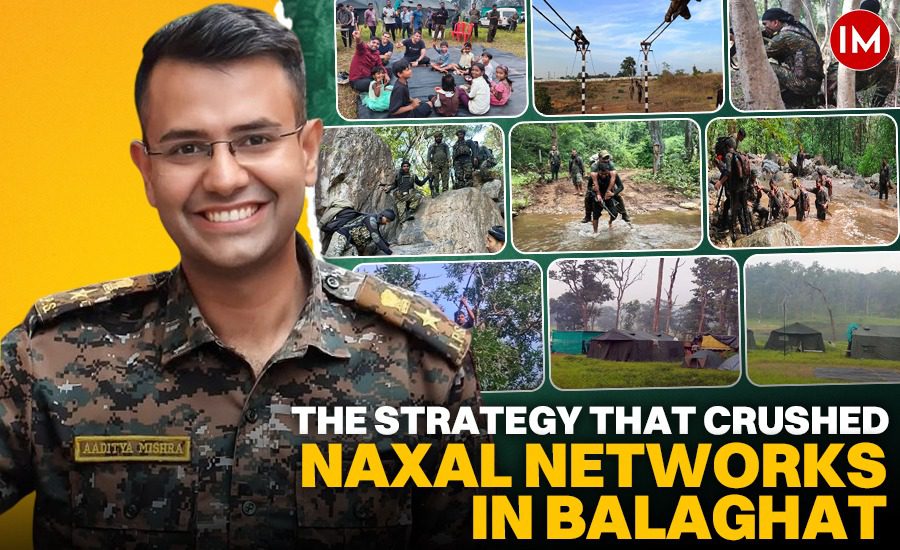
For years, the dense forests of Balaghat, MP, were seen as an advantage for Naxal groups. Thick cover, difficult terrain, poor connectivity, and scattered habitations made it a safe zone. Security forces knew the challenge. But between 2021 and 2025, something changed. The forests did not get thinner – but the State’s grip grew stronger.
What followed was not a single operation. It was a sustained campaign. A mix of intelligence, persistence, and policy push. At the center of it stood the Hawk Force – Madhya Pradesh Police’s elite anti-Naxal unit – and a leadership that decided to move from reaction to domination.
THE TERRAIN THAT TESTED THEM
Balaghat is not easy ground. Forests stretch across hundreds of square kilometers. Villages are remote. Roads were limited. During monsoon, movement becomes even harder. Rivers swell. Tracks disappear.
For Naxals, this was an advantage. They used forest patches and riverine pockets to hide. They moved across state borders—Madhya Pradesh, Maharashtra, and Chhattisgarh – using familiar routes.
For the forces, the first challenge was basic: find them.
Read Also: Radha: The Rewilded Tigress Who Brought a Forest Back to Life
“Identifying and locating them in time is the biggest challenge. Delayed intelligence has no operational value,” says Aditya Mishra, an IPS officer of 2018 batch and Superintendent of Police, Balaghat.
Mishra, a 2018-batch IPS officer of the Madhya Pradesh cadre, has been serving in the region for six years. His experience shows in the clarity of his approach.
INTELLIGENCE THAT WORKS IN REAL TIME
Earlier, intelligence often came late. By the time inputs were verified, targets had moved. This gap was reduced.
The focus shifted to real-time, actionable intelligence. Multiple agencies worked together—local police, intelligence bureau, Hawk intelligence units, and central forces.
This “whole-of-agency” approach changed outcomes.
“We moved from sharing information to owning the mission. Everyone was accountable,” Mishra explains.
This meant faster decisions. Shorter cycles. Immediate action.
HAWK FORCE: THE FRONTLINE EDGE
At the heart of operations was the Hawk Force. Agile. Young. Locally trained.
Company commanders were often Deputy Superintendents of Police. Young officers. High energy. Backed by experience.
Operations were frequent. Not occasional.
In 2025 alone, over 4,104 search operations were conducted. This marked a sharp rise from 3,290 in 2024 and 3,758 in 2022.
Hawk Force-led operations also increased significantly—reaching 2,766 in 2025.
This was not just about numbers. It was about pressure.
Continuous movement meant Naxals had little time to regroup.
OPERATION MONSOON: BREAKING THE SEASONAL BARRIER
Monsoon used to slow down anti-Naxal operations. Not anymore.
In 2025, forces decided to operate through the rains.
Slippery hills. Mud. Lightning risks. Yet operations continued.
During one such mission, three Hawk Force जवान were injured due to lightning. But the campaign did not stop.
The result: 1,029 operations during monsoon 2025 – a 27% increase compared to 2023.
Cordon and Search Operations (CASO) were also introduced. Large areas were sealed and searched inward.
Nine major CASO missions were successfully conducted.
“Operations cannot stop because of weather. That’s when they expect us to slow down,” Mishra says.
CAMPS THAT CHANGED CONTROL
Presence matters. And presence comes from camps.
Between 2022 and 2025, the number of camps expanded rapidly. From around 46–50 camps, forces moved deeper into forest zones.
Temporary camps were set up. Generators installed. Basic infrastructure created.
Each camp pushed the operational boundary further.
Forces cleared one zone. Set up a camp. Then moved ahead.
This gradual expansion reduced Naxal movement corridors.
CUTTING THE FINANCIAL LIFELINE
Another key challenge was the financial backbone of Naxals.
Estimates suggested a significant cash flow sustaining their activities.
To counter this, strict measures were introduced.
A no-cash policy was enforced in sensitive zones. Checkposts were increased. Movements monitored.
Suspicious cash movement triggered questioning.
This disrupted supply chains.
Villages that once supported Naxals began stepping back.
Through intelligence efforts, 45 Naxal collaborators were identified. Legal action was taken under UAPA and other laws.
The result: shrinking local support.
MAJOR HITS AND SURRENDERS
Operations began to show results.
Since 2022, 23 hardcore Naxals have been neutralized. Three were arrested.
In 2025 alone, 10 Maoists were killed in Balaghat and Mandla. Combined reward value: ₹1.46 crore.
Several key figures surrendered.
- Special Zonal Committee Member Vikas retreated after an encounter
- Central Committee Member Ramdher fled and later surrendered in Khairagarh
- KB Division leader Kabir surrendered in Balaghat
In total, 13 Naxals surrendered in 2025.
One of the biggest breakthroughs was the neutralization of Madkam Hidma alias Chaitu, a key Maoist operative.
Each strike weakened the network.
THE DEADLINE THAT CHANGED MOMENTUM
A major shift came from the top.
The Chief Minister, who also holds the Home portfolio, set a clear deadline—to clear the region.
Reviews were frequent. Every 15 days.
This created urgency. Coordination improved.
Departments aligned faster. Infrastructure gaps were addressed quickly.
“Deadlines create clarity. Everyone knows what needs to be done and by when,” Mishra notes.
Connectivity improved. Roads were built. Mobile towers came up.
This was not just policing. It was governance.
KEEPING THE FORCE MOTIVATED
Operations are tough. Success is not guaranteed every time.
Teams entered forests repeatedly. Sometimes 10–15 times a year. Not every mission led to contact.
Keeping morale high was critical.
Young officers brought energy. Senior officers brought experience.
“It’s always a mix of experience and youth energy. That balance matters,” Mishra says.
Brotherhood within camps helped. Isolation was real—many areas had no mobile connectivity. Satellite phones were the only link.
Yet the force stayed committed.
DEVELOPMENT AS A FORCE MULTIPLIER
Operations alone cannot end insurgency. Development followed.
Roads, bridges, and communication towers reached remote areas. Employment schemes were introduced. Youth engagement improved.
Special Central Assistance funds supported infrastructure growth.
Villages began to see change. Support for Naxals declined.
A CAMPAIGN, NOT A MOMENT
By 2025, Balaghat was no longer what it was.
Operations increased by over 25–26% compared to previous years.
Presence expanded. Intelligence improved. Networks weakened.
But officers remain cautious.
“This is not an end. It’s a phase. Pressure has to be maintained,” Mishra says.
THE ROAD AHEAD
Balaghat’s story is not just about encounters.
It is about persistence. Systems. Coordination.
It shows what happens when intelligence, force, and governance align.
The forests remain. The terrain remains tough.
But control has shifted.
And for the first time in years, the advantage is no longer with those hiding in the shadows.
Read Also: Civil Services Day Special: Evolution, Impact and Future of India’s Steel Frame