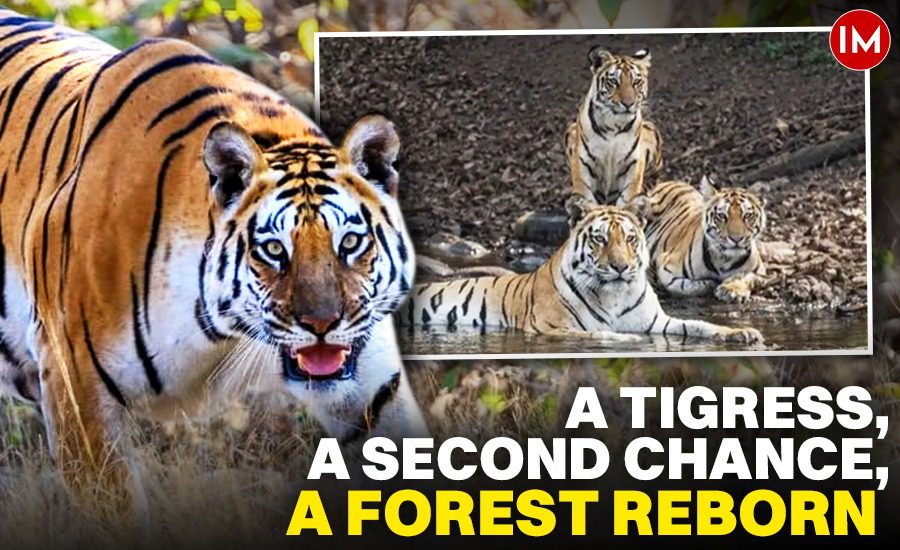
She was never meant to survive. Born into the wild, orphaned too early, and nearly erased by poison, Tigress N-1’s (fondly called as Radha) story could have ended before it truly began. Instead, she rewrote her fate. Today, deep within Madhya Pradesh’s forests, this once-rejected tigress stands as a symbol of resilience—her legacy echoing through the roars of the many cubs she has brought into the wild.
A CHILD OF TRAGEDY
N-1’s story begins in loss. She was born in 2015 in Pench Tiger Reserve to the well-known Baghin Nala tigress. Her early days were cut short by tragedy when her mother was poisoned. Two of her siblings died alongside their mother. Radha and one other cub survived.
Forest officials rescued the two surviving cubs with great difficulty. But survival in captivity is not the same as survival in the wild. The odds were stacked against them. One cub died soon after. Radha was the only one left.
Also Read- Once in the race to become India’s national bird, today is on the brink of extinction
THE REWILDING EXPERIMENT
At the time, orphaned tiger cubs were usually sent to zoos. They would never return to the wild. But Madhya Pradesh had begun experimenting with a different approach—rewilding.
Radha was moved to the Ghorela enclosures near Kanha. These enclosures were designed to mimic the wild while keeping human contact to a minimum. The system had three stages: a small quarantine space for cubs aged three months to one year, an 11-hectare carnivore-proof enclosure where they learned hunting basics, and a 35-hectare herbivore zone stocked with prey like chital.
Here, N-1 learned to hunt. She learned to survive. Most importantly, she learned to stay away from humans. “Rewilding is about giving Orphaned tiger cubs a second chance without human dependence. Radha’s journey proves that it can work,” says Shubhranjan Sen, Principal Chief Conservator of Forests, Madhya Pradesh. The 1991 batch IFS officer is the Head of Forests in Madhya Pradesh.
REJECTED, THEN REBORN
At one point, Radha was even considered for relocation to Odisha’s Satkosia Tiger Reserve. But she was turned down. Officials there wanted a fully wild tiger, not one raised through rewilding.
That rejection changed everything.
Instead, on April 18, 2018, Radha was released into Nauradehi Wildlife Sanctuary in Madhya Pradesh as part of a tiger reintroduction project. At the time, tigers had nearly disappeared from the region.
Radha was stepping into an empty forest. [A male, N2 was released at the same time]
THE MOTHER OF NAURADEHI
What followed is nothing short of extraordinary.
Radha adapted quickly to her new home. She established territory, found a mate, and began raising cubs. Over the years, she has given birth to more than 15 cubs—many estimates suggest even higher numbers.
Today, a significant portion of the tiger population in the region traces back to her. Nauradehi, now part of the Veerangana Durgavati Tiger Reserve, has seen its tiger numbers rise to around 30. Much of that growth is credited to Radha and her lineage.
She is now widely known as the “Mother of Nauradehi Tigers.”
“Her success is not just about numbers. It is about proving that even rewilded tigers can thrive, reproduce, and sustain/re-establish populations in the wild,” adds Shubhranjan Sen.
A MODEL FOR CONSERVATION
Radha’s journey has reshaped thinking around wildlife conservation in India. For decades, experts believed that orphaned cubs could never truly return to the wild. They lacked the skills, the instincts, and the independence needed to survive.
Radha proved otherwise.
Her life shows that with the right environment and minimal human interference, even vulnerable cubs can reclaim their place in nature. The Ghorela model—focused on isolation, natural training, and gradual exposure—has now become a benchmark for similar efforts.
THE LEGACY CONTINUES
Today, Radha is around 11 years old—a good age for a tigress in the wild. She has lived longer than many expected. More importantly, she has ensured that her lineage continues.
Her cubs roam the forests she once entered as a stranger. They hunt, survive, and raise families of their own. The forest that was once silent now pulses with life.
Radha’s story is not just about survival. It is about transformation.
In the dense wilderness of Nauradehi, Radha’s presence is more than biological—it is symbolic. She represents a shift in how we understand conservation, resilience, and second chances. Once rejected and nearly lost, she became the very force that revived a dying landscape.
Her journey reminds us that sometimes, survival is not just about instinct—it is about opportunity.