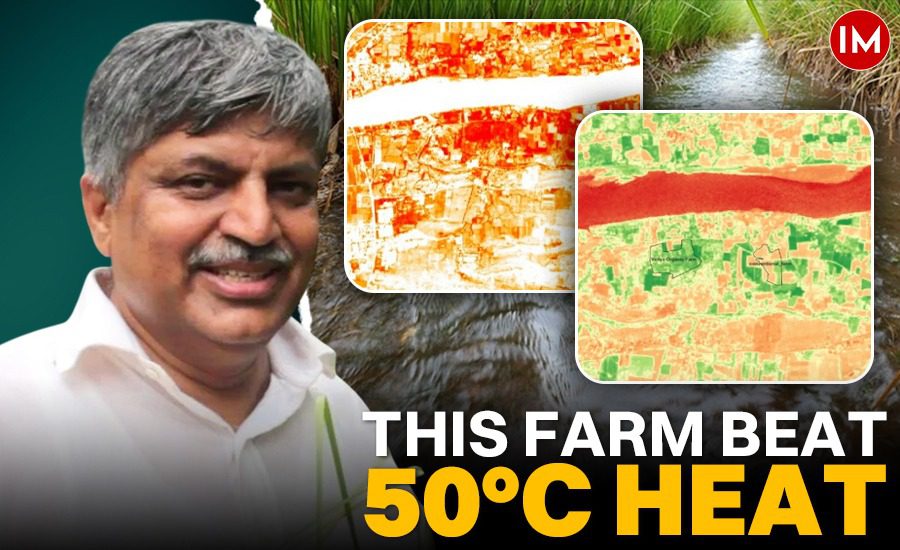
On the sun-scorched plains near Khalghat in Madhya Pradesh, where summer temperatures routinely hover between 48°C and 50°C, a 14-hectare patch of land has quietly rewritten what is possible.
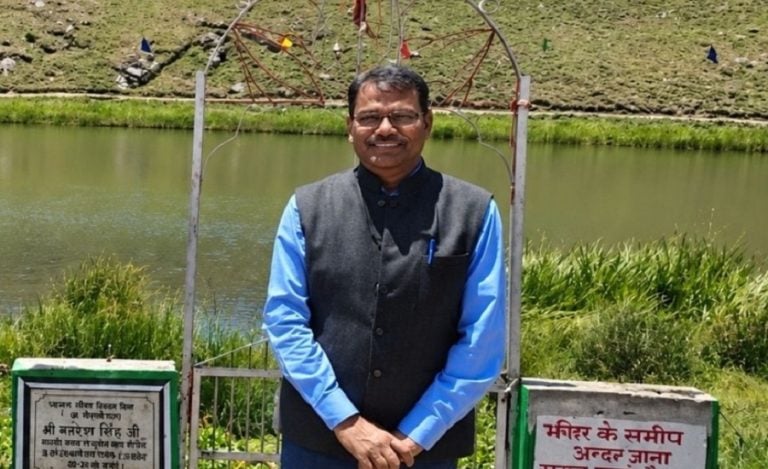
This is Vanya Organic, a dense, multi-layered food forest grown over two decades by retired IRS officer Patanjali Jha, Principal Chief Commissioner of Income Tax, Mumbai (retired), 1986 batch.
What makes this story extraordinary isn’t just the transformation from barren land to thriving forest. It’s the fact that satellites, not anecdotes, are now telling the story.
A 25-year thermal analysis using Landsat data (2000–2024), processed through Google Earth Engine, shows something startling:
The land inside Vanya has cooled by nearly 9°C purely because of the forest that now stands there.
“When we began, this land had no advantage over its surroundings. Whatever has changed has changed because of what we added to it: trees, diversity, and patience,” shared Jha in an exclusive conversation with Indian Masterminds.
THE SMOKING GUN
The most powerful detail in the entire study isn’t the 7°C cooling seen today; it’s the near-zero difference at the beginning.
Between 2000 and 2003, before the forest matured, Vanya’s land surface temperature was almost identical to the surrounding semi-arid landscape. The cooling effect stood at a negligible +0.07°C.
That number changes everything.
It proves that the cooling observed today is not due to geography, soil, or water access. It is entirely the result of the food forest itself.
From there, the story unfolds like a slow, steady curve:
- 2005–2012: Cooling rises to ~2.83°C
- 2013–2024: Averages 6.38°C cooler
- 2020–2024: Peaks at 7.32°C, touching 8°C in 2020
Meanwhile, surrounding temperatures stayed constant at 48–50°C.
Inside Vanya, the land cooled from ~50°C to ~41°C.
GROWING A MICROCLIMATE, LAYER BY LAYER
This cooling didn’t happen overnight. It grew with the forest.
What began around 2004 as degraded, arid land near the Narmada River has evolved into a dense ecosystem of tens of thousands of trees – mango, moringa, papaya, citrus, neem – along with rich understorey diversity.
No tilling.
No chemical fertilisers.
No pesticides, not even organic ones.
Just leaf fall, biomass, and natural cycles.
Inspired by Masanobu Fukuoka’s no-till philosophy and Bhaskar Save’s natural farming approach, Jha built a system where nature does the heavy lifting.
The science behind the cooling is clear:
- Thick canopy blocks direct solar radiation
- Leaves release moisture through evapotranspiration
- Deep roots access hidden soil water
- Continuous ground cover retains moisture
- Massive biomass stabilises temperature swings
Each year, as the canopy thickened, the cooling intensified.
And even now, the curve hasn’t flattened.
A FOREST THAT STORES CARBON LIKE AN OLD-GROWTH SYSTEM
Cooling is only part of the story.
Satellite-based carbon analysis reveals that Vanya is also a powerful carbon sink:
- 201.10 metric tons CO₂ per hectare — among the highest for tropical dry regions
- 2,850.54 metric tons CO₂e stored in the 14-hectare forest
- 116.59 Mg/ha biomass density, exceeding typical old-growth dry forests in Central India
And this is only above-ground biomass. Including roots and soil, actual carbon storage could be 30–50% higher.
Using 114 cloud-free Sentinel-2 images, the estimates are not guesses; they are consistent, multi-season measurements.
WHAT SATELLITES SAW ACROSS THREE DIMENSIONS
Three independent satellite analyses — vegetation (NDVI), temperature (LST), and moisture (NDMI) — converge on one conclusion:
Vanya is fundamentally different from everything around it.
- Greenness: Even in peak summer, NDVI stays at 0.59 while nearby farms drop to 0.32
- Temperature: 6–8°C cooler than the surroundings in peak summer
- Moisture: Strong positive moisture index, even in April
Three different satellites.
Three different physical measurements.
One consistent story.
UNDERGROUND ENGINEERING AT WORK
Beyond satellites, observations on the ground reveal another fascinating layer: vetiver grass.
Planted along bunds and low-lying areas, vetiver has developed deep, complex root systems that may be silently transforming water dynamics.
After heavy rains, exposed root networks show lateral spread and dense microbial activity. These roots:
- Channel water deep underground
- Prevent soil erosion
- Possibly create natural sub-surface irrigation pathways
Jha has seen its impact firsthand.
“In low-lying areas that used to remain submerged, once vetiver is established, everything survives: lemons, pink pepper, and even black turmeric,” he explains.
“No till, no chemicals, and yet plants thrive. The only explanation is what is happening underground.”
In some parts of the farm:
- Lemon trees have grown over 10 feet tall
- Tubers like black turmeric flourish
- Sheesham trees have appeared naturally, carried by birds
A MODEL FOR INDUSTRY AND CLIMATE POLICY
The implications go far beyond one farm.
If a 14-hectare food forest can:
- Cool land by up to 8°C
- Store thousands of tons of carbon
- Retain moisture in peak summer
…then scaling this approach could redefine climate action.
Jha believes this could become a practical pathway for industries.
“Instead of only talking about emissions, we should aggressively green the land around industrial zones. This is one of the fastest ways to move towards net zero,” he told Indian Masterminds.
Imagine:
- Factories offsetting emissions through dense food forests
- Surrounding landscapes are cooling down
- Groundwater stress is reducing over time
This is not theoretical. It is already visible… from space.
REWRITING WHAT A FARM CAN DO
For decades, conventional agriculture in semi-arid India has followed a familiar pattern: till, irrigate, extract.
Vanya flips that model.
It doesn’t just produce food.
It cools land.
It stores carbon.
It holds water.
And most importantly, it shows that transformation is measurable, not just visible.
The most striking part of this story isn’t any single number.
It’s the fact that 25 years ago, this land was no different from the dry fields around it. Today, it has its own climate.