India’s renewable energy story is no longer one of ambition alone—it is increasingly one of delivery. Over the past decade, the country has transformed its power landscape, emerging as one of the fastest-growing clean energy markets in the world. Yet, as India races toward its climate commitments, the real test lies not just in adding capacity, but in building a system that can absorb, distribute and sustain it.
As of late 2025, India’s renewable energy capacity has crossed 250 GW, including solar, wind, bioenergy and small hydro. When large hydro and nuclear are included, total non-fossil capacity stands at over 260 GW—more than 51% of installed power capacity, a milestone achieved five years ahead of the 2030 target.
At the heart of this transformation is solar energy. India’s solar capacity alone has surged past 130 GW, growing more than 40% in just a year, while wind power has crossed the 50 GW mark. The pace of expansion has been equally striking: in 2025, India added a record 44–48 GW of renewable capacity, nearly doubling the previous year’s additions.
Targets and How Close India Is
India’s renewable journey has been shaped by bold targets. The first major milestone—175 GW of renewable capacity by 2022—was narrowly missed, highlighting early bottlenecks in land acquisition, financing and transmission.
However, the focus has since shifted to a far more ambitious goal: 500 GW of non-fossil fuel capacity by 2030, including solar, wind, hydro and nuclear.
Today, India appears to be back on track. With over 250 GW already installed and more than 150 GW under implementation or tendered, the pipeline suggests that the country needs to add roughly 35–40 GW annually to meet the target. The current pace of additions indicates that this is achievable, provided systemic challenges are addressed.
Also Read- How Two IAS Officers Reunited A Missing Maharashtra Grandma with Her Family After Two Years
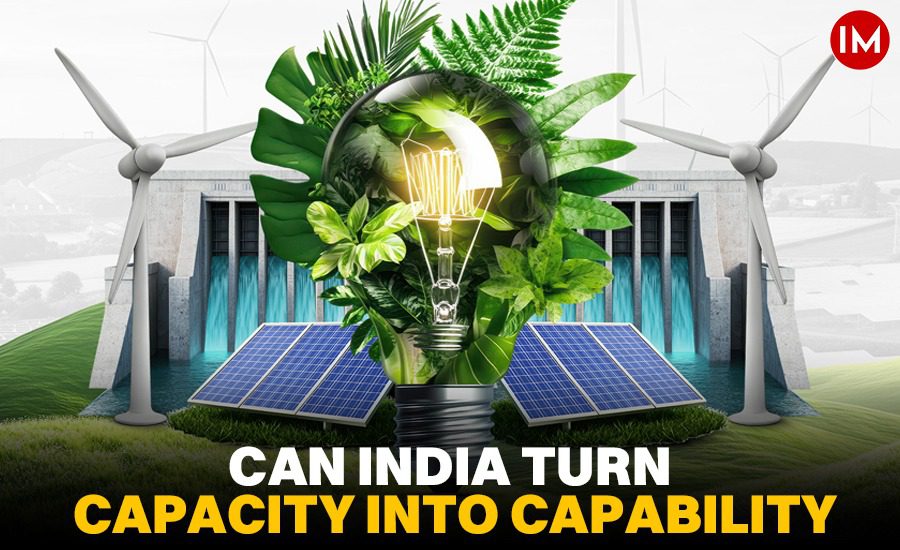
The Real Challenge: From Capacity to Capability
The next phase of India’s renewable journey is less about adding megawatts and more about integrating them effectively. One of the biggest hurdles is grid readiness. Renewable energy is inherently variable—solar generation peaks during the day, while wind patterns fluctuate seasonally.
This creates a mismatch between supply and demand, especially during evening peak hours. As a result, India is increasingly investing in battery storage systems, pumped hydro projects and hybrid renewable plants to ensure round-the-clock supply.
Transmission infrastructure is another bottleneck. A large share of renewable capacity is concentrated in states like Rajasthan and Gujarat, while demand centres are spread across the country. Delays in transmission lines and grid connectivity have, at times, left projects stranded.
Financing also remains a critical constraint. According to recent estimates, India may require over $145 billion in investment by 2035 to sustain its clean energy transition. Access to low-cost, long-term capital is essential for scaling up renewable projects.
Policy Push and Course Correction
Recognising these challenges, the government has recalibrated its approach. The focus is now on quality of power, not just quantity.
New renewable tenders increasingly mandate energy storage integration, ensuring that projects can supply power even after sunset. The Production Linked Incentive (PLI) scheme is strengthening domestic manufacturing of solar modules, reducing dependence on imports.
At the same time, investments in transmission—particularly under the Green Energy Corridor programme—are being accelerated. There is also a push towards green hydrogen, which could become a major driver of renewable demand in sectors like steel and fertilisers.
India in the Global Context
Globally, renewable energy is expanding at an unprecedented pace. In 2025, global renewable capacity reached over 5,100 GW, accounting for nearly half of the world’s total electricity capacity.
However, the growth is uneven. China remains the undisputed leader, contributing nearly two-thirds of new global capacity additions, particularly in solar.
The United States and the European Union have also accelerated investments, driven by policy frameworks like the Inflation Reduction Act and Green Deal.
India, meanwhile, stands out as a high-growth, cost-competitive market, ranking among the top four globally in solar, wind and overall renewable capacity. Its solar tariffs are among the lowest in the world, making renewables economically viable even without heavy subsidies.
On the other hand, several regions—particularly parts of Africa, Latin America and Southeast Asia—remain laggards due to financing constraints, weak grid infrastructure and policy uncertainty. These disparities highlight a larger global challenge: while renewable technology is advancing rapidly, its adoption remains uneven.
The Road Ahead
India’s renewable energy journey is entering a more complex phase. The country has demonstrated that large-scale deployment is possible. The next challenge is to build a flexible, resilient and integrated energy system.
This will require synchronised progress across multiple fronts—generation, transmission, storage and distribution. It will also demand deeper reforms in the power sector, particularly in financially stressed distribution companies.
What sets India apart is its ability to pursue growth and sustainability simultaneously. The renewable transition is not just about reducing emissions; it is about energy security, economic resilience and technological leadership.
As the world grapples with climate change and energy volatility, India’s experience offers a powerful lesson: the future of energy lies not in choosing between development and sustainability, but in achieving both together.
Also Read- How IAS Tulika Prajapati’s ATHR Initiative Is Transforming Child Nutrition in Chhattisgarh