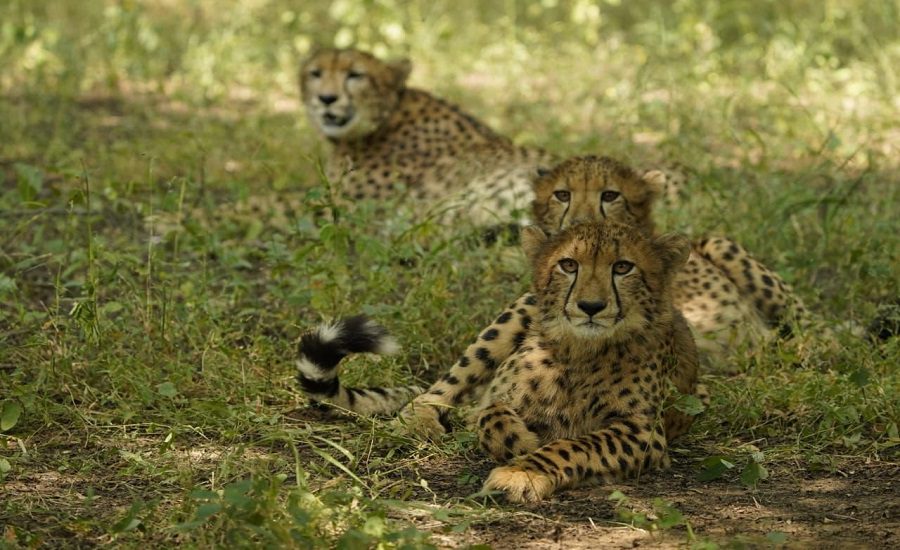
India’s ambitious Project Cheetah, often celebrated as a landmark wildlife restoration success, has come under fresh scrutiny after an official inspection report revealed that cheetahs at Kuno National Park were tranquilised 110 times within the first two years of the programme.
The revelation has triggered concerns among wildlife experts and conservationists, who warn that repeated chemical immobilisation could have long-term physiological consequences for the animals.
Also read: Kuno National Park Shock: 4 Cheetah Cubs Found Dead Near Den in MP; Predation Suspected
Inspection Report Reveals High Number of Tranquilisations
According to a 2024 inspection report prepared by then Principal Chief Conservator of Forests (PCCF) and Chief Wildlife Warden of Madhya Pradesh, V.N. Ambade, cheetahs in Kuno National Park had undergone 110 tranquilisation procedures by September 2024.
The report records discussions with veterinary officials associated with the project, including Dr. Jitendra Jatav, who informed the inspection team that he had successfully tranquilised cheetahs 110 times up to that point.
The figure covers a period of just two years since the launch of Project Cheetah in September 2022.
Concerns Over Repeated Chemical Immobilisation
Wildlife experts caution that while tranquilisation is a routine conservation and wildlife management tool, excessive use can place significant stress on cheetahs, a species known for its sensitivity to capture-related procedures.
Research studies conducted globally have highlighted risks including respiratory complications, elevated blood pressure, hyperthermia, stress responses and other physiological challenges associated with repeated immobilisation.
Conservationists argue that the frequency of interventions raises important questions about animal welfare and long-term health monitoring.
Forest Officials Defend the Practice
Officials associated with Project Cheetah maintain that all standard veterinary protocols are being followed during immobilisation procedures.
According to park authorities, tranquilisation has often been necessary for transporting animals, shifting them between enclosures, conducting medical examinations and relocating cheetahs that move beyond designated management areas.
Officials stress that trained veterinary teams closely monitor the animals before, during and after each procedure to minimise risks.
Project Cheetah’s Expanding Population
Project Cheetah began in September 2022 with the arrival of eight cheetahs from Namibia. A second batch of twelve cheetahs arrived from South Africa in February 2023 under an international conservation agreement.
Despite early setbacks and animal deaths, the programme has recorded several breeding successes.
As of 2026, India’s cheetah population has reportedly grown to 57 individuals, housed primarily in Kuno National Park in Madhya Pradesh and Gandhi Sagar Wildlife Sanctuary.
Experts Seek Greater Transparency
Veteran conservationist M.K. Ranjitsinh, widely regarded as the architect of Project Cheetah and one of India’s foremost wildlife policymakers, has called for greater transparency regarding the reasons behind each tranquilisation.
He has suggested that authorities publicly disclose which animals were immobilised, how often they were sedated and for what purposes.
According to conservation experts, many interventions have occurred because cheetahs moved beyond designated park boundaries, highlighting the need for larger habitats, stronger landscape connectivity and improved prey availability.
Balancing Conservation Success with Animal Welfare
While Project Cheetah remains one of the world’s most closely watched wildlife reintroduction programmes, the latest findings have intensified debate about balancing conservation goals with animal welfare considerations.
Experts agree that reintroducing cheetahs to India remains a historic conservation achievement. However, they argue that long-term success will depend not only on population growth but also on ensuring that management practices prioritise the health, welfare and natural behaviour of the animals.
As India’s cheetah population expands, the discussion around tranquilisation practices is likely to remain an important part of the project’s evolving conservation strategy.
In another news, Kuno National Park’s cheetah population in the wild received a boost on Saturday as female cheetah Nirva and her three 13-month-old cubs—two males and one female—were released from their enclosure into the open forest. The release, carried out in the Ahera tourism zone of the Palpur East Range, has increased the number of cheetahs roaming freely in Kuno to 20. Forest officials described the move as a significant milestone for Project Cheetah, with the animals continuing to be monitored through radio telemetry and dedicated tracking teams.
Also read: Project Cheetah Enters New Phase as Young Male Cheetahs Expand Range Beyond Kuno, Raising Conservation Questions