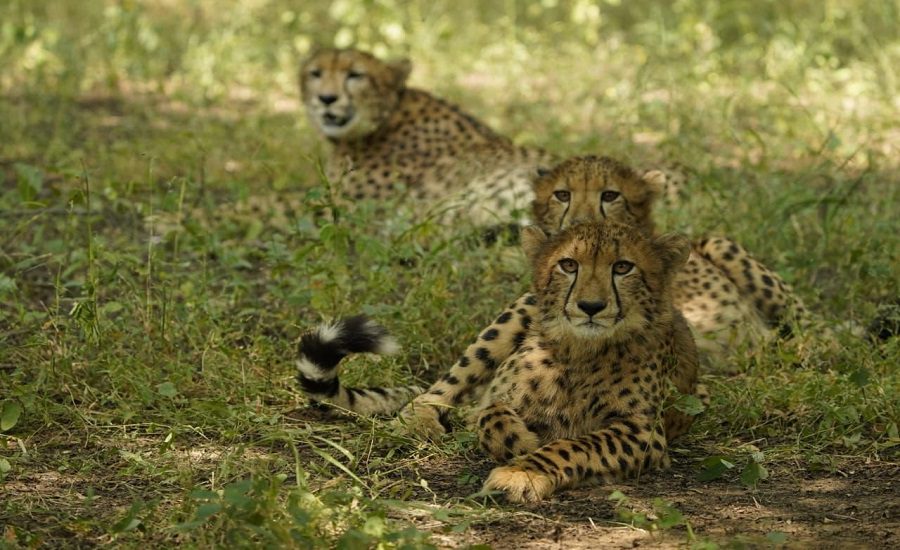
Bhopal/Jaipur: A young male cheetah from India’s flagship wildlife programme Project Cheetah has drawn fresh attention to conservation challenges after travelling nearly 150 km from Kuno National Park in Madhya Pradesh to Ranthambore Tiger Reserve in Rajasthan.
The cheetah, identified as KP-2, spent weeks moving through Ranthambore’s tourist zones before being tranquilised and brought back to Kuno. The long-distance movement has raised new questions about the feasibility of establishing a stable free-ranging cheetah population in India.
KP-2’s Long Journey and Rare Wildlife Sightings
KP-2’s dispersal was not an isolated event, but it marked one of its longest recorded movements. During its stay in Ranthambore:
- The cheetah explored territory for over a month
- Entered high-visitor tourist zones
- Triggered a rare “triple sighting” of a tiger, leopard, and cheetah in one landscape
Eventually, the animal was captured and returned to Kuno shortly before an official visit by the Madhya Pradesh Chief Minister.
What Project Cheetah Aims to Achieve
Launched in September 2022, Project Cheetah aims to reintroduce African cheetahs in India after their extinction in the country decades ago. The broader goal is to:
- Establish a free-ranging cheetah population
- Restore grassland and savanna ecosystems
- Promote biodiversity in open natural habitats
However, repeated movements of cheetahs outside designated areas are raising questions about whether the current model aligns with natural cheetah behaviour.
“Released into the Wild” or Constantly Retrieved?
KP-2 is among several cheetahs that have been released into the wild at Kuno National Park, but not all movements have gone as planned.
Key concerns include:
- Cheetahs frequently leaving Kuno boundaries
- Animals being tranquilised and brought back multiple times
- Official reports describing such interventions as “rescues”
- Uncertainty over what “rewilding” truly means in practice
KP-2 itself has been returned to Kuno on multiple occasions after dispersal attempts.
Predator-Dense Landscape Raises Survival Risks
Experts point out that Ranthambore and surrounding regions are dominated by apex predators, making survival difficult for cheetahs.
- Ranthambore has around 70 tigers (as per 2022 estimates)
- Presence of leopards increases competition and risk
- Cheetahs are naturally adapted to open grasslands, not dense predator zones
Wildlife experts say such landscapes significantly reduce the survival chances of cheetahs.
Habitat Size and Ecology Limitations in Kuno
Kuno National Park, spread across about 748 sq km, is considered by experts to be only marginally sufficient for a small number of cheetahs.
Key ecological concerns include:
- Large home range needs of cheetahs (up to 1,000 sq km)
- Low natural cheetah density requirements
- Limited open grassland habitat compared to African ecosystems
- Fragmented wildlife corridors connecting multiple reserves
Experts argue that India’s mixed forest landscapes may not fully match cheetah ecological needs.
High Mortality and Breeding Challenges
Since the beginning of the project:
- Several imported cheetahs and cubs have died
- Only one known free-ranging breeding attempt succeeded (KGP-12), whose cubs were later lost to predation
- Majority of cheetahs are still in enclosures
- Total population stands at around 53 cheetahs in India
These developments highlight ongoing challenges in survival and adaptation.
Frequent Monitoring and “Rescue” Operations Under Debate
All free-ranging cheetahs at Kuno are:
- Radio-collared
- Continuously monitored by dedicated field teams
- Accompanied by trackers and forest staff
When cheetahs move outside Kuno, they are often captured and returned, especially when crossing into neighbouring states where jurisdictional issues arise.
This has sparked debate over whether the animals are truly free-ranging or effectively managed in controlled movement cycles.
Experts Flag Habitat and Prey Limitations
Wildlife scientists highlight that successful cheetah conservation depends on:
- Large open grassland ecosystems
- Adequate prey such as antelope-sized species (20–30 kg)
- Low predator competition zones
- Long-term habitat restoration planning
Experts also stress that India must better recognize open ecosystems as conservation priorities rather than “wastelands.”
Project Cheetah at a Critical Crossroads
With KP-2’s extensive movement, rising mortality cases, and delayed annual progress reporting, Project Cheetah faces growing scrutiny over its long-term direction.
As more cheetahs are expected to be introduced in the future, key questions remain:
- Is India ready for a truly free-ranging cheetah population?
- Can existing habitats support their ecological needs?
- What does successful “rewilding” actually look like in the Indian context?