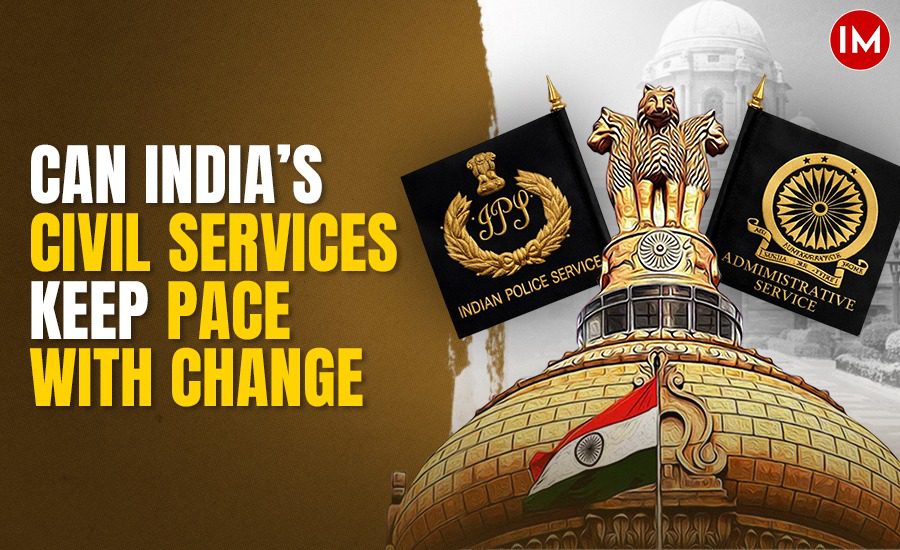
Every year on April 21, India does more than observe a date, it revisits an idea that has held the Republic together through its most testing moments. It was on this day in 1947 that Sardar Vallabhbhai Patel addressed the first batch of administrative probationers at Metcalfe House in Delhi and described them as the “steel frame of India.”,
As Sardar Patel had urged, “A civil servant must remain above all pressures and must serve the nation with complete honesty.” That ideal, however, is no longer tested in quiet files and closed rooms alone, it is tested in the glare of public scrutiny, social media, and instantaneous citizen feedback. Nearly eight decades later, that steel frame stands at a crossroads, tested not just by time, but by the scale, speed, and complexity of a nation that is rapidly redefining itself.
Deep Roots of India’s Bureaucratic Tradition
India’s bureaucratic tradition finds one of its earliest place in Arthashastra, attributed to Kautilya or Chanakya. Far from being a mere political manual, it laid out a remarkably detailed framework of governance covering taxation, espionage, public welfare, accountability, and ethical conduct of officials.
During the Mauryan period under Ashoka, governance evolved into a moral enterprise. Officers such as Rajukas and Mahamatras were not only tasked with administration but also with ensuring welfare and justice. The Gupta era introduced decentralisation, empowering local officials like Vishayapatis and Gramikas. This trend found even stronger expression in southern India under the Cholas, where village assemblies- Sabhas and Ur, functioned as vibrant institutions of grassroots governance.
Read More : IAS Saurabh Katiyar’s Model of Good Governance: Compassion, Efficiency, and Real Impact
Also in Medieval India, the Mughal Empire institutionalised a bureaucratic structure through the Mansabdari system, integrating military and civil administration. Parallelly, Shivaji Maharaj developed a highly structured administrative framework through the ‘Ashtapradhan’, eight ministers responsible for distinct domains.
Colonial Codification and Institutional Rigor
The modern civil service, as it exists today, took shape under British rule. While designed to serve colonial interests, it introduced elements that would later become foundational merit-based recruitment, codified procedures, and administrative hierarchy.
Charles Cornwallis (Governor-General of Bengal from 1786-1793) is often regarded as the architect of the Indian Civil Service. His reforms institutionalised discipline, fixed salaries to curb corruption, and attempted to build a professional administrative class.
The Charter Act of 1853 marked a turning point by introducing open competitive examinations. Though initially exclusionary, it laid the groundwork for meritocratic recruitment. Over time, Indians began entering the service, with Satyendranath Tagore becoming a pioneering figure. Also, institutions like Fort William College and Haileybury College formalised administrative training.
Reinvention After Independence
Post-1947, India faced a critical choice: dismantle the colonial administrative apparatus or reform it. The Constitution-makers chose continuity with transformation.
The creation of All India Services- Indian Administrative Service, Indian Police Service, and Indian Foreign Service, ensured a unified administrative ethos across a federal structure. These services were envisioned as neutral, competent, and committed to the constitution rather than any political regime.
Sardar Patel’s insistence on preserving a strong civil service was rooted in foresight. In a diverse and newly independent nation, administrative continuity was essential for stability. Over decades, this system would guide India through wars, economic transitions, social movements, and democratic churn.
When the System Delivers: Scale, Speed, and State Capacity
If there is one defining feature of the Indian civil services today, it is scale- executing complex policies across a population larger than most continents, often in real time.
The Direct Benefit Transfer (DBT) architecture is perhaps the clearest illustration. Government data indicates that over Rs. 30 lakh crore has been transferred directly into beneficiaries’ accounts since its inception, across more than 300 schemes. Today, DBT reaches hundreds of millions of citizens annually, turning welfare delivery into a precise, technology-driven system rather than a discretionary process.
Also Read- Tough on Crime, Gentle with Citizens: How Nirlipt Rai is Redefining Policing in Rajkot
The COVID-19 vaccination drive further demonstrated administrative capacity under pressure. India administered more than 2.2 billion doses, with the managing registrations, scheduling, and certification in real time. At its peak, CoWIN platform handled millions of vaccinations in a single day, an operational scale that required coordination across over 700 districts, thousands of cold-chain points, and a vast network of health workers.
Sanitation under the Swachh Bharat Mission saw the construction of over 11 crore toilets, taking rural sanitation coverage from below 40% in 2014 to near universal levels within a few years. On the same line, the ‘Aspirational Districts Programme’ covers many underdeveloped districts of India, impacting nearly 25 crore people.
Healthcare access has expanded through Ayushman Bharat, which now covers over 50 crore beneficiaries. Government data shows that tens of millions of hospital admissions have been authorised under the scheme, significantly reducing out-of-pocket expenditure for vulnerable families.
Digital governance has been a force multiplier. India’s e-governance ecosystem now offers over 23,000 e-services across central and state platforms. The CPGRAMS handles over one lakh grievances every month, with improving disposal timelines and citizen feedback integration. The expansion from around 11,500 e-services in 2023 to over 23,000 reflects rapid digitisation of governance.
Other flagship programmes reinforce this scale- the PM Awas Yojana has sanctioned over 3 crore houses for rural and urban beneficiaries. Taken together, these numbers are not just statistics, they represent a structural shift in State capacity. They indicate a governance model where policy intent is matched by delivery capability, where technology enables scale, and where administrative systems are increasingly measurable and accountable.
Innovation at the Cutting Edge: Stories from the Field
The true strength of the civil services lies not in frameworks, but in field-level innovation.
Armstrong Pame’s “People’s Road” in Manipur, built without government funding, remains one of the most remarkable examples of participatory governance.
Kannan Gopinathan earned recognition for his disaster relief work during the Kerala floods, showcasing administrative responsiveness in crisis.

Environmental governance too, has seen innovation, Durga Shakti Nagpal’s crackdown on illegal sand mining highlighted the environmental dimension of administrative responsibility.
In tribal and remote areas, officers like Pradeep Singh Kharola have worked on transport and connectivity reforms, while grassroots administrators across India have quietly transformed districts through nutrition drives, digital literacy campaigns, and women’s self-help group mobilisations.
These examples are not isolated, they represent a pattern of administrative entrepreneurship that often operates beyond headlines.

Fault Lines beneath the Surface
Yet, structural tensions persist.
The balance between political direction and administrative independence remains delicate. Procedural rigidity often slows decision-making. Informal directives risk undermining accountability.
Technology introduces new ethical dilemmas- data privacy, cybersecurity, and algorithmic bias. The civil servant must now navigate not just governance, but the philosophy of governance in a digital age.
Also Read – From Access to Accountability: At Mission IAS Event, Jitendra Singh Redefines What It Means to Serve
Reform as Destiny: Reimagining India’s Civil Services for 2047
If Indian civil services have demonstrated anything over the decades, it is their capacity to endure. But endurance alone will not define the next phase of India’s governance story, adaptation will. As the country moves toward its centenary of independence in 2047, administrative reform is no longer incremental housekeeping; it is a structural imperative. The ambition of a Viksit Bharat demands a civil service that is faster, smarter, more specialised, and deeply aligned with citizen outcomes.
At the centre of this transformation lies Mission Karmayogi, the Government of India’s flagship reform in public administration. Conceived as the National Programme for Civil Services Capacity Building, it marks a decisive shift from a rule-bound bureaucracy to a role-based, competency-driven system. Through platforms like iGOT Karmayogi, civil servants are being trained continuously with emphasis not just on knowledge, but on behavioural change as well: cultivating a “people-first” ethos, strategic thinking, and technological fluency.
This reform, however, is not emerging in a vacuum. It is the decades of institutional thinking. The Second Administrative Reforms Commission (ARC) had, as early as the 2000s, underscored the need for ethical governance, citizen-centric administration, and performance-based evaluation. Mission Karmayogi can thus be seen as a culmination, translating these recommendations into an actionable framework.
In recent years, NITI Aayog has added a sharper edge to this reform narrative. It has repeatedly emphasised that a 21st-century India cannot rely solely on a generalist bureaucracy. Complex sectors ranging from digital technology and climate change to financial regulation require domain expertise. Alongside this, NITI Aayog has advocated for modernised recruitment processes, the creation of central talent pools, and the use of technology to improve both selection and performance evaluation.
Institutionally, this transition is being anchored by bodies like the Department of Personnel and Training, UPSC etc. which seeks to standardise training and align civil service capabilities with national priorities. UPSC, through the recently introduced PRATIBHA Setu connects verified employers with top UPSC aspirants who cleared exams, but missed final selection, offering them new career opportunities.
More importantly, administrative reform cannot succeed in isolation. As policy thinkers and government assessments consistently highlight, the effectiveness of civil services is deeply intertwined with the broader governance ecosystem. Judicial delays, regulatory complexity, and opacity in political processes, all impose limits on administrative efficiency. Reform, therefore, must be systemic, cutting across institutions rather than being confined to bureaucracy alone.
Civil Services Day, in this context, is not merely a celebration of legacy. It is a reminder of unfinished work. The “steel frame” that Sardar Patel envisioned was never meant to be static. It was designed to hold firm under pressure, but also to adapt to changing realities.
Future of Indian Civil Services: Reinvention, not Incrementalism
The next two decades will define not just India’s growth trajectory, but the relevance of its administrative machinery. The future civil servant will not resemble the past.
They will need to be data-literate, technologically fluent, and domain-specialised. Artificial intelligence, climate change, cybersecurity, and global economic integration will demand expertise far beyond traditional generalist roles.
Also Read – How One IAS Officer Reimagined Education in Sawai Madhopur and Earned the CM Excellence Award
The bureaucracy of 2047 will likely be more hybrid, combining career civil servants with domain experts through lateral entry. Decision-making will increasingly rely on data analytics and real-time dashboards. Governance itself will shift from reactive to predictive, anticipating problems before they escalate.
At the same time, ethical complexity will deepen. Civil servants will be required to make decisions not just based on legality, but on questions of data ethics, algorithmic fairness, and long-term sustainability.
Perhaps most importantly, the citizen will no longer be a passive recipient of governance. With digital platforms, social media, and real-time feedback loops, the citizen is becoming an active participant, and sometimes a watchdog.
Moment of Reckoning and Opportunity
India, today stands at a historic intersection, demographically young, technologically advancing, and globally consequential.
The world is watching the “India model” of governance, not just for its scale, but for its ability to deliver in a democracy of this magnitude. Whether that model becomes a benchmark will depend significantly on the quality, integrity, and adaptability of its civil services.
The steel frame has held the Republic together through crises and transitions. But the future will demand more than endurance, it will demand evolution.
Also Read – Mission IAS Redefining Access, Aspiration, and Achievement