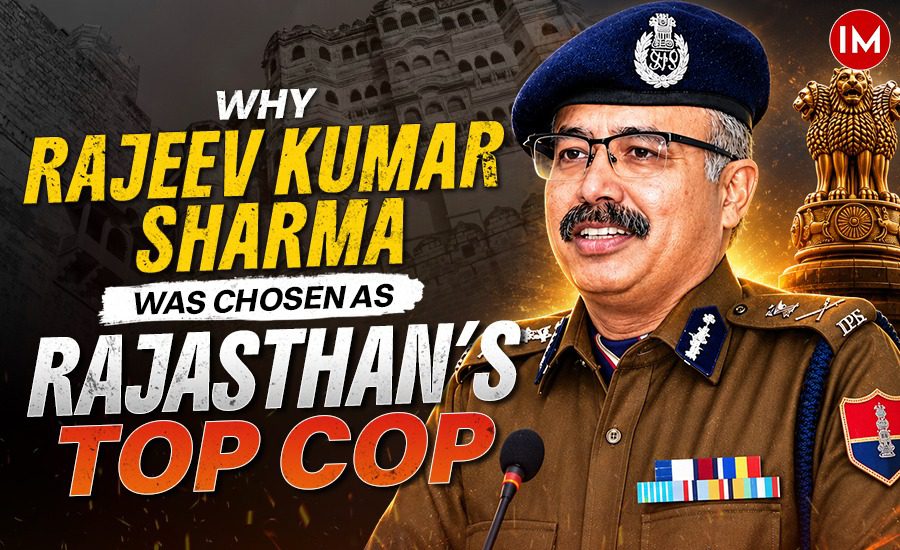
When Rajeev Kumar Sharma walked into the Rajasthan Police Headquarters in Jaipur to assume charge as the 27th Director General of Police (DGP) of Rajasthan, it marked more than just a routine administrative transition. It signalled the arrival of a police officer whose career has been defined by discipline, institutional credibility, field experience, and a reputation for integrity across three decades of public service.
At a time when policing in India is increasingly being tested by cybercrime, organised crime networks, communal sensitivities, public scrutiny, and demands for citizen-centric reforms, Sharma’s appointment is being viewed as an attempt to restore professionalism and continuity at the top of Rajasthan Police.
A 1990-batch Indian Police Service (IPS) officer of the Rajasthan cadre, Rajeev Kumar Sharma took charge in July 2025 after succeeding former DGP Utkal Ranjan Sahoo, who opted for voluntary retirement following his appointment as Chairman of the Rajasthan Public Service Commission.
For Sharma, however, the role represents the culmination of a long administrative journey that moved steadily from district policing to institutional leadership at both the state and national levels.
FROM MATHURA TO THE IPS
Hailing from Mathura in Uttar Pradesh, Rajeev Kumar Sharma entered the IPS through direct recruitment via the UPSC Civil Services Examination in 1990. Officially joining the service on August 20, 1990, Sharma belonged to a generation of officers who witnessed Indian policing evolve through insurgencies, economic liberalisation, technological disruption, and changing public expectations.
Academically, Sharma brought a strong intellectual foundation into policing. He holds an M.A. and M.Phil., qualifications that colleagues often say reflected in his analytical approach to administration and training.
Over the years, Sharma built a career that balanced operational policing with institutional reform. He served as Superintendent of Police in several Rajasthan districts, gaining extensive grassroots policing experience early in his career.
Those years in district policing became critical in shaping his understanding of Rajasthan’s complex law-and-order landscape — from rural crime and caste tensions to border sensitivities and communal management.
Also Read – Bringing the State Closer: Jamnagar Model of Village-Level Governance
A CAREER BUILT ACROSS KEY INSTITUTIONS
Rajeev Kumar Sharma’s administrative journey steadily moved through some of the most important policing assignments in Rajasthan.
He served as Director General of the Anti-Corruption Bureau (ACB), where he earned praise for handling sensitive investigations with transparency and restraint. His tenure, though relatively brief, strengthened his image as an officer with a clean reputation and procedural discipline.
He later headed the Rajasthan Police Academy (RPA) as Director General-cum-Director, overseeing police training and institutional capacity-building. Officers who worked under him often describe his emphasis on discipline, professionalism, and modernisation in training practices.
In 2024, Sharma was elevated as DGP overseeing Administration, Law & Order, Armed Battalions, and the State Disaster Response Force (SDRF), placing him at the centre of Rajasthan’s internal security framework.
Soon after, he moved to the national level on central deputation as Director General of the Bureau of Police Research and Development (BPR&D), New Delhi — one of the country’s premier policing think tanks responsible for police modernisation, research, reforms, and training frameworks.
That assignment significantly widened his exposure to national policing challenges and institutional reforms.
WHY THE GOVERNMENT CHOSE HIM
Rajeev Kumar Sharma’s appointment as Rajasthan DGP came after a detailed selection process involving the Union Public Service Commission (UPSC).
The Rajasthan government had submitted a panel of seven DGP-rank officers to the UPSC. Eventually, the UPSC shortlisted three names — Rajeev Kumar Sharma, Rajesh Nirvana, and Sanjay Agarwal.
Government sources indicated that Sharma emerged as the preferred choice for several reasons.
The first was seniority and experience. Among the shortlisted candidates, Sharma was the senior-most officer with over 36 years of service spanning field policing, anti-corruption work, disaster response, training, administration, and police reforms.
The second was his professional reputation. Within the police establishment, Sharma is often viewed as an officer known for honesty, discipline, and institutional loyalty rather than political positioning.
The third factor was alignment with the Rajasthan government’s administrative priorities. Sources suggested the Bhajanlal Sharma government was looking for a police chief who could combine operational competence with reform-oriented leadership.
Another aspect discussed in political and bureaucratic circles was social representation. Sharma belongs to the OBC category, a factor that carried significance in Rajasthan’s broader political context.
Importantly, his appointment also fulfilled the Supreme Court’s directive mandating a minimum two-year tenure for state DGPs. Sharma is expected to continue in office till mid-2027 unless exceptional circumstances arise.
A POLICE FORCE IN TRANSITION
When Sharma assumed office, Rajasthan Police itself was standing at an important crossroads.
Like police forces across India, Rajasthan Police faces mounting challenges — cyber fraud, narcotics trafficking, organised crime, digital surveillance demands, social media misinformation, and rising public expectations for accountability and responsiveness.
Sharma made his priorities clear soon after taking charge.
He said Rajasthan Police would continue its “glorious traditions” while striving to make the state a model in policing for the country.
“The police team of the State will work with promptness, sensitivity and collaboration to ensure safety and security for all. Every police station will be people-friendly,” Sharma stated after assuming office.
That statement reflected a broader philosophy increasingly associated with modern policing — balancing enforcement with public trust.
AN OFFICER SHAPED BY BOTH FIELD AND POLICY
One of the defining features of Rajeev Kumar Sharma’s career is the unusual balance between field policing and institutional policymaking.
Many officers spend careers largely confined either to operational postings or administrative headquarters. Sharma’s trajectory has consistently moved between both worlds.
From district policing and anti-corruption investigations to disaster management, police training, law-and-order administration, and national police reforms, his career reflects layered administrative exposure.
His honours also mirror that journey.
Sharma received the Police Medal for Meritorious Service in 2006, the President’s Police Medal for Distinguished Service in 2014, and another Police Service Medal recognition in 2021.
Today, as Rajasthan’s top police officer, Sharma carries not only the responsibility of maintaining law and order but also the larger task of steering Rajasthan Police through an era of rapid institutional change.
For Rajasthan Police, his appointment is not merely about seniority. It is about choosing an officer whose career has been built on continuity, credibility, and the belief that policing must evolve without losing its institutional core.
Also Read – Meet Aalin: The 10-Month-Old Organ Donor Behind Kerala’s New School Notebook Campaign