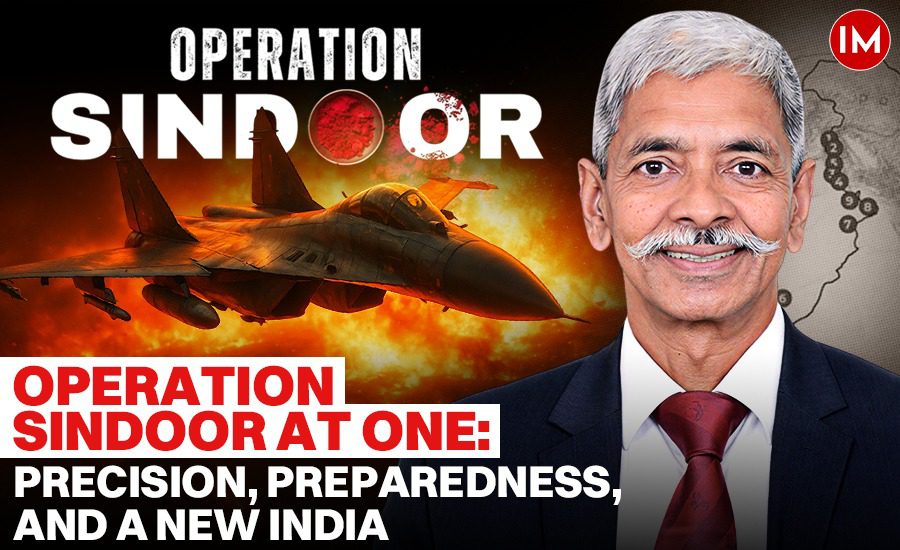
One year on, the valley remembers not just the scars of Pahalgam, but the steel that followed. Operation Sindoor was not a mere response, it was a strategic recalibration.
Anniversaries in military history are not ceremonial markers. They are audit points. They force a nation to ask what did we learn, what did we change, and more importantly, what did we become?
The answers are neither simplistic nor uniform. They are layered. Some visible. Some still unfolding beneath the surface and in the process of making.
Leadership Under Fire: Calm, Calculated, Consequential
Every crisis exposes leadership. Few redefine it.
What stood out in the immediate aftermath of Pahalgam was not outrage that was expected. It was restraint paired with precision. Political leadership avoided the trap of reactive escalation. Military leadership translated intent into calibrated action. That alignment mattered.
Recalling an old military adage which said – “Amateurs talk tactics, professionals study logistics, but leaders decide timing.”
Operation Sindoor was about timing.
The decision cycle shortened. Intelligence loops tightened. Execution windows became sharper. There was no theatrical build-up, no prolonged signalling. Just decisive action.
Did India always have this capability? Yes. But did it always have the political-military synchronisation to employ it this way? Not consistently.
That gap has narrowed now.
Also Read – IAS Saurabh Katiyar’s Model of Good Governance: Compassion, Efficiency, and Real Impact
Civil-Military Fusion: From Parallel Tracks to Converged Intent
Historically, India’s civil-military interface has often been described as functional, but not fully integrated rather tested. Pahalgam was that acid test.
It demonstrated that shift from coordination to convergence.
Intelligence agencies, armed forces, diplomatic channels, and internal security apparatus did not operate in silos. They operated as a grid.
Real-time intelligence was not just collected but was acted upon. Diplomatic messaging was not reactive it was pre-aligned with military outcomes. Internal security measures were not isolated—they were synchronized with external posture.
What changed?
Not structure alone. Mindset and Resilience.
The system moved from “information sharing” to “mission ownership.”
That distinction is critical. Indian Resilience: Beyond Rhetoric, Into Systems
Resilience is often spoken of in emotional terms- public unity, national resolve. But real resilience is infrastructural.
Post-Pahalgam, India invested in layered resilience:
- Border infrastructure accelerated not just roads, but surveillance grids.
- Logistics chains became more agile and decentralised.
- Rapid deployment capabilities improved across sectors.
- Civil defence awareness quietly expanded in sensitive regions.
At the same time, indigenous growth received sharper focus.
Defence procurement narratives shifted from import substitution to capability ownership. Indigenous platforms were no longer symbolic but became operationally relevant.
Drones, surveillance systems, communication networks saw accelerated induction or deployment refinement.
Necessity finally drives strategic clarity.
Zero Tolerance: From Policy Statement to Operational Doctrine
India has long articulated a zero-tolerance stance on terrorism. But articulation and enforcement are not the same.
Operation Sindoor marked a doctrinal shift.
Zero tolerance moved from a stated policy declaration to an executable framework.
Actions executed only reaffirm this strategic shift:
- Response thresholds were lowered; slightest provocation was dealt with decisive action.
- Attribution timelines shortened and accountability established faster
- Retaliation became targeted, specific and visible to the global lens.
- Escalation control mechanisms dovetailed into operational planning
What one witnessed was not aggression but about credibility.
A policy gains weight only when adversaries believe it will be enforced.
The past year, has only reinforced that belief.
Governance, Military Strategy, and National Identity: A Subtle Fusion
There is a deeper understanding required as to how this transformation evolved, often less discussed but more consequential.
Integration of governance, military strategy, and national identity was the ultimate synergy.
Pahalgam was not treated as a standalone security incident. It was framed within a broader narrative of sovereignty, internal stability, and national resolve.
Government messaging, military action, and public communication aligned to reinforce a single idea that India will absorb shocks, but not indefinitely.
This alignment matters because modern conflict is not confined to battlefields. It is cognitive. Informational. Psychological.
National identity becomes both shield and signal.
India, over the last year, has begun to wield this weapon which was long hidden in its armoury.
Twelve Months Later: Has India’s Defence Posture Changed?
Today after the passage of twelve months one can be sure that our defence posture is no longer in a single dimension.
It has evolved across five axes of the battlefield domain:
1. Speed of Response
Decision-making cycles are tighter. The lag between intelligence and action has reduced.
2. Precision Over Volume
Operations are more targeted. Less noise, more effect.
3. Integrated Deterrence
Military, diplomatic, and economic tools are being used in combination, not in isolation.
4. Forward Preparedness
Infrastructure and deployment patterns indicate a shift from reactive defence to anticipatory positioning.
5. Narrative Control
India is shaping the story not just responding to it.
This playbook is your deterrence card. It has to be played every single time.
For deterrence is never permanent. It is maintained, not achieved.
The Global Context: Lessons from the U.S.–Iran Theatre
While India has secured its immediate environment through Operation Sindoor, the global stage remains volatile.
The ongoing tensions between the United States and Iran offer a parallel lesson.
Control of escalation. Strategic signalling. Proxy dynamics. Energy security implications.
These are not distant issues.
They intersect with India’s interests both internal and external.
If the Strait of Hormuz becomes unstable and regional conflicts expand, supply chains react and trades suffer as strategic space narrows.
India therefore must afford to remain regionally focused.
Operation Sindoor secured a frontier. Business of the future demands a wider spectrum and will dictate that we think more about theatres and not about borders.
Strategic Imperatives
The past year has shown progress and not permanence. A clarion call for a strategic overhaul
has been sounded with three imperatives standing out:
First—Institutionalise Integration
Civil-military convergence must move from crisis-driven to structurally embedded fusion.
Second—Accelerate Indigenous Capability
Not just production create innovation ecosystems as technology cycles shrink and get outdated faster.
Third—Expand Strategic Reach
From the Indian Ocean to Pacific Ocean to West Asia and beyond our engagement must be proactive, not episodic.
Strategic needs of today, has to be met with both patience and clarity.
Reflections That Linger On
A year after Pahalgam, India is not the same.
Stronger? Yes.
More prepared? Certainly.
Finished evolving? Final lap is still far away.
“Victory is not the end state. Preparedness is.”
Operation Sindoor was just the transition that mattered.
India had demonstrated that it can respond with precision, absorb with resilience, and adapt with intent.
But the real test lies ahead.
Because in an era where local conflicts are tied to global machinations, securing borders is only your first move, mastering the wider strategic chessboard requires synchronous and seamless game play.
India’s campaign has just begun.
Also Read- Beyond the UPSC Dream: How Pratibha Rani Is Redefining Governance in Bihar