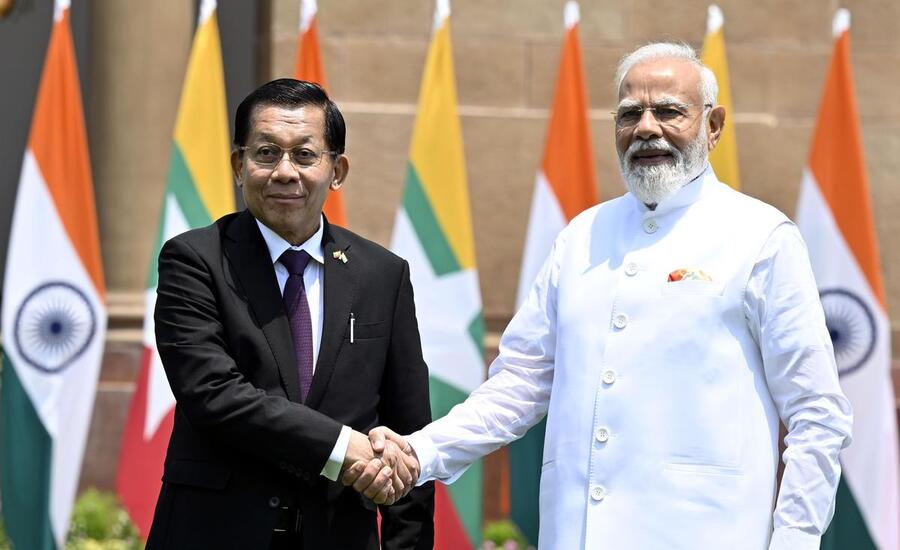
New Delhi: India-Myanmar trade and security cooperation received a major boost after Prime Minister Narendra Modi and Myanmar President U Min Aung Hlaing held high-level talks in New Delhi.
The discussions covered trade, connectivity, border security, investment, development cooperation and regional stability. Myanmar assured India that its territory would not be allowed to be used against India’s security interests, while both countries agreed to deepen cooperation in several strategic sectors.
Key Highlights of the India-Myanmar Meeting
Myanmar Reassures India on Security Concerns
- Myanmar President U Min Aung Hlaing assured Prime Minister Narendra Modi that Myanmar’s territory would not be used for activities harmful to India’s security interests.
- Both leaders stressed the importance of preventing the misuse of their territories by militant groups and other anti-national elements.
- India raised concerns about insurgent groups operating near the India-Myanmar border and their impact on northeastern states.
Focus on Border Management
- Border security emerged as one of the most important topics during the talks.
- India and Myanmar share a border of around 1,643 kilometers.
- The border passes through India’s northeastern states including Nagaland, Manipur, Mizoram and Arunachal Pradesh.
- Both countries agreed to strengthen coordination to ensure peace and stability along the border.
Read also: Explained: What Were the Key Decisions Taken in PM Modi’s 51st PRAGATI Session?
Trade and Economic Cooperation
Bilateral Trade Continues to Grow
- Bilateral trade between India and Myanmar currently exceeds USD 2 billion annually.
- Both countries agreed to facilitate greater trade and investment opportunities.
- Discussions covered cooperation in:
- Agriculture
- Agro-processing
- Energy
- Petroleum
- Mining
- Manufacturing
- Critical technologies and digital sectors
- The two sides also welcomed the progress made under the Rupee-Kyat Trade Settlement Mechanism, which helps businesses trade using local currencies.
Why Trade Cooperation Matters
Myanmar acts as India’s gateway to Southeast Asia. Stronger trade ties can:
- Improve market access for Indian businesses.
- Support economic growth in India’s northeastern region.
- Enhance regional supply chains.
- Reduce dependence on traditional trade routes.
Education, Health and Development Cooperation
Apart from security and trade, both nations agreed to strengthen cooperation in:
- Health care
- Education
- Energy
- Development assistance
- Cultural exchanges
- Technology collaboration
India also announced an increase in scholarships available to Myanmar students under the Mekong-Ganga cooperation framework, highlighting growing people-to-people ties.
India-Myanmar Meeting: Connectivity Projects Receive Fresh Push
Kaladan Multi-Modal Transit Transport Project
One of the most important outcomes of the meeting was the renewed commitment to accelerate the Kaladan Multi-Modal Transit Transport Project.
This project aims to:
- Connect India’s eastern coast with Myanmar.
- Improve transportation links to India’s Northeast.
- Reduce logistical costs.
- Boost cross-border trade and tourism.
Both countries agreed to work quickly toward its completion.
India-Myanmar-Thailand Trilateral Highway
The leaders also discussed the importance of advancing the India-Myanmar-Thailand Highway project.
Expected benefits include:
- Better regional connectivity.
- Faster movement of goods.
- Increased tourism.
- Stronger economic integration between South and Southeast Asia.
Strategic Importance of Myanmar for India
Myanmar occupies a unique position in India’s foreign policy.
According to Indian officials, Myanmar sits at the intersection of:
- Neighbourhood First Policy
- Act East Policy
- MAHASAGAR Vision
- Indo-Pacific Strategy
For India, maintaining strong relations with Myanmar is important because of:
- Shared border security.
- Trade access to Southeast Asia.
- Regional stability.
- Infrastructure connectivity.
- Energy and critical mineral resources.
Read also: Explained: Why Myanmar Is Crucial to India’s Neighbourhood First, Act East and MAHASAGAR Vision