In the heart of Chhattisgarh’s Bastar region lies Bhairamgarh in Bijapur district, an area more often associated with conflict than with stories of national success.
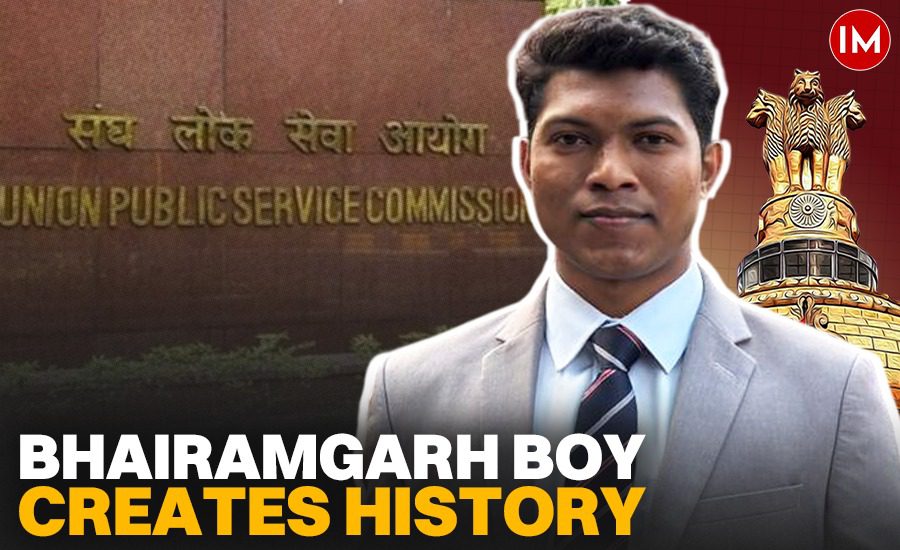
From this Naxal-affected region, 24-year-old Ankit Sakni has scripted history.
By securing All India Rank 816 in the UPSC Civil Services Examination 2025, Ankit has not only changed his own life but has become the first student from Bijapur district to crack UPSC, putting his district firmly on India’s administrative map.
His journey is not one of privilege or polished coaching corridors. It is a story of government schemes opening doors, parents making sacrifices, financial hurdles, heartbreak, and a young man who kept moving forward.
“I wanted to achieve something good from here… and I am the first student from this district to get selected for UPSC,” Ankit told Indian Masterminds with quiet pride.
BORN IN CONFLICT, RAISED IN HOPE
Ankit Sakni was born on July 4, 2001, in Gudma village, under Kutru tehsil in Bijapur district. He grew up in Bhairamgarh, a remote, Naxal-affected pocket of Bastar.
His father, Chandriya Sakni, is a farmer. His mother, Jamuna Sakni, is a homemaker. The family had limited means, no government job security, and no direct exposure to the world of bureaucracy.
“I studied till Class 5 in Saraswati Shishu Mandir, Bhairamgarh,” Ankit recalls.
His childhood was rooted in the realities of rural India: fields, farming, and modest means. But somewhere in that small village, ambition quietly began to take shape.
THE GOVERNMENT SCHEME THAT CHANGED HIS LIFE
A turning point came in Class 5.
Ankit appeared for an exam under the Jawahar Utkarsh Yojana, a scheme that identifies talented students and funds their education in private schools.
He was among the district’s top four students selected.
That single opportunity changed everything.
Under the scheme, he studied from Class 6 to 8 at Allons Public School. Because the distance became difficult to manage, he later moved to Krishna Public School, Raipur, where he studied from Class 9 to 12.
The Tribal Welfare Department’s schemes played a direct role in shaping his educational path.
Later, after clearing the UPSC Preliminary Examination, the department again stepped in, this time with ₹1 lakh financial assistance to help him prepare for the Mains and Interview.
That support proved crucial.
Principal Secretary Sonmoni Borah highlighted how welfare schemes are helping talented youth from Naxal-affected areas move ahead and create new possibilities.
ENGINEERING DREAMS IN DURG, UPSC DREAMS IN CHHATTISGARH
After school, Ankit pursued B.Tech in Electrical and Electronics Engineering from Bhilai Institute of Technology, Durg, completing his graduation in July 2022.
It was in the final year of college that the thought of civil services took hold.
“My father told me about these posts and what they do. Gradually, my interest grew,” he says.
Unlike many aspirants who relocate permanently to Delhi, Ankit largely prepared from Chhattisgarh using online resources. He did spend five to six months in Delhi for optional subject coaching, but the financial burden became too heavy.
“Delhi was very expensive…room rent and everything. So, after six or seven months, I came back and continued preparing from Chhattisgarh,” he told Indian Masterminds.
That decision did not slow him down.
THE FAILURE THAT COULD HAVE BROKEN HIM
Ankit’s UPSC 2025 success came after a painful near miss.
In UPSC 2024, he had reached the Interview stage but missed the final list by just nine marks.
And then came the real challenge.
Only 25 days later, he had to appear for the next Preliminary exam.
For many aspirants, that kind of setback can drain confidence. For Ankit, it became fuel.
“Not making it to the final list last year was the biggest challenge because just 25 days later, Prelims was there. Coping with that and studying again was tough.”
Instead of giving in to disappointment, he analysed his weaknesses and worked on them.
A 50-MARKS COMEBACK
Ankit’s comeback was not accidental; it was strategic.
He improved his score by over 50 marks overall.
- Around 25 marks improvement in Mains
- Around 32 marks improvement in the interview
- Better performance in Prelims as well, with around 117 marks expected
He worked specifically on:
- Ethics paper
- Essay paper
- Weak areas in the Sociology optional
- Personality-based interview preparation
His optional subject was Sociology.
“It was trending, the syllabus was relatively shorter, and I found it interesting because you get to understand society more,” he says.
For Interview preparation, he focused heavily on his DAF (Detailed Application Form).
His interview became highly personalised, covering his region, hobbies, and achievements. This preparation paid off.
A HISTORIC FIRST FOR BIJAPUR
Ankit is now officially the first UPSC-selected candidate from Bijapur district.
For a district often in the headlines for violence and underdevelopment, this achievement carries enormous symbolic value.
His success has sparked celebrations across the region.
He was congratulated by top state leaders and was also honored by Bijapur MLA Vikram Mandavi, who wished him success in the future.
His story has become a source of pride not only for his family but also for the entire Bastar region.
A MESSAGE TO ASPIRANTS
Ankit’s message to aspirants is simple and powerful:
“Dream big. If I can do it, I think anyone can do it.”
He believes students no longer need to depend entirely on expensive coaching hubs.
“There are so many resources available online. It is not necessary to go to Delhi.”
And his biggest advice?
“Discipline is more important than motivation.”
Those words come from someone who studied through financial struggles, faced failure, rebuilt himself, and made history.
MORE THAN A RANK, A SHIFT IN MINDSET
Ankit Sakni’s story is bigger than AIR 816.
It is about what happens when talent meets opportunity.
It is about a farmer’s son from a Naxal-hit village stepping into India’s most competitive examination and succeeding.
It is about how government support systems like Jawahar Utkarsh Yojana and the ₹1 lakh encouragement grant can change lives.
And it is about showing young people in Bastar that their pin code does not define their future.
From Bhairamgarh to the UPSC list, Ankit Sakni has given his district something priceless: belief.