In today’s digital era, crime no longer needs a weapon – it needs only a screen, a connection, and a moment of vulnerability. Every day, thousands of ordinary citizens – farmers, workers, small traders – lose their life savings to faceless cybercriminals operating from hidden corners of the internet.
But in this vast and complex battlefield, where technology often outpaces law enforcement, a remarkable story has emerged from within the system itself. It is the story of Dr. Pushpendra Singh Yadav- a constable who refused to remain confined by rank, resources, or limitations, and instead carved his own path to become one of India’s most impactful cybercrime investigators.
His journey is not just about solving cases – it is about building systems, saving lives, restoring dignity, and proving that dedication can outmatch even the most sophisticated crime networks.
Humble Beginnings: A Constable with an Uncommon Vision
Dr. Singh’s journey began in 2009, when he was recruited into the police force of Madhya Pradesh as a constable. A native of Gwalior, his early years in service were like those of many others – structured, disciplined, and bound by routine responsibilities.
When the Cyber Wing in Madhya Pradesh was established around 2013, he was posted in Bhopal. At that time, cybercrime policing was still in its infancy. The systems were new, the challenges unfamiliar, and the resources limited.
The period between 2013 and 2015 was, in his own words, a learning phase. But from 2015 onwards, he began working in cybercrime in a real, operational sense.
By 2016, he was transferred to Gwalior – a move that would eventually shape the most defining chapter of his career.
The Incident That Changed Everything
Sometimes, a single moment defines an entire life’s direction.
For Dr. Singh, that moment came on a scorching summer day in May or June. Temperatures hovered above 40 degrees Celsius. There was even a power cut in the office.
In the middle of this, a man arrived – exhausted, distressed, and desperate. He had cycled nearly 20 kilometers to reach the police station. His savings – ₹80,000 – had been siphoned off through a Paytm fraud.
There was no time, no ideal setup, no system ready. But there was intent.
Dr. Singh immediately reached out to the Paytm nodal officer, explained the situation, and managed to get ₹70,000 blocked and reversed in real time.
That moment triggered a powerful realisation – If one case could be solved like this, how many more people across India were suffering simply because systems weren’t connected?

The Birth of ‘Stop Banking Fraud’: A Nationwide Shield
In 2017, driven by this realization, Dr. Singh created something unprecedented – a coordinated network called the “Stop Banking Fraud” group.
This was not just a WhatsApp group. It was a real-time national response system.
He connected:
- Cyber police units from Leh-Ladakh to Kanyakumari
- Nodal officers from fintech companies like Paytm, PhonePe, and PayU
- Police teams across states
With the support of senior officer Pranay Nagwanshi, this network became a powerful bridge between victims, police, and financial institutions.
For the first time, coordination that usually took hours or days began happening instantly.
And the impact was massive.
From that point onwards, Dr. Singh and his network saved and returned nearly ₹1 billion (₹100 crore+) directly to victims’ accounts.
Mastering the Cybercrime World: Beyond Tools and Technology
What sets Dr. Pushpendra apart is not just his work – it is his philosophy.
He firmly believes that software and tools are secondary. The real weapon is the human mind.
According to him, solving cybercrime begins with:
- Identifying the loophole in the crime
- Understanding how the criminal thinks
- Reconstructing the crime from the offender’s perspective
He often emphasises: “To catch a criminal, you must think like one – because the criminal is already thinking like the police.”
This mindset led him to go far beyond standard training.
He studied cybercrime cases from across the world, translated foreign case studies, analyzed different investigative methods, and applied them in India.
At the same time, he built strong networks – constantly interacting with officers across the country, helping them solve cases, and learning from each experience.
A Self-Made Expert: Learning Without Limits
Despite being a constable, Dr. Singh never allowed his position to limit his learning.
After joining service, he completed 97 specialized courses, most of them funded from his own salary.
His areas of study included:
- Python programming
- Cryptocurrencies and blockchain
- VPNs and IPDR analysis
- Tor network and darknet operations
- Human intelligence techniques
- Deep web and cyber forensics
Academically, he holds:
- A B.Sc. in Computer Science
- A Law degree
- A Diploma in Cyber Law
This combination of formal education and self-driven learning transformed him into a highly skilled cyber investigator.
Inside the Darknet: Cracking India’s First Case of Its Kind
One of the most defining moments of his career came with a groundbreaking darknet case.
The case involved:
- Data breach of 50,000 international credit cards
- Transactions executed within India
- Use of cryptocurrency for payments
- Goods ordered from global platforms and delivered across India
To crack the case, Dr. Singh and his team did something extraordinary – they entered the darknet (Tor network)themselves.
They created fake identities, registered on hidden platforms, and launched a strategic phishing operation – like casting a net into a vast ocean.
Slowly, one suspect began reacting unusually. His activity increased. He showed specific interest in certain posts.
That digital behavior became the clue.
From there, they tracked IP patterns and eventually identified the accused – linked to Gwalior itself.
This became India’s first successfully solved darknet-based international cyber fraud case.
Recognition and Records: A Constable Who Made History
Dr. Singh’s work did not go unnoticed.
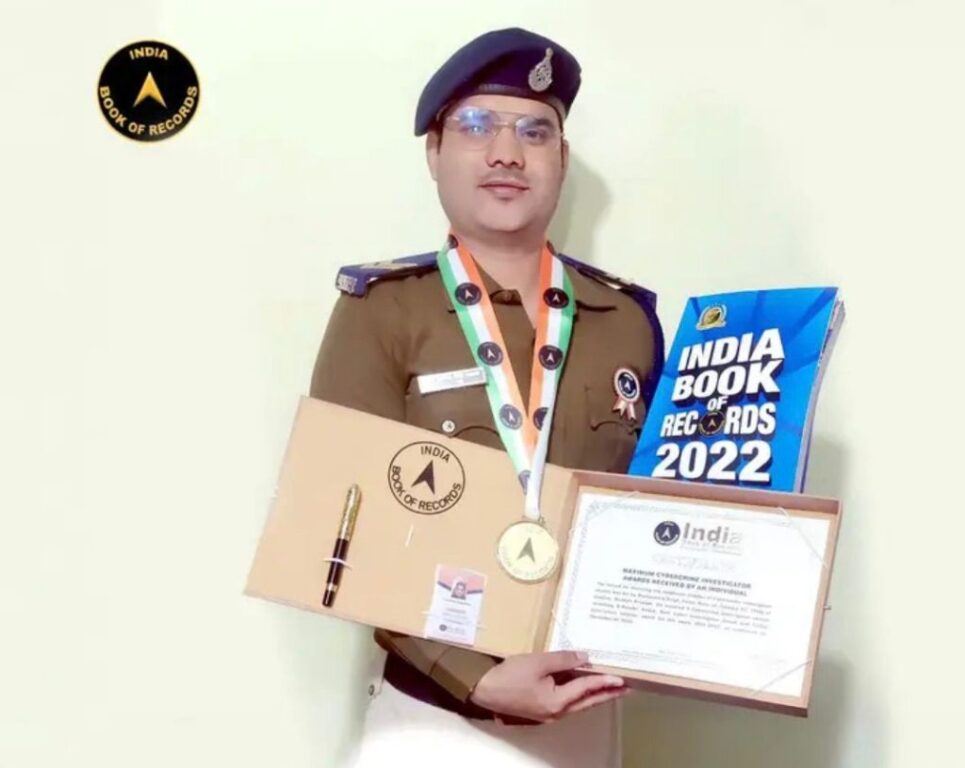
His innovations and casework earned him five national-level awards, making him:
- The first constable from Madhya Pradesh to achieve this
- The youngest individual to receive five national awards
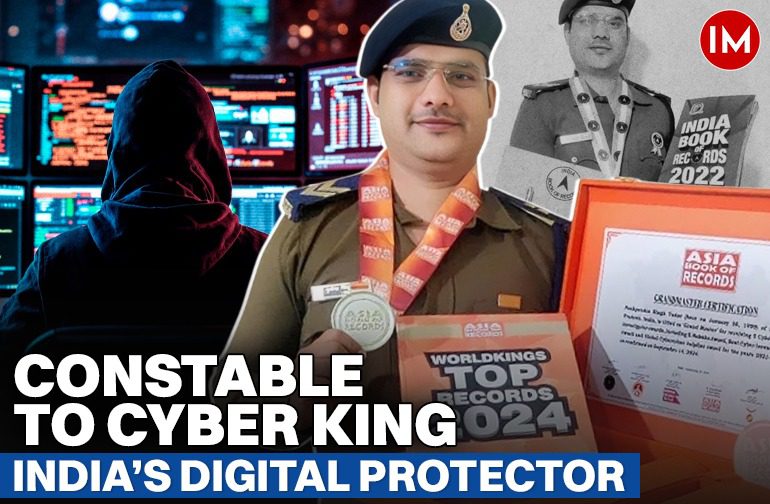
His name was entered into the India Book of Records, and later into the Asia Book of Records, where he was awarded the title of Grandmaster – a rare recognition in the cyber domain.
Among his major honours:
- Digital Innovation Award (Haryana, 2019)
- E-Raksha Awards (NCRB, Ministry of Home Affairs – 2020 & 2022)
- National Cyber Award & Best Cyber Investigator (2021)
- Ambassador of Indian Cyber Crime Investigator (2022)
He was also recognised by global corporate leaders, including senior officials from Amazon and PhonePe, for his exceptional support.
Doctorate and National Impact
In recognition of his extraordinary work, Dr. Singh was awarded an Honorary Doctorate in Delhi, conferred through the Indian Peace Council in association with Delhi University.
This honour was based not just on cases solved, but on victim feedback from across India, highlighting his effectiveness, empathy, and dedication.
Service Beyond Duty: A Life Committed to Society
Even beyond cybercrime, Dr. Singh’s work reflects deep social commitment.
He has been actively involved in multiple initiatives:
- Supporting the marriage of 29 underprivileged girls
- Funding education for 100 children
- Running “Laawaris Ka Sahara”, providing medical care to over 5,000 abandoned animals
- Operating “Bhatke Hue Ka Sahara”, helping reunite lost individuals with their families across India
- Running www.cyberfraudhelp.in, a self-funded platform assisting cybercrime victims, especially the poor
These initiatives are not institutional—they are personal missions, often supported by his own resources and close associates like Radha Raman Tripathi.
A Story That Redefines Possibility
Dr. Pushpendra Singh’s journey is a powerful reminder that greatness is not defined by designation—it is defined by determination.
From a constable in 2009 to a nationally celebrated cybercrime expert, from a single saved victim to a system that protects millions – his story is one of relentless pursuit of purpose.
In a world where crime is becoming increasingly invisible, his work makes one thing visible again – hope.
Read Also: From Queues to Clicks: How IAS Raghvendra Singh is Digitally Transforming Healthcare in Jabalpur