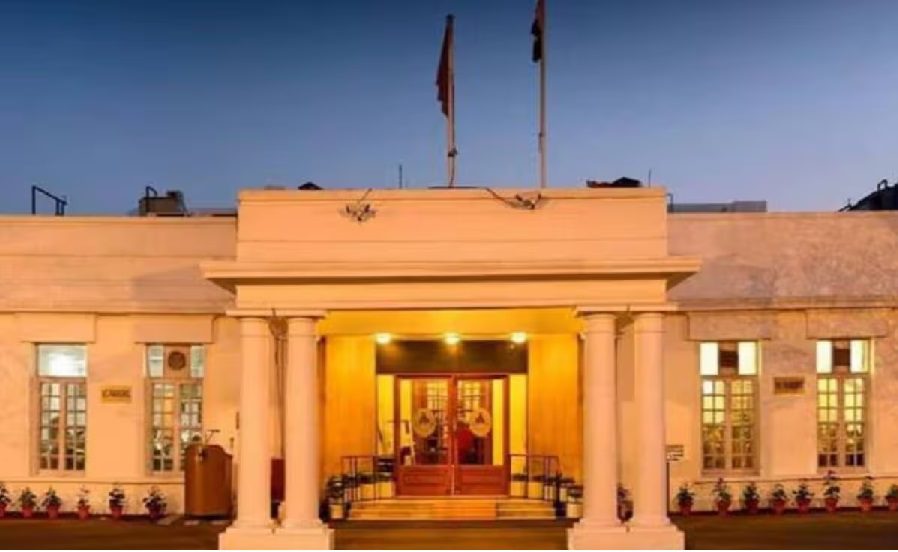
New Delhi: One of India’s most prestigious and exclusive institutions, the Delhi Gymkhana Club, is staring at a defining moment in its 113-year history as the Centre moves to reclaim the club’s sprawling 27.3-acre property in the heart of Lutyens’ Delhi. The Ministry of Housing and Urban Affairs (MoHUA) has directed the elite club to vacate its Safdarjung Road premises by June 5, setting the stage for the culmination of a high-profile dispute that has sparked debates over heritage, public land, governance, and privilege.
Founded during the British colonial era, the Delhi Gymkhana Club has long been associated with India’s political, bureaucratic, diplomatic, military and corporate elite. However, the institution now finds itself embroiled in a controversy that extends far beyond its historic legacy.
Centre Invokes Lease Clause to Reclaim Land
The government has invoked Clause 4 of the lease agreement governing the property, which allows it to re-enter and take possession of the land for “public purposes.”
According to the Centre, the land occupied by the club is situated in a strategically sensitive zone of the national capital and is required for strengthening defence-related infrastructure and other public-interest projects.
The government has argued that the public purpose requirement justifies the re-entry into the property and that the action is in accordance with the lease conditions.
Prime Property Worth an Estimated ₹27,000 Crore
The dispute has drawn widespread attention because of the enormous value of the land involved.
Spread across 27.3 acres in one of the most sought-after locations in New Delhi, the property is estimated to be worth around ₹27,000 crore. Located on Safdarjung Road in the heart of Lutyens’ Delhi, the land represents one of the most valuable parcels occupied by a private-membership institution in the country.
Critics have questioned whether such a large expanse of public land should continue to be occupied by a club whose membership remains highly restricted and inaccessible to most citizens.
Legal Challenge Before Delhi High Court
The government’s decision has triggered a legal battle, with members of the Delhi Gymkhana Club challenging the eviction order before the Delhi High Court.
Petitioners have argued that:
- The government’s action is arbitrary.
- The move threatens a historic institution with over a century of legacy.
- The club serves as an important cultural and social landmark.
- Adequate procedural safeguards must be followed before any eviction.
During the proceedings, the Delhi High Court declined to grant interim relief to the club. However, the court directed that any action taken by the government must strictly adhere to due process.
The Centre, in turn, assured the court that it would not resort to forcible possession without following legal procedures.
As a result, all eyes are now on June 5, the deadline set by the government for vacating the premises.
Financial and Governance Issues Add to Scrutiny
The land dispute has also brought renewed attention to allegations concerning the club’s financial management and governance practices.
According to reports, forensic audits and investigations have highlighted:
- Alleged billing irregularities.
- Membership-related discrepancies.
- Financial management concerns.
- Significant financial losses.
These findings have reportedly attracted the attention of multiple government agencies and added another layer to the controversy surrounding the institution.
Pending Dues Under Scanner
Apart from governance-related concerns, the Delhi Gymkhana Club is also facing allegations regarding unpaid dues.
Reports indicate that outstanding liabilities in the range of ₹47 crore to ₹48 crore are under scrutiny, further intensifying questions about the club’s financial compliance and obligations.
While club representatives have contested several allegations, the issue has become part of the broader debate surrounding the future of the institution.
A Symbol of Colonial-Era Exclusivity
Established in 1913 during British rule, the Delhi Gymkhana Club has historically been viewed as one of India’s most exclusive social institutions.
For decades, membership at the club has been considered a status symbol among:
- Senior bureaucrats
- Politicians
- Diplomats
- Military officers
- Corporate leaders
- Business families
Membership waiting lists have often stretched for years, and in some cases decades, reinforcing perceptions of exclusivity.
The current controversy has reignited discussions about whether institutions rooted in colonial-era privilege should continue to enjoy access to large tracts of public land in independent India.
Heritage Versus Redevelopment Debate
Supporters of the club argue that the Delhi Gymkhana Club represents an important part of the capital’s historical and architectural heritage.
They contend that:
- The institution preserves a significant chapter of Delhi’s social history.
- Heritage structures deserve protection.
- Redevelopment should not come at the cost of historically significant institutions.
On the other hand, proponents of the government’s move argue that:
- Public land should be utilised in the broader national interest.
- Strategic infrastructure requirements must take precedence.
- Exclusive institutions should not enjoy perpetual control over valuable public assets.
The dispute has therefore evolved into a larger conversation about balancing preservation of heritage with contemporary development needs.
More Than a Land Dispute
Observers note that the controversy is no longer merely about a club or a parcel of land.
The Delhi Gymkhana Club case has emerged as a symbolic confrontation between:
- Heritage and redevelopment
- Exclusivity and public access
- Legacy institutions and changing governance priorities
- Colonial-era privileges and contemporary public interest
The outcome could influence future debates involving other legacy institutions occupying prime government land across the country.
June 5 Could Be a Turning Point
With the Centre’s deadline fast approaching and legal proceedings continuing, June 5 is expected to be a critical date in the history of the Delhi Gymkhana Club.
Whether the dispute results in a negotiated settlement, further judicial intervention, or eventual repossession of the property by the government, the case has already become one of the most closely watched institutional battles in the national capital.
As the countdown continues, the future of one of India’s oldest and most influential clubs hangs in the balance, with implications that extend far beyond the boundaries of its iconic Safdarjung Road premises.
Read also: Who Is IPS Officer Abdur Rahman? Supreme Court Orders Fresh Review of His Voluntary Retirement Plea