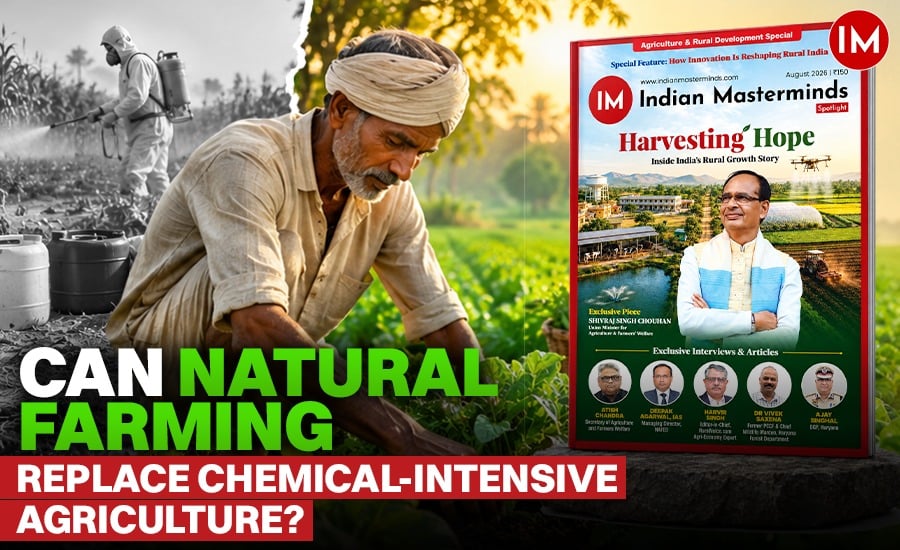
India’s Green Revolution transformed the country from a food-deficit nation into one of the world’s largest foodgrain producers. However, the indiscriminate use of chemical fertilisers and pesticides over the past six decades has also created serious ecological challenges. The challenge before policymakers today is no longer simply producing more food but producing it sustainably.
Recognising this, the Government of India has launched the National Mission on Natural Farming (NMNF) while continuing support through the Paramparagat Krishi Vikas Yojana (PKVY). Yet the financial support available to farmers adopting natural farming remains modest when compared with the massive subsidies extended to chemical-intensive agriculture.
Heavy Subsidy, Light Incentive
The Government spends nearly ₹1.75 lakh crore annually on fertiliser subsidies, largely through the Urea Subsidy and Nutrient-Based Subsidy (NBS) schemes. On average, this works out to an indirect support of roughly ₹4,800 per acre or about ₹17,700 per farmer. In addition, India spends around ₹1.4 lakh crore every year importing fertilisers and fertiliser raw materials, particularly phosphatic and potassic nutrients, increasing dependence on volatile global markets.
Also Read – Hello Sidhi–Jai Jawan: How Sidhi Is Supporting Soldiers’ Families Through Better Governance
By comparison, under the National Mission on Natural Farming, farmers receive an Output-Based Incentive of ₹4,000 per acre per year for two years, limited to one acre per farmer. The assistance is meant to support preparation of bio-inputs, maintenance of livestock, training, purchase of storage and mixing containers, or procurement of inputs from Bio-input Resource Centres. PKVY also provides limited financial assistance for organic farming. While these schemes represent an important beginning, the support is too modest to encourage large-scale transition.
Ironically, farmers practising natural farming are not availing fertiliser subsidies at all. By eliminating synthetic fertilisers and pesticides, they actually reduce the Government’s subsidy burden and India’s dependence on costly fertiliser imports. Yet the incentives they receive remain only a fraction of the public expenditure incurred on conventional farming.
ICAR’S EVALUATION
The Indian Council of Agricultural Research (ICAR) has been evaluating natural farming through the All India Network Programme (AINP) on Natural Farming, involving 20 research centres across 16 states, 11 State Agricultural Universities, eight ICAR institutes and one deemed university. The programme evaluates eight major cropping systems under different agro-climatic conditions and develops region-specific packages of practices.
The findings are encouraging. In the Himalayan centres at Bajaura (Himachal Pradesh), Almora (Uttarakhand) and Gangtok (Sikkim), a soybean-maize-vegetable pea-coriander cropping system recorded an average productivity of 6,475 kg soybean equivalent per hectare annually over five years under complete natural farming—around 5% higher than comparable organic and integrated crop management systems.
Unaffected Production
Similarly, trials at Bhopal, Jabalpur and Raipur, covering the soybean-maize-wheat-mustard system common to central India, produced an average 3,346 kg soybean equivalent per hectare annually, matching the productivity achieved under integrated crop management and organic farming.
In Gujarat and Rajasthan, the cowpea-maize or groundnut-sesame-fennel-cabbage system achieved 9,209 kg cowpea equivalent per hectare annually, again demonstrating productivity comparable with conventional integrated farming systems.
These results indicate that natural farming, when practised scientifically and adapted to local agro-climatic conditions, need not compromise productivity in the long run.
The biggest concern among farmers is the temporary decline in yields during the transition from chemical farming. Scientific studies acknowledge that the first two or three crop cycles may witness some reduction in yields, as the soil ecosystem gradually rebuilds after years of chemical dependence. During this phase, biological activity, organic carbon and nutrient cycling are still recovering.
Lower Input Cost
However, this temporary decline is substantially offset by a sharp reduction in cultivation costs. Natural farming replaces expensive chemical fertilisers and pesticides with locally prepared bio-inputs such as Jeevamrit, Beejamrit, Ghan Jeevamrit, mulches and botanical extracts, many of which can be prepared using farm resources including cow dung, cow urine and crop residues. Consequently, expenditure on purchased inputs declines significantly.
Field studies from Madhya Pradesh indicate that the cost of wheat cultivation can decline from roughly ₹10,000-12,000 per acre under conventional farming to about ₹5,000-7,000 per acre under natural farming, representing savings of nearly 40-50%. Thus, although yields may initially fall, lower production costs compensate for a substantial portion of the income loss. As soil health improves over the next few seasons, yields stabilise and farmers often record higher net profits than before.
ICAR’s research also demonstrates remarkable improvements in soil health. Soil organic carbon—a key indicator of long-term fertility—increased from about 0.90% to 1.15% within two to three years in Himalayan field trials. The diversity and abundance of beneficial bacteria, fungi and actinomycetes increased significantly, strengthening nutrient cycling and improving soil structure.
Healthy Soil Ecosystem
Research conducted by the ICAR-Indian Institute of Soil Science (IISS), Bhopal, further found 14% higher dehydrogenase activity and 18.2% higher alkaline phosphatase activity under natural farming, indicating a far more active and biologically healthy soil ecosystem.
These improvements have practical consequences. Better soil structure enhances water infiltration and moisture retention, making crops more resilient to drought. Mulching suppresses weeds, conserves soil moisture and increases organic matter, while mixed and multi-cropping improves biodiversity, reduces pest incidence and enhances nutrient utilisation.
Improved Productivity, Better Soil Health
Independent evidence reinforces these scientific findings. According to an assessment by NITI Aayog, 91.2% of farmers practising natural farming reported improved productivity and better soil health, while 90.1% experienced lower production costs.
The evidence therefore suggests that the principal obstacle is not agronomic feasibility but economic risk during the transition period. Since most Indian farmers are small or marginal cultivators, even a temporary decline in yields can discourage adoption.
This is where public policy must intervene more decisively. Rather than restricting incentives to one acre, the Government should consider extending support to the entire area converted under verified natural farming. Enhanced financial assistance during the first two or three years would help compensate transitional losses while encouraging wider adoption. Given that natural farming also reduces fertiliser subsidy requirements, import dependence and environmental degradation, such expenditure should be viewed as an investment rather than a subsidy.
Natural farming is no longer merely an alternative philosophy; it is emerging as a scientifically validated pathway towards sustainable agriculture. The evidence from ICAR’s nationwide trials shows that while the transition requires patience, healthier soils, lower cultivation costs, improved profitability and greater climate resilience make it a compelling long-term strategy. With stronger incentives, effective training, scientific extension and better market support, India can accelerate this transition while safeguarding both farmers’ incomes and the country’s natural resources for future generations.
(The article is authored by Anil Agrawal, an engineer and expert in natural farming, and was originally published in the August edition of IM Spotlight Magazine.)
Also Read – The Bridge That Rose From the Ruins: How IFS Gurharsh Singh United a Village After the Samej Disaster