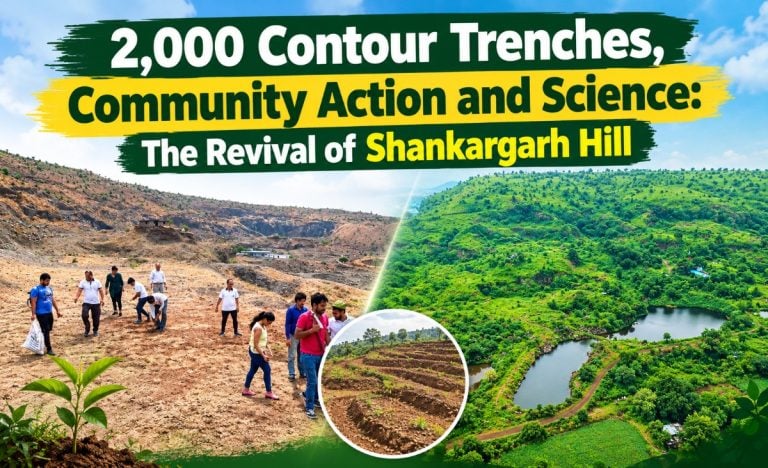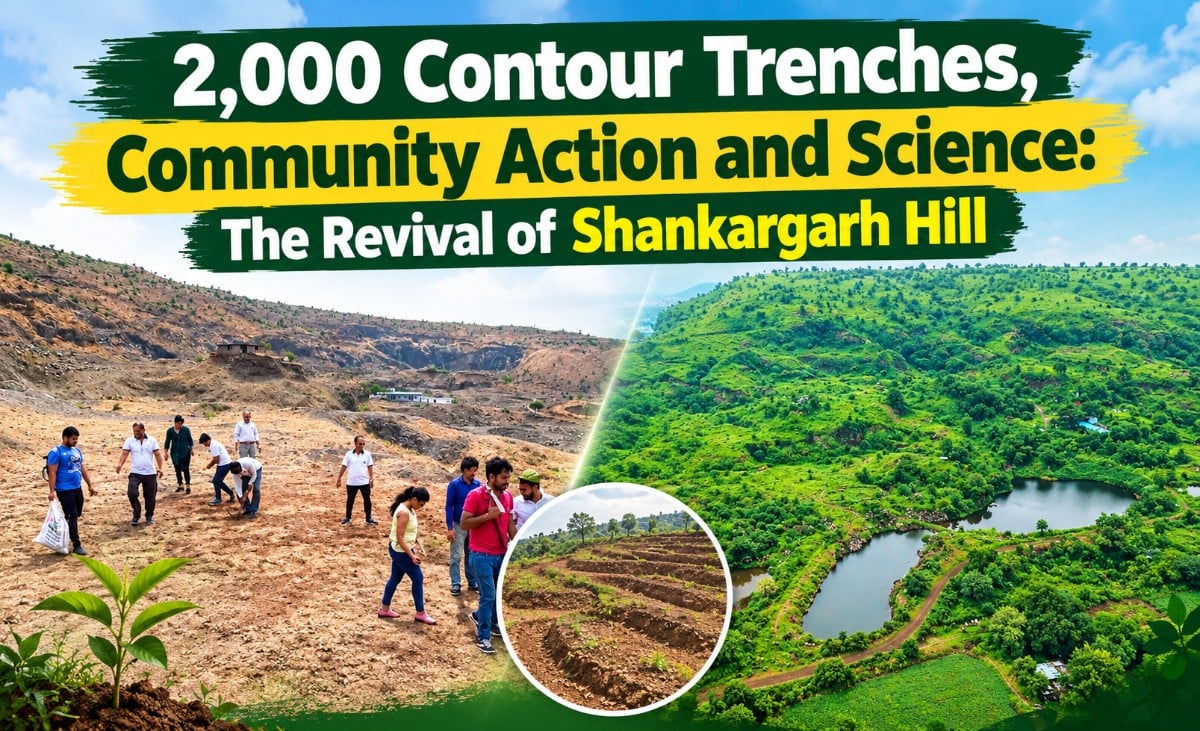
Once scarred by years of unregulated mining, Shankargarh Hill in Madhya Pradesh’s Dewas district is emerging as an example of how degraded landscapes can be brought back to life through restoration science, judicial intervention and community participation. Abandoned quarry pits, unstable slopes and barren land once threatened the hill’s ecological value, but sustained efforts have helped revive its vegetation and protect it from further damage.
For Pradeep Mishra, a 2013-batch Indian Forest Service (IFS) officer of the Madhya Pradesh cadre, the restoration of Shankargarh is a reminder that planting trees alone cannot heal a damaged landscape. Soil and moisture conservation, legal protection, interdepartmental coordination and community ownership must work together to make restoration sustainable. Satellite data from 2017 to 2025 now provides scientific evidence of the hill’s recovery, offering lessons for ecological restoration across India.
What was Shankargarh Hill like when restoration began — and what made the situation urgent?
Shankargarh’s restoration began with the vision of Shri P.N. Mishra, the then DFO Dewas, who first proposed the site as a Nagar Van and initiated the early efforts to give the project a formal shape. When I later joined as DFO Dewas, the hill still showed the scars of years of unregulated open-cast mining. What had once been a forested sandstone ridge, important for groundwater recharge, biodiversity and local identity, had been reduced to abandoned quarry pits, unstable slopes and almost barren land.
By 2015, as many as 33 mining leases were active on the hill, some legal and many not. The soil had lost its structure, moisture retention was very poor, and natural regeneration had almost stopped. For the people of Dewas, the hill was more than just a piece of land. It held spiritual significance, memories of its ecological past and a strong connection with the local community. This combination of ecological urgency and community attachment ultimately made its recovery possible.
Also Read – Air Marshal Ashutosh Dixit: From Fighter Cockpit to Chief of the Indian Air Force
How did the courts get involved — and did the legal action actually change things on the ground?
The legal turning point came from a 2013 petition filed before the National Green Tribunal by a local resident, Smt. Radharani Vajpayee. Her application warned that illegal mining had nearly wiped out the hills and that dozens of mines operated without mandatory environmental clearances.
The NGT’s response was unusually strong. In September 2014, it observed that ‘the environment as a whole is being targeted and needs not only protection but improvement’ — and directed that the area be handed over to the Forest Department. By March 2015, the Tribunal had cancelled all 33 mining leases. Stone-crushing units were sealed. The Tribunal also ordered miners to deposit restoration funds — a security of ₹1 lakh per hectare — to finance the repair.
The polluter-pays principle, often cited and rarely enforced at the small-mine scale, took unusually concrete form here. That said, legal closure did not mean ecological closure. Illegal mining continued until 2019. The court order was necessary, but the hill came back only when a social constituency for recovery had formed alongside the legal process.
Citizens were involved long before the Forest Department. How did that happen?
That history matters enormously. Before the Forest Department formally re-entered the site in 2019, a small group of young Dewas residents had already been climbing the hill with seed packets and jerry cans of water — at their own expense, with no institutional support. Shri Samarjeet Jadhav was central to this early citizen effort. His persistence, and that of the group around him, established something more durable than any single plantation: a social baseline of care for the hill.
The survival rate in that early phase was barely 10 to 12 per cent. The soil was too damaged, the moisture too scarce. But the volunteers kept coming. When the Forest Department formally engaged, the relationship shifted from parallel action to genuine partnership. The Green Army, which formalised in 2021, took on patrolling, fire response, encroachment reporting and volunteer mobilisation.
My role was to create the institutional conditions — legal protection, technical design, funding convergence — within which that existing community energy could be channelled and amplified. The Green Army didn’t need motivation. They needed to be supported.
What did the Forest Department actually do differently — and why did survival rates improve so dramatically?
The most important decision was sequencing. Plantation did not begin first. Soil and moisture conservation did. We constructed over 2,000 contour trenches, continuous contour trenches on the upper slopes, boulder check-dams, and lined ponds. We then applied mulching, soil amendments, and fire lines. Only after we hydrologically stabilised the slopes did we begin large-scale planting.
This is the technical reason survival rates rose from 10–12 per cent in the volunteer phase to 65–70 per cent and above from 2022 onward — a sixfold improvement. It reflects basic restoration ecology, not novel intervention. A sapling planted on a moisture-depleted slope will not survive the first dry season. Fix the soil first, and the tree has a chance.
On the institutional side, convergence was key. CAMPA funds supported plantation and protection works. The Agriculture Department contributed to bunds. The PWD assisted with access and drainage. The judiciary contributed a Nyaya Vatika; the police a Suraksha Vatika. The Bank Note Press, Dewas, engaged through CSR. Business communities sponsored water tankers. No single department carried the full load.
Your research paper used satellite data to track the recovery. What did the science actually show?
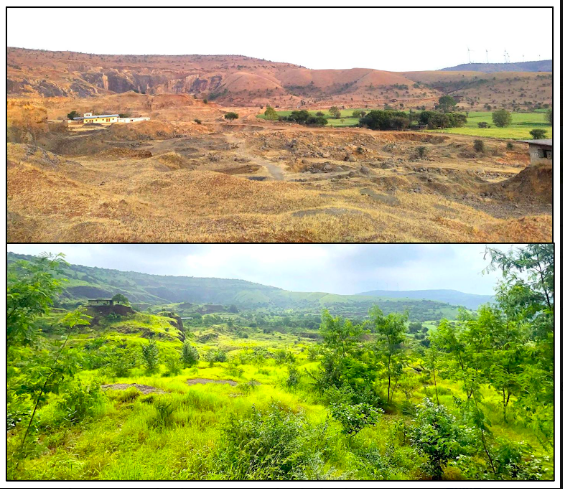
The paper — NDVI- and NDMI-Based Assessment of Post-Mining Ecological Restoration in Shankargarh Hills, Madhya Pradesh, India (2017–2025), published in The Indian Forester (Vol. 152, July 2026) — used eight years of Sentinel-2 satellite imagery processed in ArcGIS Pro 3.5.4 to independently verify what field observation suggested: that the landscape had undergone a measurable and substantial ecological transformation.
Mean NDVI — a satellite measure of how much living, photosynthesising vegetation is present — rose from 0.19 in 2017 to 0.30 in 2025. Sparse vegetation declined by nearly 24 hectares, while moderate and dense vegetation increased by the same amount. Most importantly, 83.4 per cent of the study area showed positive vegetation change — the recovery was not concentrated in a few favourable patches but spread across the landscape.
Where the satellite earlier saw rock, it now sees leaves. For forest managers, this kind of satellite record matters beyond any single site. It provides an independent, spatially explicit, temporally continuous method for evaluating restoration outcomes—one that field reporting can’t manipulate and that outlasts any individual officer’s tenure. I have also written for Down to Earth on Shankargarh’s recovery to carry these findings beyond the scientific literature to a wider public audience.
A second NGT order came in 2025, protecting the restored land from a tourism project. What does that mean for Shankargarh’s future?
The October 2025 NGT order — OA 37/2025 (CZ) — directed that the 50.292 hectares of restored Shankargarh Nagar Van land must retain its forest status and blocked a proposed tourism project on the site. This closes a vulnerability all restoration projects face: the risk that a recovered landscape becomes attractive for the very commercial development that degrades landscapes in the first place.
The legal arc that began with the first NGT order in 2013 has now come full circle. The first order removed the harm. The intervening decade funded the repair. The second order protects the regenerated landscape. For restoration practitioners, this sequencing matters. Ecological recovery without legal protection is vulnerable. A landscape restored at high public cost should not be available for commercial exploitation simply because it has become visually attractive.
India has committed to restoring 26 million hectares. Where does a small 83-hectare hill fit in that picture?
A handful of large flagship projects will not meet India’s restoration commitments. They will be met, hectare by hectare, at sites like Shankargarh — where local knowledge, institutional persistence and community ownership can accomplish what centralised programmes rarely achieve on their own.
Within the Nagar Van Yojana specifically — a Ministry of Environment programme to develop 1,000 urban forests over a decade — Shankargarh is among the few of the initial 75 sites that can point to a measurable ecological gradient supported by peer-reviewed satellite evidence. Most Nagar Van sites are still in the early stages of plantation. Shankargarh has an eight-year recovery trajectory, a published research paper, two NGT orders and documented wildlife return. That makes it a reference case—a demonstration that the programme’s ambition is ecologically achievable within a decade when implementation is grounded in restoration science.
What are the next research questions you are pursuing after documenting this recovery?
The NDVI and NDMI analysis establishes the vegetation and moisture trajectory, but it raises as many questions as it answers. The first is carbon. Vegetation indices tell us that biomass has increased, but not how much carbon has been sequestered. I am working to correlate satellite-derived indices with field-measured above-ground carbon from sample plots to assess whether restored mining landscapes can qualify for carbon credits, creating a financial mechanism to sustain restoration beyond the initial CAMPA funding cycle.
The second is species composition. A landscape dominated by a single fast-growing species can show strong NDVI improvement while its biodiversity remains impoverished. My ongoing work on Rare, Endangered, and Threatened species—published as a commentary in Mongabay India—is directly relevant here. The third is replication. I am now extending the satellite-monitoring approach piloted at Shankargarh to the West Betul Working Plan area, where I am currently posted, as part of building a transferable remote-sensing toolkit for forest practitioners across India.
Also Read – Chhattisgarh’s Rural Bus Revolution: How the State Is Reconnecting Remote Tribal Villages