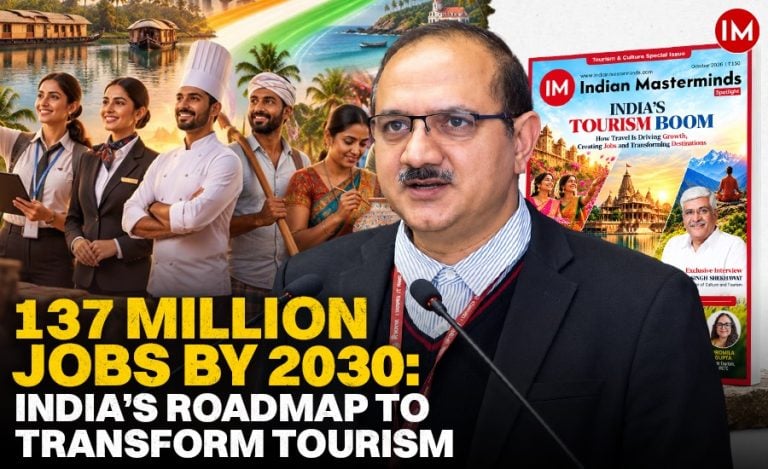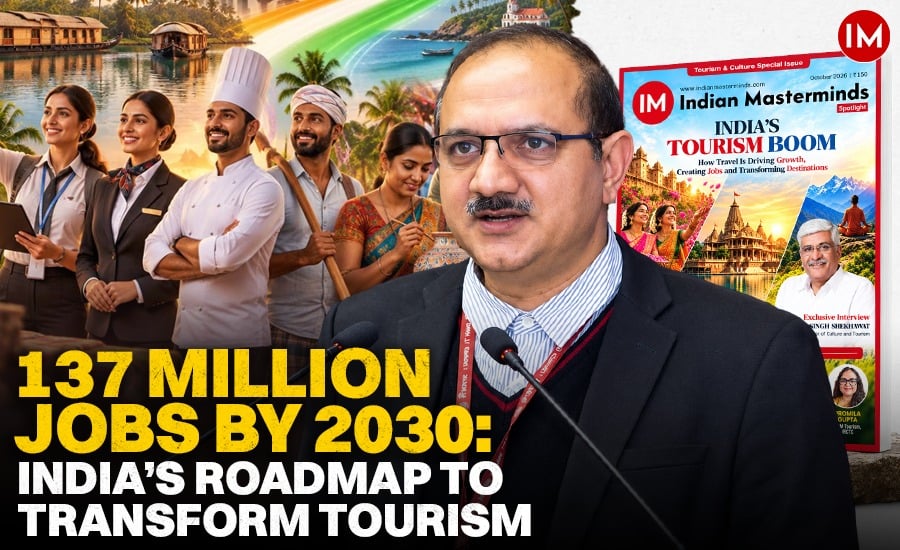
India’s tourism sector is undergoing a significant transformation, moving beyond destination promotion towards integrated infrastructure, diversified experiences and sustainable economic growth. From heritage and spiritual tourism to medical wellness, cruise travel, MICE and destination weddings, the country is seeking to unlock its vast tourism potential while creating employment, attracting investment and strengthening its position in the global travel market.
With targets of contributing US$250 billion to the tourism economy, generating 137 million jobs and earning US$56 billion in foreign exchange by 2030, the government is focusing on better connectivity, destination management, skill development and regulatory reforms. Initiatives such as Swadesh Darshan 2.0 and PRASHAD are supporting destination development, while digitalisation and private-sector participation are expected to improve visitor experiences.
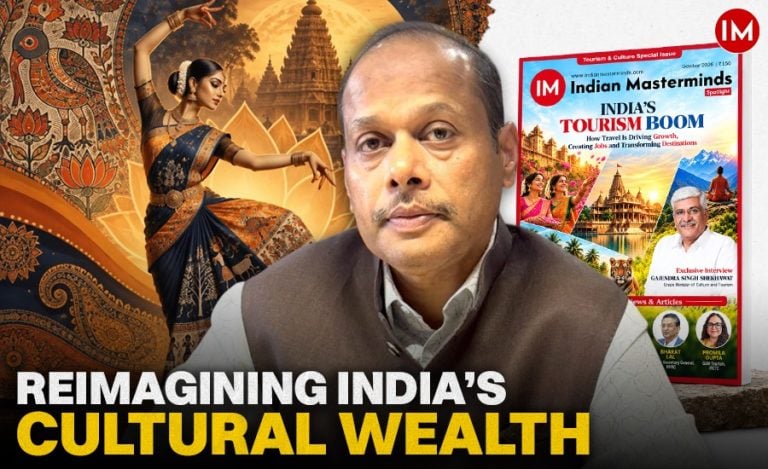
In an exclusive interview with Indian Masterminds Spotlight, Bhuvnesh Kumar, Union Tourism Secretary, discusses India’s tourism roadmap, the challenges holding back its global competitiveness, the push for year-round tourism and the strategies needed to turn tourism into a major engine of employment and economic growth.
Here is the Interview :
India’s tourism story has changed significantly over the past decade. What, are the three most important structural changes in India’s tourism ecosystem since 2014?
The biggest change has been the shift from tourism promotion to tourism ecosystem development. I would identify three structural changes. First, public investment has increasingly focused on connectivity, tourism infrastructure and development of complete destinations rather than isolated attractions.
Second, India’s tourism portfolio has become much more diversified, with greater emphasis on MICE, adventure, wellness, medical, cruise, rural, eco and wedding tourism alongside our traditional heritage and spiritual strengths. Initiatives such as Meet in India, Wed in India, Travel for LiFE and recent work on MICE institutions and adventure-safety standards support this diversification.
Third, there is a much stronger focus on creating an enabling ecosystem through ease of doing business, digitalisation, private investment, skills and community participation.
India has enormous tourism potential but captures a relatively modest share of global international tourist arrivals. What are the principal bottlenecks holding India back?
Good tourism experience requires improvement in international and last-mile connectivity, visa and entry facilitation, quality accommodation, cleanliness, safety, service standards and destination management. We are also simplifying the business environment so that new hotels, tourism services and experiences can come up more easily and investment can respond faster to demand.
At the same time, we are developing high-potential segments such as MICE, cruise, adventure, wedding, medical and wellness tourism. The objective is to make India easier to access, easier to experience and more competitive in both quality and value.
The government has set ambitious targets for tourism as a driver of GDP, employment and foreign exchange. What are the measurable targets for the sector for 2030?
The government has set targets for 2030 which include about US$250 billion in tourism GDP contribution, 137 million tourism jobs, US$56 billion in foreign exchange earnings and 25 million foreign tourist arrivals. These provide clear, measurable outcome indicators for the sector.
We are also strengthening the statistical base against which progress can be assessed. In 2023–24, tourism contributed an estimated 5.22% to GDP and supported 84.63 million, or 8.46 crore, direct and indirect jobs. In 2025, India recorded 20.22 million international tourist arrivals and about ₹2.7 lakh crore in foreign exchange earnings.
How is the Ministry implementing innovating through initiatives such as the Swadesh Darshan programme?
Swadesh Darshan 1.0 was primarily a thematic-circuit infrastructure programme. It created important public assets across 15 circuits, including visitor amenities, interpretation facilities, pathways, parking, illumination and access-related infrastructure. Of 76 projects sanctioned under the first phase, 75 have been physically completed.
Swadesh Darshan 2.0 is different in its basic design. It is destination-centric and tourist-centric rather than circuit-centric. The scheme requires holistic destination planning and looks at the entire visitor journey. It combines hard infrastructure with soft interventions such as skills, destination management, digitalisation, community participation, private-sector involvement, sustainability and operation and maintenance. So far, 53 projects worth about ₹2,208 crore have been sanctioned under Swadesh Darshan 2.0.
Is the Ministry considering an institutional mechanism to deliver integrated tourism projects from planning to execution?
Tourism is perhaps one of the strongest examples of why a whole-of-government and Centre-State approach is essential. A tourist experiences a destination as one integrated whole, even though its different elements—roads, sanitation, transport, safety, heritage, public spaces, utilities and tourism services—may be managed by different agencies. The task is therefore to ensure that all these elements are planned and delivered together. The Ministry’s approach is increasingly centred on integrated destination planning, with stronger institutional arrangements at the State and destination levels.
Swadesh Darshan 2.0 is designed to address this through an institutional framework that includes a State Steering Committee chaired by the Chief Secretary, a State Mission Director and a Destination Management Committee. The latter is intended to resolve implementation bottlenecks, improve local conditions, support destination branding, skills, private investment and data-driven management.
How can the Ministry turn heritage sites into world-class visitor experiences?
Heritage tourism must be built on a simple principle: conservation and visitor experience have to reinforce each other. ASI and the Ministry of Culture have the core responsibility and expertise for conservation, while the tourism ecosystem can complement this through better visitor amenities, accessibility, interpretation, signage, circulation, digital information and destination linkages.
A stronger model would be joint site planning involving ASI, Tourism, the State/UT and the local body. Digital integration is also improving: online ticketing for more than 170 ASI monuments and museums has been enabled through the ONDC network. The Union Budget 2026–27 has proposed developing 15 archaeological sites as experiential cultural destinations.
How can infrastructure and carrying capacity be improved so that rising visitor numbers do not overwhelm religious destinations?
The Ministry’s approach is not merely to promote pilgrimage, but to improve the quality of the destination and increase the local economic benefit from each visit. Under PRASHAD, 54 projects across 28 States/UTs have been sanctioned at an estimated cost of ₹1,726.74 crore to strengthen pilgrimage and heritage destinations.
The 2026–27 Budget has also proposed a Buddhist Circuit initiative in the North-East with preservation, interpretation, connectivity and pilgrim amenities. However, growth has to be managed. At high-footfall destinations such as Ayodhya, Varanasi or major festival locations, carrying capacity must precede planning.
What is the Ministry’s strategy for converting tourism growth into quality local employment?
Tourism is already one of India’s large employment ecosystems. In 2023–24, it supported an estimated 84.63 million—or 8.46 crore—direct and indirect jobs. The Government has earlier articulated an ambition of 137 million tourism jobs by 2030 as stated at the National Conference of State Tourism Ministers in Dharamshala in September 2022.
Between 2014–15 and 2024–25, more than 4.5 lakh persons were trained under the Ministry’s Capacity Building for Service Providers scheme. Further, the Union Budget 2026–27 has proposed a National Institute of Hospitality and a pilot programme to upskill 10,000 guides across 20 iconic tourist sites.
What regulatory or policy changes are being considered to make Indian destinations more competitive?
An important recent reform has been the discontinuation of the Ministry’s voluntary scheme of project approvals for hospitality units at the construction/pre-construction stage. Licences have been delinked from the Ministry’s voluntary classification of hospitality units. Operational hotel classification continues as a voluntary quality-assurance mechanism.
The next phase is broader regulatory simplification. In June 2026, the Ministry of Tourism and NITI Aayog released a report identifying regulatory and procedural bottlenecks affecting accommodation, hospitality establishments, homestays, food and beverage services, tour operators and tourism infrastructure.
Digitalisation is another important part of ease of doing business. NIDHI+ enables online registration, recognition and classification across tourism and hospitality categories. Investment policy is also being strengthened: 100% FDI is permitted under the automatic route in tourism and hospitality, and the Budget has announced infrastructure-status support for hotels in identified top tourist destinations.
Is there a strategy to woo high-paying tourists?
The objective is not to choose between volume and value. India needs both a strong visitor base and higher spending per visitor, longer stays and greater economic value retained within destinations. That requires improving the quality of the tourism product. Better accommodation, seamless mobility, high-quality guides, interpretation, gastronomy, curated experiences and strong destination management encourage visitors to stay longer and spend more. It also requires developing segments where India has a clear competitive advantage.
MICE is one such segment, supported by new convention infrastructure, improving global visibility and initiatives such as Meet in India and City MICE Promotion Bureaus. Medical and wellness tourism is another major opportunity. Wedding tourism similarly leverages India’s palaces, heritage properties, beaches, spiritual destinations and luxury hospitality. Cruise, luxury, adventure and experiential heritage tourism add to this portfolio.
Looking ahead to 2047, what will India’s tourism map look like?
By 2047, India’s tourism map should be much more dispersed, diverse and year-round with focus on promoting India as a 365-days destination. The June 2026 Ministry of Tourism–NITI Aayog report places this in the context of the longer-term ambition of 100 million inbound tourists and a US$3 trillion tourism economy by 2047.
Five interventions are critical over the next five years: first, integrated destination master planning and empowered destination management; second, faster air, road, rail and last-mile connectivity; third, accommodation capacity and private investment supported by simpler regulation; fourth, a major upgrade in skills, service quality, safety and cleanliness; and fifth, data-led digital discovery, global marketing and sustainability management.