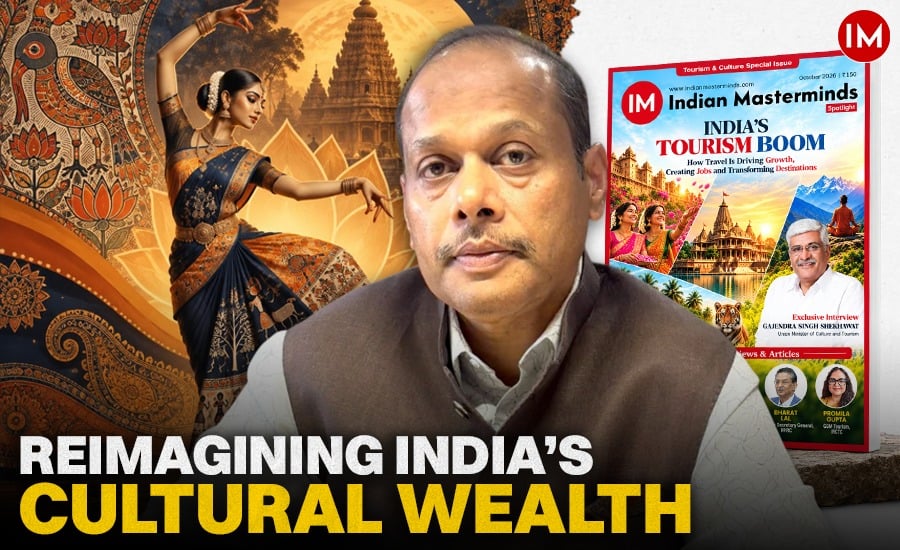
India’s cultural heritage is more than its monuments, museums and manuscripts. It is a living repository of knowledge, traditions, artistic expression and livelihoods that continues to shape the country’s identity. The challenge today is to preserve this legacy while making it accessible to younger generations, creating economic opportunities for traditional artists and artisans, and strengthening India’s cultural presence globally.
From digitally mapping 6.26 lakh villages through the Mera Gaon Meri Dharohar initiative to digitising manuscripts under the Gyan Bharatam Mission, the Ministry of Culture is adopting technology-driven approaches to heritage preservation. It is also focusing on immersive museum experiences, sustainable heritage tourism, support for traditional art forms and stronger international cultural partnerships.
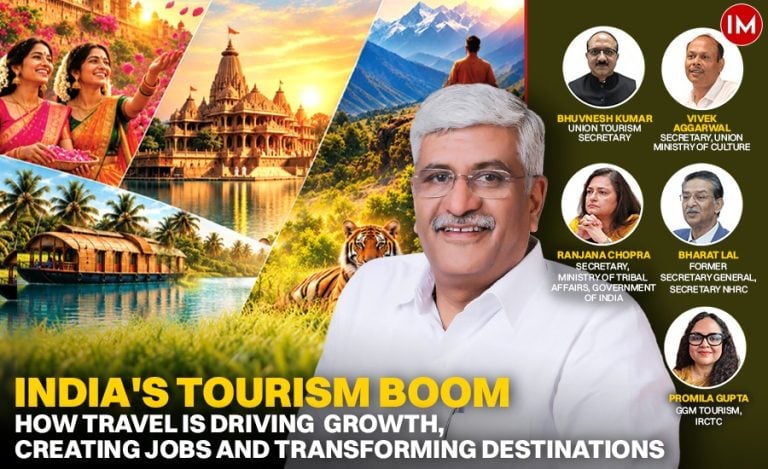
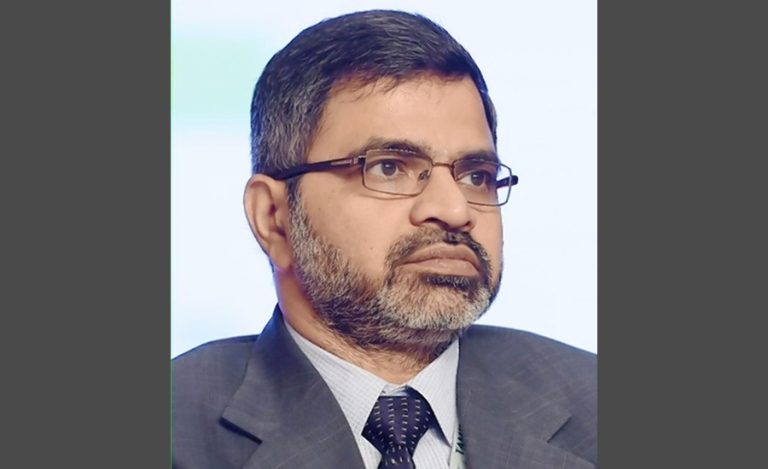
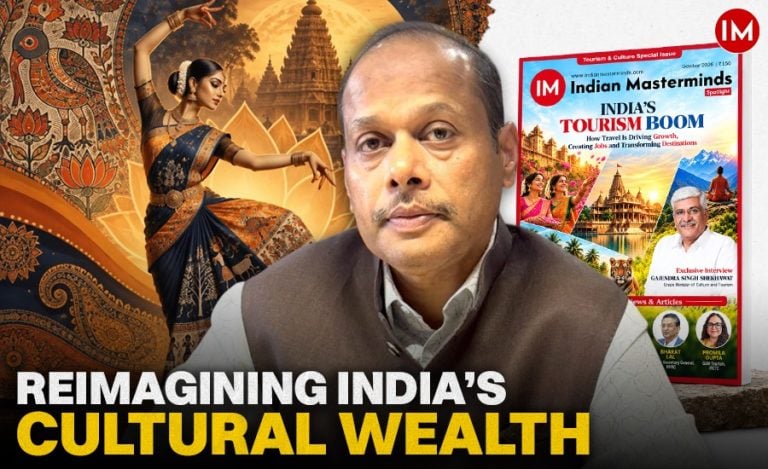
In an exclusive interaction with Indian Masterminds Spotlight, Vivek Aggarwal, Secretary, Union Ministry of Culture, discusses the government’s vision for building a vibrant cultural ecosystem, the role of artificial intelligence and digital technologies in preserving India’s civilisational heritage, and how culture can become a source of knowledge, employment, innovation and global influence.
What is the Ministry’s overarching strategy to move from simply preserving heritage to creating a living, accessible and globally competitive cultural ecosystem?
The Ministry of Culture is moving beyond a predominantly passive approach to heritage preservation towards a holistic Creative Economy Framework, integrating heritage conservation with livelihood generation, tourism, private-sector participation and greater public engagement.
The focus is on transforming heritage zones into vibrant economic hubs by linking local artisans, performers, craftspeople and traditional practitioners more closely with the tourism value chain. The Ministry is also encouraging Public-Private-People Partnerships through CSR, corporate sponsorship and community-led management of heritage sites and cultural infrastructure.
Key archaeological sites such as Lothal, Dholavira, Rakhigarhi, Sarnath and Hastinapur are being developed as experiential and thematic destinations under the DESH Scheme, combining conservation with meaningful visitor engagement.
The National Mission on Cultural Mapping has received renewed importance. What is its status, and when can India expect a comprehensive digital cultural map?
The National Mission on Cultural Mapping (NMCM) aims to preserve, safeguard and revitalise India’s cultural traditions through systematic documentation. Its key component, Mera Gaon Meri Dharohar (MGMD), is creating a national database of India’s tangible and intangible heritage.
The MGMD portal functions as a digital cultural map, covering artists, traditions, institutions, heritage sites and cultural practices at the village level. So far, 6.26 lakh villages have been mapped, with the information available publicly. Panchayati Raj Institutions and Gram Sabhas are also being involved in data collection and validation to ensure authenticity and regular updating.
How will technology, artificial intelligence and virtual reality change the way people experience India’s history and civilisation?
The Yuge Yugeen Bharat National Museum, being developed across the North and South Blocks over approximately 1.17 lakh square metres, is envisioned as one of the world’s largest museums and will showcase more than 5,000 years of India’s civilisational history.
Across cultural institutions, technologies such as Virtual Reality, Augmented Reality and interactive multi-touch displays are making heritage more immersive. Such experiences have already been developed at Hampi, Konark, Man Mahal and Nalanda, with a target of extending them to 50 ASI sites by 2030.
AI is also being deployed for conversational curator bots, automated archival metadata tagging and high-resolution 3D digital twins of rare artefacts. These technologies can significantly expand access to India’s cultural collections for visitors, researchers and scholars worldwide.
With the Gyan Bharatam Mission receiving substantial funding, what are the Ministry’s priorities for India’s manuscripts and documentary heritage?
The Gyan Bharatam Mission, with an approved outlay of ₹491.66 crore for 2025–31, seeks to systematically survey, conserve, digitise and publish India’s manuscript heritage and create a National Digital Repository.
A nationwide manuscript survey launched in March 2026 has already reported data on more than 1.25 crore manuscripts held by institutions, individuals, scholars, temples, mutts, libraries and other repositories. More than 10 lakh digitised manuscripts have already been uploaded to the National Digital Repository.
Technology is central to the mission. AI-based tools are being developed for OCR and handwriting recognition, transliteration and translation, including for old Devanagari scripts. Gyan Mitram AI and BhartiyaGPT are live on the Gyan Bharatam portal, while Pandulipi Darpan enables AI-assisted script recognition, transliteration and translation of digitised manuscripts.
How is India balancing the pursuit of UNESCO recognition with conservation and sustainable visitor management?
India currently has a substantial UNESCO World Heritage footprint, alongside numerous intangible cultural heritage elements. The emphasis is increasingly on ensuring that recognition is accompanied by effective conservation and visitor management.
At sensitive sites, technology-enabled measures such as digital ticketing, timed entry and real-time footfall monitoring are being used where appropriate. Integrated Management Plans are also being implemented, including measures to protect buffer zones and regulate development around heritage sites.
The Ministry is exploring ways to ensure that revenue generated at heritage sites can be reinvested in conservation, visitor infrastructure, local amenities, eco-friendly transport and regular maintenance.
How is the Ministry ensuring that India’s living cultural traditions remain economically viable rather than becoming merely tourist performances?
The Ministry supports grassroots artists and traditional practitioners through a range of schemes providing financial assistance, pensions, scholarships, stipends and performance opportunities.
The Kala Sanskriti Vikas Yojana (KSVY) is being revamped to make it more inclusive and eliminate overlaps. With a proposed financial outlay of ₹1,369.85 crore over five years, the revamped scheme is expected to support 47,425 artists and 5,061 organisations, with particular attention to endangered art forms, tribal arts, visual arts and traditional practices.
The Sangeet Natak Akademi is developing an Artist Repository Portal, with a target of accrediting one lakh artists by 2030.
The Ministry’s seven Zonal Cultural Centres also organise festivals, cultural exchanges, workshops, fairs and craft exhibitions throughout the year. These programmes provide traditional artists and artisans with performance opportunities, honorariums, travel support and avenues to market their work, helping connect cultural preservation with livelihoods.
How is the Ministry working with States, local bodies and communities to conserve lesser-known heritage sites?
The Adopt a Heritage 2.0 framework, launched in 2023, encourages private companies, PSUs and NGOs to provide visitor amenities and facilities at non-centrally protected monuments. So far, 32 MoUs have been signed.
The framework also allows greater flexibility for cultural events at adopted sites while ensuring that activities follow prescribed guidelines. A national Public-Private Partnership framework is also being developed to encourage greater institutional and private-sector participation in the management and sustainable development of heritage sites.
How is India strengthening cultural diplomacy and using culture as an instrument of soft power?
India is shifting from event-driven cultural diplomacy towards sustained institutional engagement. The Ministry has Cultural Exchange Programmes and bilateral cultural agreements with more than 100 countries, covering art, culture, heritage and knowledge.
Flagship initiatives such as the Festival of India abroad and programmes associated with the International Day of Yoga are being institutionalised. Through the ICCR and diplomatic channels, India is also supporting academic chairs in Indian Studies, classical languages and traditional arts at foreign universities.
India’s cultural outreach includes participation in the Venice Biennale, the India Art, Architecture and Design Biennale and the BRICS Theatre Festival. Buddhist cultural diplomacy is another important component, with exhibitions of the Holy Relics of Lord Buddha organised in countries including Thailand, Mongolia, Vietnam, Bhutan, Russia and Sri Lanka.
Does the Ministry need to modernise the governance and functioning of its museums, academies, libraries and autonomous institutions?
The Ministry is seeking to strengthen institutional capacity and move towards more professional and expert-led management, supported by clearly defined Key Performance Indicators.
Digital transformation is another priority. Institutions are being encouraged to adopt digitised catalogues, virtual galleries, online ticketing and booking systems and remote access to library resources. Greater attention is also being given to younger audiences through interactive exhibitions, digital campaigns, scholarships and new engagement formats.
The Ministry is working towards a comprehensive civilisational digital twin through 3D spatial mapping and digital archiving of monuments, manuscripts and museum artefacts.
It is also seeking to strengthen the contribution of the cultural sector to the economy by linking heritage, tourism, crafts, digital media and gaming. A dedicated Creative Economy Division has been established for this purpose.
How can India’s cultural memory become a source of knowledge, creativity, employment and confidence for the next generation?
The objective is to ensure that India’s cultural heritage is not confined to museums and monuments but becomes part of contemporary knowledge, education and economic life.
Through the Gyan Bharatam Mission, India’s manuscript wealth is being documented and digitised for wider academic and public access. Traditional knowledge is also being connected with modern education through Buddhist-Tibetan institutions and the Indian Institute of Heritage, which provides specialised training in archaeology and history.
The National School of Drama supports education, research and training in theatre and dramatic arts. Under KSVY, the Ministry supports repertories, fellowships, scholarships, festivals and cultural organisations.
The larger objective is fourfold: turn knowledge into practice, create space for new expression, connect culture with livelihoods and build cultural confidence among young Indians. Heritage, therefore, must not be viewed simply as something inherited from the past; it should be understood as a living source of identity, creativity, knowledge and opportunity for the future.