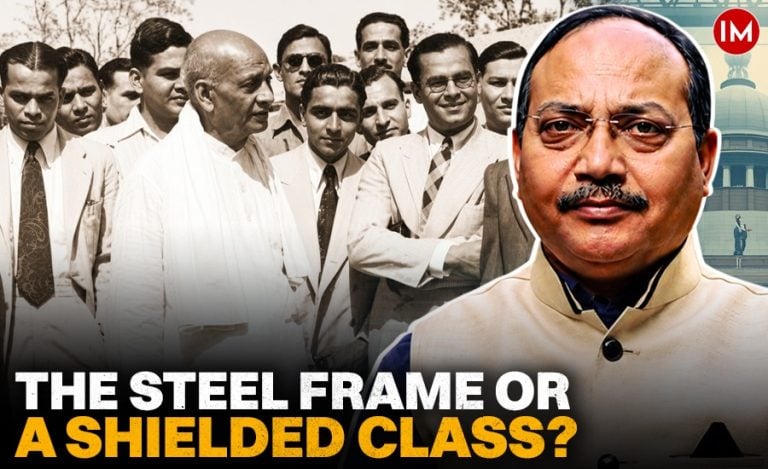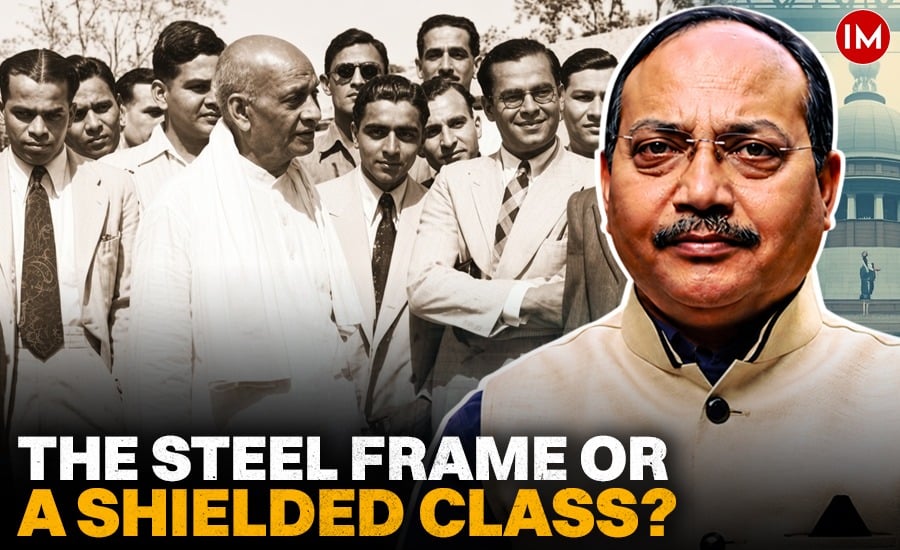
On October 31, India will celebrate the birth anniversary of Sardar Vallabhbhai Patel, the man who gave independent India its administrative steel frame. He wanted a civil service that would be strong enough to withstand political pressure, courageous enough to take difficult decisions and committed enough to hold a newly independent nation together. He fought for the protection of civil servants because he believed that without an independent and efficient administrative machinery, the unity and stability of India would be in jeopardy.
Nearly eight decades later, the question is whether the steel frame is still serving the purpose for which Patel envisioned it—or whether, in some quarters, it is turning into an increasingly protected establishment, with accountability struggling to keep pace with authority.
The Black Sheeps
The latest controversy involving senior Rajasthan IAS officer Shikhar Agrawal brings this uncomfortable question into sharp focus. Agrawal, a 1993-batch officer and former Additional Chief Secretary, was placed under awaiting posting orders on October 28, following allegations that he, his IPS officer wife Prashakha Mathur, their two sons and parents-in-law purchased 40 villas and cottages from the same company over a period of approximately two-and-a-half years. The reported transactions have raised questions about the nature of these purchases and possible conflicts of interest. The allegations have not yet been established, and an independent investigation must determine the facts.
But the episode is a reminder that public office carries obligations far beyond the privileges and powers attached to it. When senior officers and members of their families become embroiled in allegations of questionable financial dealings, the damage is not confined to an individual. It strikes at the credibility of an entire institution.
The uncomfortable truth is that this is not an isolated problem. Corruption allegations against public servants continue to surface across the country, while the disciplinary process often moves at a painfully slow pace.
DoPT Report
The Department of Personnel and Training’s Annual Report 2024-25 recorded 1,272 complaints against IAS officers between April 1, 2024 and March 6, 2025. Of these, 1,213 were processed and disposed of. During the same reporting period, 22 prosecution sanctions were granted against 22 IAS officers under the Prevention of Corruption Act, covering April 2023 to March 2025, with one sanction subsequently withdrawn. These figures should make the services introspect rather than become defensive.
The Dismissals
There is also the question of how frequently errant officers actually face the ultimate penalty of dismissal. The numbers are surprisingly small when compared with the scale of the complaints and proceedings. Among the prominent cases in the last decade are IAS officers Sanjeev Kumar, dismissed following conviction in the Haryana JBT teachers’ recruitment scam; Sandeep Garg, dismissed in 2021 after conviction in a disproportionate-assets case; and Odisha IAS officer Vinod Kumar, dismissed in 2022 after corruption convictions in the rural housing scam. IPS officer Manilal Patidar was dismissed in 2022, with the decision becoming public in June 2023.
Compulsory retirement has also been used against officers whose records have raised serious concerns. Among the cases are former Chhattisgarh IAS officer Babulal Agrawal, whose compulsory retirement was upheld by the Delhi High Court in 2025, and former Gujarat IAS officer K. Rajesh, who was compulsorily retired in October 2026 following bribery allegations connected with arms licences and government land allotment. Gujarat also compulsorily retired IAS officer Gaurav Dahiya in the same exercise.
These cases demonstrate that the system does possess instruments to punish wrongdoing. The real question is whether they are being used swiftly, consistently and without regard to an officer’s seniority or influence.
Constitutional Immunity
This brings us to the constitutional protections that make the Indian civil services distinctive. Article 311 was incorporated to ensure that civil servants could not be arbitrarily dismissed, removed or reduced in rank by political dispensations. Patel understood that an administrator who feared losing his job for taking an unpopular but lawful decision would never be able to function independently. But Article 311 is a safeguard against arbitrary executive action, not a licence to indulge in corruption or a bar against criminal prosecution.
Another layer of protection came through Section 17A of the Prevention of Corruption Act, introduced by the 2018 amendment. It requires prior approval of the competent government before an inquiry or investigation into an alleged offence relating to a public servant’s official recommendation or decision. There is an important exception for cases where an officer is caught accepting or attempting to accept an undue advantage on the spot. Nor does the provision say that an officer can be prosecuted only if he personally pockets money.
Judicial Scrutiny
The provision itself has become contentious. In January 2026, the Supreme Court delivered a split verdict on its constitutional validity. Justice B.V. Nagarathna held it unconstitutional, while Justice K.V. Viswanathan upheld it subject to an interpretation involving the Lokpal or Lokayukta. The disagreement has underscored the difficult balance between protecting honest decision-making and preventing corruption from escaping investigation.
The argument that civil servants are not answerable to Parliament or the public also needs qualification. They are accountable through their ministers, legislative scrutiny, parliamentary committees, audit institutions, vigilance bodies and courts. However, they are not directly elected that’s why even Parliament can’t take any action against them. Citizens too can not remove them through the ballot box. That makes institutional accountability, transparency and enforceable service standards all the more important.
What Patel Wanted
Perhaps the most compelling reminder of what Patel expected from the services comes from his own words. In his October 10, 1949 address to the Constituent Assembly, he declared: “I do not defend the black sheep; they may be there.” He went on to defend the overwhelming majority of honest officers, whose patriotism and loyalty, he believed, had prevented the Union from collapsing during the difficult years after Independence.
That was the essence of Patel’s faith. He did not ask the country to trust every officer blindly. He asked it to trust an institution because he believed its members would honour their responsibility. The distinction is crucial.
Today, India’s civil services enjoy constitutional safeguards, considerable administrative authority, job security and access to the highest levels of policymaking. But with such power comes an equally high obligation to maintain probity. An officer who takes a courageous decision in public interest deserves protection. One who uses public office to advance private interests deserves investigation and, where guilt is established, punishment.
The best tribute to Sardar Patel on his birth anniversary would not be another ceremony, a garland or a speech praising the steel frame. It would be a renewed commitment to the values for which he built it. The steel frame must remain strong, but it must never become a shield for corruption. After all, the ultimate test of a civil servant is not how much constitutional protection he enjoys, but how faithfully he serves the Constitution and the people of India.