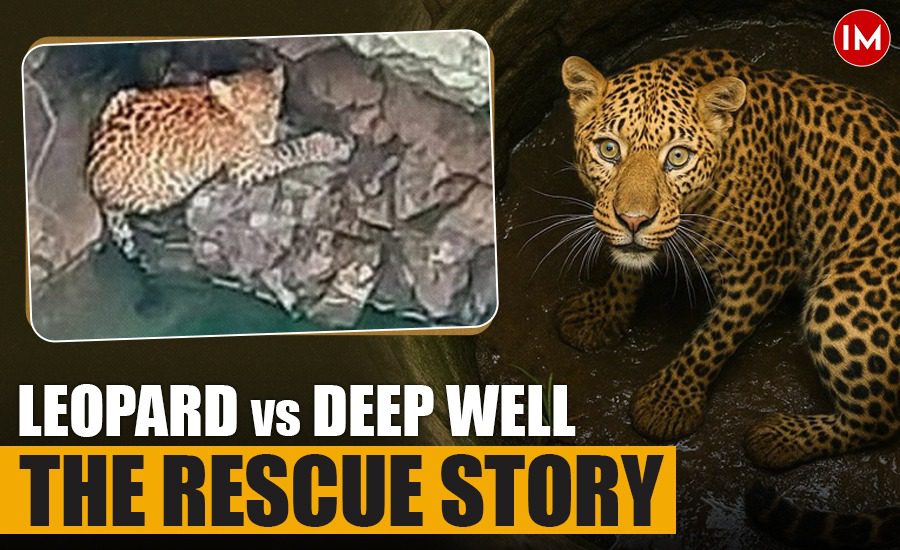
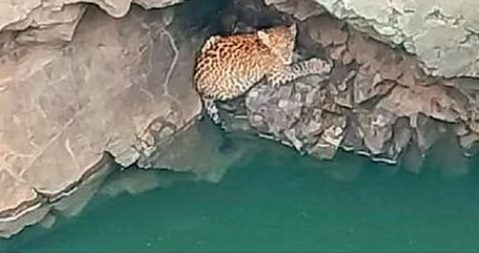
Last week in Mhow – officially known as Dr. Ambedkar Nagar, a tehsil in Madhya Pradesh’s Indore district – a leopard cub was rescued after falling into an 80-foot-deep well. The incident occurred on Sunday morning when a local farmer, while switching on a water pump around 10 a.m., spotted the trapped cub and quickly alerted the authorities.
The forest department responded promptly. Using ropes, the team carefully lowered a cage into the well. Remarkably, within just five minutes, the leopard entered the cage, allowing rescuers to pull it to safety.
The cub was immediately transported to the Indore Zoo for a medical check-up. After veterinarians confirmed it was healthy and unharmed, it was released back into the wild. According to forest officials, the cub was about a year old.
In the last five months, this was the ninth leopard rescue in the area. Even in the past two weeks, it was the second such incident of a leopard falling into a well. So, what is causing these frequent falls? Is the situation gradually becoming risky for a sensitive and protected species like the leopard? How are forest officials responding, and what measures are they taking to prevent such incidents?
Indian Masterminds spoke with Pradeep Mishra, Divisional Forest Officer (DFO) of Indore and a 2013-batch Indian Forest Service (IFS) officer, to understand more about the situation and the reasons behind these recurring incidents.
THE REASONS
Speaking with us, Mr Mishra explained that the main reason behind these incidents is the lack of protective boundaries around the wells. “Most wells in the area have no walls or fencing around them. That’s why, during the night when wild animals like leopards are on the move, they accidentally fall into these open wells,” he said. “These incidents are mostly accidental. The leopard moves through what it believes is familiar territory and, unable to see the uncovered well in the dark, ends up falling inside.”

When Indian Masterminds asked whether the movement of leopards into residential areas could pose a threat to human safety, Mr Mishra clarified, “Don’t think of it that way. Here, the forest and villages follow a model of coexistence. The forest area is vast, and many villages lie right along its boundary. In tribal regions, you’ll often see houses located directly next to the jungle. This is common in areas like Mhow, where the boundary between forest and village isn’t sharply divided like in big cities. Instead, the two have grown together over time. It’s a unique coexistence model, where both humans and wildlife share the landscape.”
However, he also mentioned that sometimes when leopards cannot find prey in the forest, they venture into villages in search of goats, lambs, or stray dogs. That is often the reason for their movement toward human settlements. “Leopards are very smart and sharp animals,” he said. “If they sense danger, they usually avoid falling into wells.”
While, some experts also suggest that habitat loss and encroachment are pushing leopards closer to human settlements in search of prey and water. Many wells in the region, often located on farmland or near forest edges, remain uncovered or poorly marked – turning them into hidden traps for unsuspecting wildlife.
“In dry seasons, leopards often wander near villages where they smell water or livestock. These open wells become death traps,” says a wildlife expert on condition of anonymity. “They can’t see the depth until it’s too late.”
IS IT BECOMING A THREAT TO BIODIVERSITY?
Leopards are a protected species under the Wildlife Protection Act, and their frequent entrapment is both a conservation concern and a sign of a growing conflict between human expansion and wildlife habitats.
“This kind of repeated distress calls for urgent intervention,” said a wildlife biologist working in Madhya Pradesh. “Each rescue may seem like a victory, but it also reflects a deeper problem – these animals are losing their safe spaces.”
PREVENTION
To prevent such incidents, the forest department is actively spreading awareness among villagers. They are encouraging residents to build fences around wells, often with the help of government schemes or other support. A fenced well acts as a natural barrier, significantly reducing the risk of animals falling in.
Mr Mishra added, “In the past, villagers have shown great promptness by informing forest officials quickly, which has helped save the lives of leopards. This kind of cooperation is key to preventing future accidents.”

The Forest officials also claim they are beginning to take note. Efforts are now being made to identify and secure high-risk wells, spread awareness among local farmers, and implement preventive measures such as fencing, signage, and covering open wells. In response to the rising incidents, the department has reportedly started-
- Surveying open wells near forest areas
- Creating awareness among farmers about keeping wells covered or fenced
- Exploring GPS tagging for vulnerable young leopards in known conflict zones
However, implementation remains uneven due to limited manpower and resources.
Environmentalists argue that more proactive measures are needed – such as long-term habitat management, community engagement programs, and collaboration with local authorities to enforce safety norms for wells and water bodies.
THE NUMBERS
When asked if there are more leopards in the forest than there should be, Mr Mishra replied that it is difficult to count them precisely at the local level. However, MP is known as the “Leopard State,” and population numbers are recorded during wildlife censuses. He acknowledged that the leopard population has been steadily increasing. While some leopards do die in territorial fights, the overall numbers continue to grow because there are no natural predators for them in this area. As a result, they regulate their population mainly through conflicts with each other.
Although the official number of leopards in the Indore Forest Division is reported to be 26–27, local residents and some experts believe the actual figure could be over 60.
Mr Mishra further explained, “In the western region of Madhya Pradesh, there are no tigers, so leopards here do not have territorial conflicts with them.”
He added, “Whenever such incidents occur, our team responds to rescue the leopard. We are doing everything possible to ensure their safety and conservation within the biodiversity. Not only in this district, but our teams also travel to other districts like Dhar and Khargone to carry out leopard rescues.”