When Madhya Pradesh began experimenting with AgriStack and personalised digital advisories for farmers, it wasn’t merely introducing another government portal. It was attempting to change the way agriculture itself was governed. Instead of blanket recommendations, farmers started receiving crop-specific advice based on their land records, soil health and cultivation history. Fertiliser use became more scientific, cultivation costs declined and policy-making gradually shifted from assumptions to data.
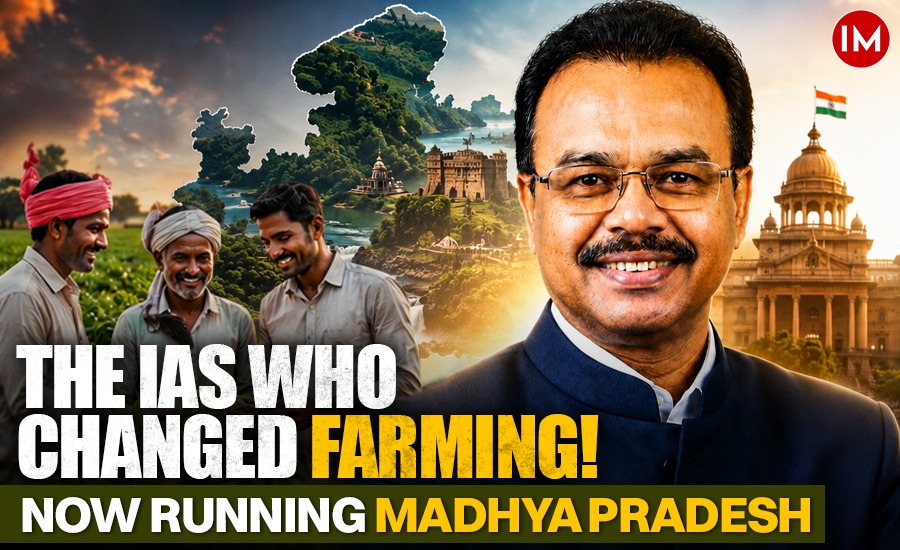
One of the architects behind this transition was Ashok Barnwal, the soft-spoken 1991-batch IAS officer who has now taken over as the Chief Secretary of Madhya Pradesh. Long before he became the state’s top bureaucrat, Barnwal had earned a reputation for quietly modernising some of the state’s most complex sectors—from agriculture and forests to healthcare and food security.
His appointment comes after the Centre named outgoing Chief Secretary Anurag Jain as the Chief Executive Officer of NITI Aayog. While Jain leaves behind a strong legacy of infrastructure and industrial reforms, Barnwal brings something equally valuable to the table: a rare combination of technological vision, administrative depth and sectoral experience that spans nearly every pillar of governance.
The Engineer Who Chose Governance
Born on January 27, 1967, in what is now Jharkhand, Barnwal’s academic journey began not in political science or public administration but in engineering. He completed his B.Tech in Mining Engineering, before pursuing a Post Graduate Diploma in Public Policy and Management, a combination that would later define his administrative style.
Also Read – Why Bishwanath Sinha Was Chosen to Lead Kerala’s Bureaucracy
Engineering taught him systems thinking. Public policy taught him how those systems affect people.
Over the last 35 years, the 1991-batch IAS officer has handled an extraordinary range of assignments across Madhya Pradesh—district administration, agriculture, forests, food security, environment, healthcare, rehabilitation and the Chief Minister’s Office. Colleagues often describe him as an officer who believes governance should solve problems rather than merely manage them.
The Digital Agriculture Pioneer
Among Barnwal’s most significant contributions has been his work in transforming agriculture through technology. As Agriculture Production Commissioner and Additional Chief Secretary of the Agriculture Department, he championed what he often calls “Digital Agriculture.”
Recognising that Indian agriculture could no longer rely solely on conventional extension services, Barnwal pushed for a data-driven ecosystem centred around the AgriStack. Under his leadership, Madhya Pradesh launched the E-Vikas pilot project.
Rather than offering generic recommendations, E-Vikas digitally enrolled farmers, mapped individual landholdings, recorded cropping histories and integrated soil health information. Using this database, farmers received personalised fertiliser recommendations specific to their crops and land conditions. The results were encouraging.
Areas covered under E-Vikas reported either reduced fertiliser consumption or no increase despite expanding cultivation. Lower fertiliser use meant lower production costs without compromising yields. Barnwal has consistently argued that agriculture’s future lies in precision rather than excess. By integrating digital land records, soil health cards and crop-specific advisories developed in collaboration with the Indian Council of Agricultural Research (ICAR), the state began replacing guesswork with scientific decision-making.
For a country where the average landholding is less than two hectares, Barnwal believes technology offers the only realistic pathway to improving farmer incomes.
Looking Beyond Production
Barnwal’s understanding of agriculture extends beyond cultivation.
In several policy discussions, he has highlighted structural issues that Indian farmers continue to face—small landholdings, climate uncertainty and global competition. He has repeatedly pointed out that while countries like Australia and the United States benefit from large farms and substantial subsidies, Indian agriculture remains largely fragmented.
Instead of attempting to replicate those models, he argues for improving efficiency through technology, better advisory services, water management and smarter input use. His approach reflects a broader philosophy: productivity must increase, but sustainability cannot be compromised.
Balancing Development with Nature
Before agriculture, Barnwal had already built a formidable reputation in environmental governance.
As Additional Chief Secretary, Forest and Wildlife, Environment Commissioner, Director General of the Environmental Planning & Coordination Organisation (EPCO) and Chairman of the Madhya Pradesh State Forest Development Corporation, he handled some of the state’s most sensitive ecological responsibilities.
His tenure focused on balancing infrastructure expansion with biodiversity conservation, climate resilience and sustainable natural resource management. Rather than viewing economic development and environmental protection as competing objectives, Barnwal sought to integrate the two.
That balanced perspective has become increasingly relevant as states navigate the twin challenges of economic growth and climate change.
A Healthcare Administrator at a Critical Time
In early 2026, Barnwal was entrusted with one of the state’s most demanding assignments—Additional Chief Secretary, Public Health and Medical Education. Alongside this role, he also served as Food Safety Commissioner and oversaw Bhopal Gas Tragedy Relief and Rehabilitation.
The portfolio required administrative precision as well as empathy.
His focus has been on strengthening healthcare infrastructure, improving medical education, ensuring food safety and modernising health administration while continuing long-term rehabilitation efforts for victims of the Bhopal gas tragedy. It was another example of his ability to transition seamlessly between sectors without losing focus on outcomes.
A Career Built Across Departments
Few officers accumulate experience across as many domains as Barnwal. Over three decades, he has served as District Collector, Commissioner, Secretary, Managing Director, Additional Secretary, Mission Coordinator and Principal Secretary to the Chief Minister.
His tenure in the Chief Minister’s Office proved particularly significant. As Principal Secretary, he coordinated several flagship governance initiatives and played an important role in preparing Madhya Pradesh’s long-term Vision 2025 development roadmap.
He also headed the Food and Civil Supplies Department, where he worked on improving food security and strengthening the public distribution system. This diversity of experience now gives him an unusually comprehensive understanding of how different government departments intersect.
Leadership Beyond Files
Barnwal’s colleagues frequently describe him as an officer who leads quietly. His administrative style is characterised by consensus-building rather than confrontation. He is known for encouraging institutional reforms, promoting digital governance and relying on evidence-based decision-making instead of administrative intuition alone.
Even outside government offices, he has demonstrated a knack for team building. During the IAS Service Meet 2025, he captained the Green Team to overall victory in sports, cultural events and a cyclothon, reflecting the collaborative leadership style for which he is known.
Taking Charge as Chief Secretary
Barnwal now assumes office at a time when Madhya Pradesh is pursuing ambitious goals across industrialisation, infrastructure, healthcare, agriculture, digital governance and environmental sustainability. His immediate challenge will be maintaining administrative continuity while accelerating reforms already underway.
Unlike many bureaucrats associated with a single flagship programme, Barnwal’s career has touched nearly every major sector of governance. That breadth may prove to be his greatest strength.
Whether modernising agriculture through AgriStack, strengthening environmental governance, reforming healthcare or improving public distribution systems, his work reflects a consistent belief that technology should make governance more responsive rather than more complicated. As he settles into the state’s highest bureaucratic office, Madhya Pradesh is not merely getting a new Chief Secretary.
It is getting an administrator whose career has been defined less by headlines and more by systems that quietly work better because he helped redesign them.And perhaps that is the hallmark of effective governance—not creating the loudest reforms, but building institutions that continue delivering results long after the announcements are over.
Also Read – The Officer Chosen at a Critical Time: Inside IPS Anurag Kumar’s Journey to Delhi Police Chief