Just days before Parliament’s Monsoon Session, Delhi witnessed an unexpected change at the top of its police force.
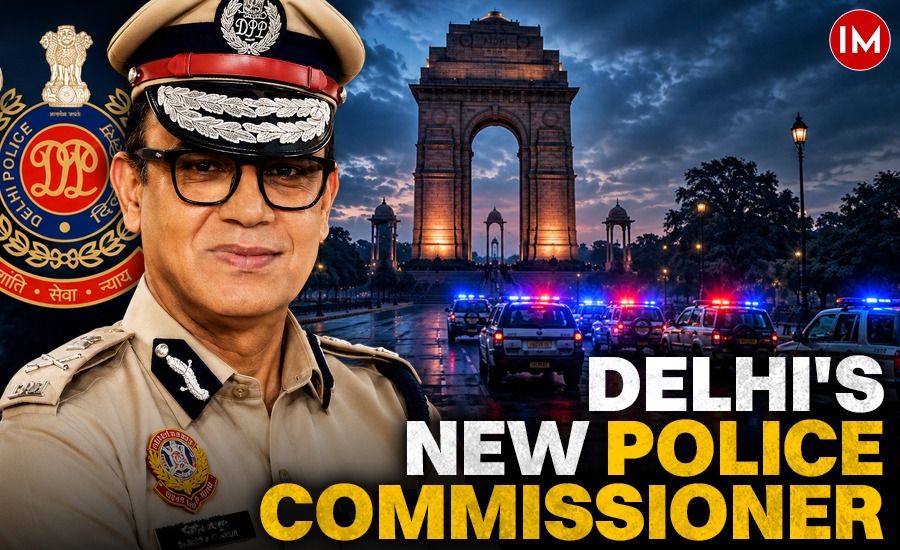
The Ministry of Home Affairs replaced Delhi Police Commissioner Satish Golcha with IPS officer Anurag Kumar, a move that immediately drew attention—not only because Golcha still had several months left before retirement, but also because of its timing.
Within 24 hours of Anurag Kumar taking charge, climate activist Sonam Wangchuk was detained ahead of his planned Parliament march. Days later, protests outside Parliament turned confrontational, with clashes between police and demonstrators, including students. Videos circulating on social media triggered questions over police handling of the protests and allegations of excessive force.
Whether the appointment was part of a routine administrative reshuffle or a carefully timed decision to prepare Delhi Police for a sensitive security environment remains a matter of public debate. What is beyond dispute, however, is that the Centre has entrusted the country’s most strategically important police force to one of India’s most experienced intelligence officers.
A CAREER BUILT ON INTELLIGENCE
Anurag Kumar belongs to the 1994 batch of the AGMUT cadre of the Indian Police Service. Originally from Uttar Pradesh, he officially joined the IPS on September 4, 1994, after clearing the Civil Services Examination.
An engineering graduate, Kumar has spent nearly 32 years in policing, building a career that combines field policing with high-level intelligence operations. While many IPS officers are known primarily for district policing, Kumar earned his reputation inside India’s premier intelligence agency—the Intelligence Bureau (IB).
His appointment as Delhi Police Commissioner marks a return to operational policing after nearly two decades spent working in national security and intelligence.
Also Read – Politics Without Politicians? How Retired IRS Officer Sanjay Gahlot Wants to Reimagine Democracy
FROM DISTRICT POLICING TO NATIONAL SECURITY
Kumar began his policing career in Delhi Police, serving as Deputy Commissioner of Police (DCP) in several districts.
These assignments exposed him to some of the country’s most challenging urban policing responsibilities, including maintaining law and order, preventing crime, handling public protests and ensuring public safety in the national capital.
But the defining chapter of his career came after he moved to the Intelligence Bureau.
For almost twenty years, Kumar worked on some of India’s most sensitive national security assignments. Rising steadily through the ranks, he eventually became Special Director of the Intelligence Bureau, one of the organisation’s highest positions.
His responsibilities included counter-terrorism operations, intelligence coordination, internal security strategy, counter-espionage, threat assessment and VIP security.
Before being appointed Delhi Police Commissioner, Kumar was heading the Jammu and Kashmir desk in the Intelligence Bureau—one of the agency’s most sensitive assignments given the region’s security challenges.
A RAPID RETURN TO THE AGMUT CADRE
His appointment followed a quick sequence of decisions at the highest levels of government.
On July 16, the Appointments Committee of the Cabinet approved his repatriation from the Intelligence Bureau to his parent AGMUT cadre by relaxing the IPS tenure policy.
The following day, the Ministry of Home Affairs appointed him Commissioner of Police, Delhi.
He succeeds Satish Golcha, a 1992-batch AGMUT cadre IPS officer, who had taken charge as Delhi Police Commissioner in August 2025 and was expected to continue until April 2027. Instead, Golcha was directed to report to the Lieutenant Governor of Delhi for further posting after handing over charge.
The sudden leadership change immediately attracted attention because it came just before Parliament’s Monsoon Session and amid heightened political activity in the national capital.
WHY THE TIMING MATTERS
Appointments to the post of Delhi Police Commissioner are always significant.
Unlike most state police chiefs, the Delhi Police Commissioner is responsible not only for maintaining law and order but also for securing Parliament, the Supreme Court, diplomatic missions, foreign embassies, VVIPs and major national events.
The timing became even more significant because it coincided with a series of politically sensitive developments.
Just a day after Kumar assumed office, activist Sonam Wangchuk was detained by Delhi Police ahead of his planned Parliament march. On July 21, police clashed with protesters during demonstrations near Parliament. The protests included students, and videos shared online sparked widespread debate over crowd-control measures and allegations of excessive force.
While the government has not linked Kumar’s appointment to these developments, the sequence of events has led to public discussion about whether the leadership change reflected evolving security priorities in the national capital.
A DECORATED POLICE OFFICER
Throughout his career, Kumar has received some of the country’s highest police honours.
He was awarded the Police Medal for Meritorious Service in 2010 and the President’s Police Medal for Distinguished Service in 2016, recognising his contributions to policing and national security.
While serving on Central deputation, he also received a proforma promotion to the Director General of Police (DGP) rank in February 2025.
These recognitions reflect a career marked by consistent professional advancement and experience across multiple domains of policing.
THE CHALLENGES AHEAD
Delhi Police today faces a rapidly changing security landscape.
Traditional law-and-order responsibilities now coexist with cybercrime, organised crime, terrorism, misinformation, large-scale public protests and the security demands of the national capital.
Kumar’s engineering background and extensive intelligence experience are expected to strengthen technology-driven policing, strategic planning and counter-terror preparedness.
However, the challenge extends beyond security management.
As Commissioner, he will also have to maintain public confidence while ensuring effective policing during politically sensitive events. Balancing operational efficiency with democratic rights will remain one of the most closely watched aspects of his tenure.
A TEST OF LEADERSHIP
For nearly two decades, Anurag Kumar worked largely behind the scenes, analysing threats, coordinating intelligence and shaping national security responses.
Now, he occupies one of the country’s most visible policing positions.
His appointment signals the Centre’s preference for an intelligence specialist at a time when Delhi’s policing challenges extend far beyond conventional crime control.
The months ahead will determine how successfully he translates decades of intelligence experience into frontline police leadership—and whether he can steer Delhi Police through one of its most politically and operationally demanding phases.
Also Read – Why India Must Build Public Services Around Migration Routes, Not Just Villages