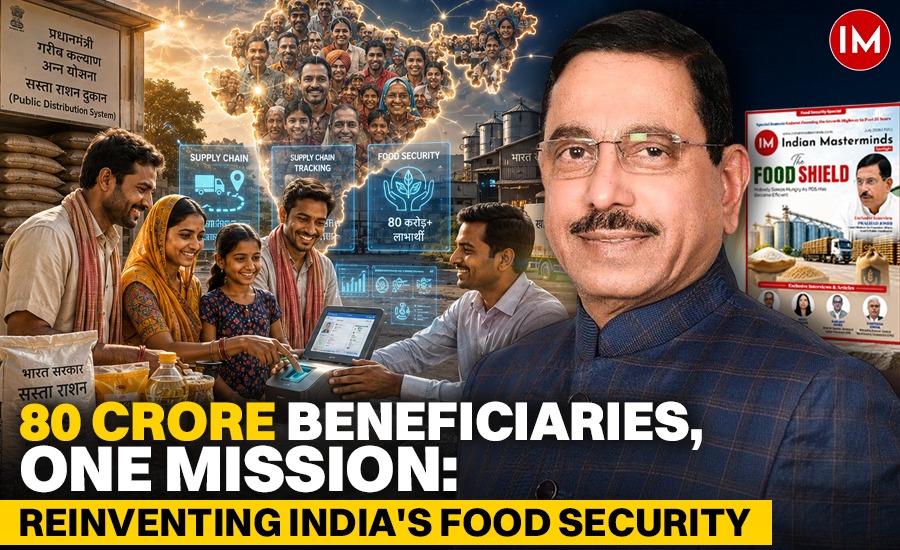
India’s food security system is undergoing one of its biggest transformations since the National Food Security Act (NFSA) came into force. While the government continues to provide free foodgrains to nearly 80 crore beneficiaries under the Pradhan Mantri Garib Kalyan Anna Yojana (PMGKAY), it is also modernising the Public Distribution System through AI, digital technology, scientific storage and targeted welfare. In this exclusive interview with Indian Masterminds Spotlight, Union Minister for Consumer Affairs, Food & Public Distribution, Shri Pralhad Joshi, discusses the government’s vision for a smarter, more transparent and future-ready food security architecture, the role of technology in reducing leakages, strengthening storage infrastructure, and ensuring that no eligible beneficiary is left behind.
How much foodgrain is being given away free of cost every month and at what cost?
The National Food Security Act, 2013 is being implemented in all the States/UTs aims to supplement the food requirements of upto 75% of the rural and upto 50% of the urban population, which at Census 2011 comes to 81.35 crore persons. While Antyodaya Anna Yojana (AAY) households, which constitute poorest of the poor are entitled to 35 kg of foodgrains, per household per month, Priority Households (PHH) are entitled to 5 kg of foodgrains per person per month free of cost. The Coverage under the Act is substantially high to ensure that all the vulnerable and needy sections of the society get its benefit. As of June 2026, against the intended coverage of 81.35 crore, 79.20 crore beneficiaries are receiving foodgrains free of cost.
The period for distribution of free of cost foodgrains has been extended for five years from 1st January, 2024, with an estimated financial outlay of Rs. 11.80 lakh crore totally to be borne by Central Government. The Food subsidy released by DFPD during FY 2025-26 is Rs 227739.96
What is the criterion for selecting the 80 crore NFSA beneficiaries ?
The NFSA is operated under the joint responsibility of the Central and the State Governments. Under the joint responsibility of the Union and the States, the responsibility for identification of beneficiaries, within the coverage determined for the State/UT, rests with the concerned States/UT. Identification of beneficiaries under the Act is under two categories- households covered under Antyodaya Anna Yojana (AAY) which constitute poorest of the poor, to the extent specified by the Central Government and the remaining households as priority households (PHH) to be identified by the State Governments/ UT Administrations as per criteria evolved by them, within the coverage determined for the State/UT. Thus, the criteria for identification of PHH households may vary from time to time depending upon socio-economic and demographic profile of the State.
NFSA coverage is capped at 75% of the rural population and 50% of the urban population (about 67% of the total population), based on the Census 2011 population, translating to a ceiling of 81.35 crore persons. Within this ceiling, State/UT Governments identify actual Antyodaya Anna Yojana (poorest of the poor) and Priority Household beneficiaries using their own approved inclusion/exclusion criteria, subject to Central guidelines, followed by digitisation and Aadhaar seeding of ration cards for verification. How much foodgrain is with GoI under current stock and how much should be under buffer stock ? How much grain is lost annually due to storage inefficiencies ?
How much foodgrain is with GoI under current stock and how much should be under buffer stock ? How much grain is lost annually due to storage inefficiencies?
Do we have enough stock in case crop yields are not as per the expectation due to vagaries of weather or some other factor ?
Food Grains currently available in the Central Pool are sufficient to meet the domestic requirement of wheat and rice to government programmes under TPDS/NFSA and other Welfare requirement
With rising subsidy bills, how does the government balance food security com-mitments with fiscal sustainability ?
DFPD reimburses the expenditure incurred by States, that have opted for Decentralized Pro-curement (DCP) mode for distribution of food-grains to the beneficiaries of Central Schemes as per allocation made by Government of India. The difference between Economic Cost and Central Issue Price (CIP), at which foodgrains are issued to States, is reimbursed to Food Corporation of India (FCI) and DCP States as food subsidy. The food subsidy released to DCP States & FCI is made as per budgetary allocation made by MoF. Further, funds are also released by Food Corpo-ration of India (FCI) to the States for the quan-tum of food-grains handed over to them by States for Central Pool. During FY 2025-26, entire food subsidy allocated by MoF was released to FCI & DCP States as under:
(Fig. in Rs. Crores)
Sr. No. Particulars Subsidy for FY 2025-26
1. Food Subsidy to DCP States 73919.10
2. Food Subsidy to FCI 153820.86
Total 227739.96
What is the long-term thinking of the government-will it become a permanent feature or evolve into a more targated system?
The Government’s long-term vision is to ensure that Pradhan Mantri Garib Kalyan Anna Yojana (PMGKAY) remains a strong pillar of India’s food security system while continuously evolving to meet changing socio-economic needs. The extension of PMGKAY for five years from January 2024 reflects the Government’s commitment to providing food security to approximately 81.35 crore beneficiaries under the National Food Security Act.
Going forward, PMGKAY is expected to become more efficient, transparent, and technology-driven rather than simply expanding in size. Reforms such as the One Nation One Ration Card (ONORC) initiative, Aadhaar-based authentication, end-to-end digitisation of the Public Distribution System, and improved beneficiary management are expected to enhance targeted delivery and reduce leakages.
As India’s economy grows and poverty patterns change, the scheme may gradually evolve through periodic review of beneficiary databases, better identification of eligible households, and greater emphasis on nutritional security. Future reforms may also include diversification of the food basket with millets and other nutritious commodities, in line with the Government’s broader objective of improving health and nutrition.
Therefore, while the commitment to ensuring food security is expected to remain permanent, PMGKAY is likely to evolve into a smarter, more targeted, and technology-enabled system that delivers food support efficiently to those who need it most, while adapting to India’s changing developmental priorities.
Also Read – The Cyber Sentinel: How Dr Pushpendra Singh Turned a Constable’s Duty into a National Mission
Despite digitization and reforms, concerns about leakages and exclusion errors persist in the Public Distribution System. What evidence can you share on how much leakage has actually reduced in recent years?
Independent and government studies over the last decade have shown a marked decline in PDS leakage compared to the historically high estimates of the pre-reform era, attributable to Aadhaar seeding of ration cards, biometric authentication at ePoS-enabled Fair Price Shops, and end-to-end computerisation of the supply chain from FCI godown to the beneficiary. Rightful Targeting has added a further layer by cross-verifying beneficiary data against databases such as income tax, PFMS, vehicle registration and EPFO, resulting in the identification and removal of several crore ineligible beneficiaries, thereby further cleaning the system.
During the month of May 2026, 3.28 Lakh beneficiaries were removed under rightful targeting exercise and the cumulative number is approx.2.43 Cr.
The Portability scheme has been widely praised, especially for migrant workers. What percentage of beneficiaries are actively using ONORC today, and what operational challenges remain?
One Nation One Ration Card is now operational across all 36 States/UTs and covers virtually the entire NFSA beneficiary base of about 81 crore persons, with roughly 3 crore portability transactions recorded every month and over 221 crore cumulative transactions since 2019. However, the bulk of this volume is intra-state portability; the interstate transactions most relevant to long-distance migrant workers remain a small fraction of the total, reflecting low beneficiary awareness of the interstate facility at the Fair Price Shop.
India often ends up with excess grain stocks beyond buffer norms leading to storage and wastage issues. How is the government rationalising procurement and storage to avoid inefficiencies?
The Government’s strategy focuses on balancing procurement with distribution requirements, timely liquidation of surplus stocks, scientific storage augmentation, modernization of infrastructure and technology-driven inventory management to minimize wastage and improve overall efficiency of the foodgrain management system. Various steps and initiative are taken by the government to rationalise procurement and storage to avoid inefficiencies as:
Procurement of wheat and paddy at Minimum Support Price (MSP) is undertaken primarily to safeguard farmers from distress sales and to meet the requirements of the National Food Security Act (NFSA), Other Welfare Schemes (OWS), buffer stocking norms and strategic reserves. Procurement remains open-ended for foodgrains conforming to prescribed quality specifications.
To avoid excess accumulation of stocks, the Government continuously reviews procurement, stock position, buffer norms and distribution requirements. Surplus foodgrains are periodically liquidated through the Open Market Sale Scheme (Domestic) [OMSS(D)], thereby reducing carrying costs, creating storage space and helping moderate market prices. During 2025-26 (up to 30.12.2025), 77.31 LMT of rice and 1.97 LMT of wheat were sold under OMSS(D).
Food Corporation of India (FCI) continuously assesses storage requirements based on procurement trends, peak stock levels, buffer norms and State-wise distribution requirements. Storage capacity is created in a calibrated manner based on identified storage gaps, particularly in procuring and consuming States, thereby avoiding indiscriminate capacity creation.
With a view to meet storage requirements and ensure safe scientific storage of foodgrains across the country, Government is augmenting storage capacity through the Private Entrepreneurs Guarantee (PEG) Scheme, Private Warehousing Scheme (PWS), construction of steel silos under PPP mode, creation of godowns under Asset Monetization, Centre Sector Scheme (CSS), and hiring of storage capacity from CWC, SWCs and State agencies.
CAP phase out- To phase out conventional Covered and Plinth (CAP) storage, Government has launched the New PEG Scheme-2024 for creation of 90 LMT of scientific covered storage capacity in Punjab and Haryana, thereby improving storage efficiency and reducing post-harvest risks.
Modern steel silos with bulk handling facilities are being developed to enhance preservation, reduce handling losses, improve operational efficiency and minimize transit and storage losses. As on 01.06.2026, 39 LMT silo capacity has been completed, 25.625 LMT is under construction and tenders for another 25.125 LMT have been awarded.
i. Technology-enabled monitoring through initiatives such as the Depot Darpan Portal, Smart Warehousing, Vehicle Location Tracking System (VLTS) and scientific storage protocols has strengthened stock monitoring, improved warehouse performance and reduced operational losses.
ii. Storage Losses:
With sustained efforts by the implementing agency of DFPD, i.e. FCI, storage losses have been maintained at minimal levels and reflects performance favourably with international benchmarks and underscoring the effectiveness of scientific storage management:
| Commodities | FCI (FY 2025–26) | International/Global Practice |
| Rice | 0.19% Loss | 0.41–4.0% Loss |
| Wheat | 0.41% Storage Gain | 0.3–2.0% Storage Loss |
Procurement remains heavily skewed towards rice and wheat, benefiting a few states disproportionately. Is there a roadmap to diversify procurement towards pulses, millets and oilseeds?
Procurement of coarse grains is regulated by guidelines for allocation, distribution and disposal of millets/coarse grains (Jowar, Bajra, Maize & Ragi etc.) and 6 minor millets procured by the States. Under these guidelines States are allowed to procure these commodities in Decentralized Procurement mode from farmers at Minimum Support Price (MSP) for distribution under Targeted Public Distribution System (TPDS)/ Other Welfare Schemes (OWS). Government of India has taken following measures to increase Millets Procurement:
(i) Government of India in 2021 has revised guidelines for procurement of Coarsegrains.
(ii). Distribution period/Shelf life of millets was increased from earlier 3 months to 6-10 months.
(iii). Provision of inter-state transportation of surplus millets through FCI has been incorporated.
(iv). Increase in administrative charges on acquisition stage from 1% to 2% of MSP, to incentivise procurement of millets.
(v). Government in 2023 has expanded scope of procurement of millets by States/ Union Territories by including 6 minor millets: Foxtail Millet(Kangani/Kakun), Proso Milet (Cheena), Kodo Millet (Kodo), little millet (Kutki), Buck-wheat (kuttu) and Ameranthus (Chaulai) under Minimum Support Price (MSP) scheme on the MSP of Ragi upto KMS 2028-29.
As a result of above measures, as on 05.07.2026 the total procurement carried out during Kharif Marketing Season (KMS) 2025-26 is 14.53 LMT and procurement is still going on. This is the highest procurement of coarse grains since KMS 2004-05
FCI is central procurement and distribution but also faces criticism over inefficiency and high costs. Are there structural reforms being considered to make FCI learner and more efficient?
The high costs are primarily due to the large volume handled by the FCI and the open-ended procurement policy aimed at supporting farmers. However, as far as efficiency is concerned, the FCI has improved significantly over the last one to two decades. Transparency in its operations has been enhanced through various technological initiatives and continues to improve with the implementation of new measures. Further, based on the recommendations of the Shanta Kumar Committee, a number of reforms have been undertaken by FCI to make it leaner and more efficient including the following:
(i) The procurement of foodgrains is now undertaken by the State Govt. Agencies under Decentralized mode of procurement (DCP mode) in the following states which is annexed as Annexure-II.
(ii) Decentralised procurement of food grains by the State Govt. and their agencies has been promoted and encouraged to widen penetration of MSP operations to every nook & corner of the country. Continuous efforts and desirable hand holding to the State Govt. agencies have been extended in the Eastern and North-Eastern States to increase the penetration of MSP operation. In KMS 2022-23, KMS 2023-24 and KMS 2024-25 a quantity of 99.36 LMT, 76.83 and 92.20 LMT paddy (in terms of rice) respectively has been procured in Eastern States. During KMS 2025-26, 87.01 LMT Paddy (in terms of rice) has been procured in Eastern States up to 19.04.2026. To extend the benefit of MSP to the famers of Tripura, procurement of paddy in Tripura has commenced from KMS 2018-19. Massive awareness programmes and desirable hand holding to the State Govt. Agencies have been extended in the Eastern Sates and North-eastern States to increase the penetration of MSP operations.
(iii) FCI has strengthened its quality control system, modernized the laboratories and has involved independent agencies for quality check.
(iv) Levy rice procurement has been discontinued from Kharif Marketing Season 2015-16.
(v) In addition to maintaining buffer stocks and meeting the requirement of the Targeted Public Distribution System (TPDS) and Other Welfare Schemes (OWS), Food Corporation of India, on the instructions from the Government, sells excess stocks of wheat and rice from the Central Pool at pre-determined prices in the open market from time to time under Open Market Sale Scheme.(Domestic) to offload the excess stocks and to moderate the open market prices.
(vi) The following technological initiatives have been undertaken to improve transparency and operational efficiency in procurement:
- CFPP & SFPPs — The Central Food Grains Procurement Portal digitises the entire MSP procurement chain, integrating all State Foodgrain Procurement Portals into a single source for monitoring and strategic decisions.
- Minimum Threshold Parameters (MTPs) — Common parameters mandated across all portals cover online farmer registration, land-record and PFMS payment integration, digitised mandi operations and CMR/wheat delivery management. MTP data flows via API-based integration to CFPP for real-time reporting of farmers benefitted, quantity procured and payment made.
- Additional MTPs — Further efficiency measures include biometric-based procurement and linking mill electricity consumption with milled paddy quantity. Transport vehicles are integrated with Vahan Sarathi and GPS-tracked from procurement centres to mills and godowns to minimise leakages.
- Grading of PCs & PCSAP — Procurement centres are graded nationwide through the AI-enabled Procurement Centres Self-Assessment Portal, improving infrastructure, transparency and service delivery for farmers.
- MSP through DBT — “One Nation, One MSP through DBT” (since RMS 2021-22) pays MSP directly into Aadhaar-linked farmer accounts, ensuring transparency and preventing diversion of payments.
- JPV App & Extension Module — The JPV mobile app enables real-time, geo-tagged verification of unmilled paddy, while its SMART-PDS Extension Module automates mill selection and workflow-based processing of extension requests.
Procurement Module (SMART PDS) — A digital platform streamlines end-to-end foodgrain procurement across stakeholders — operational in Uttarakhand, with phased rollout to more states planned.
Looking ahead, how do you see India’s food security architecture evolving-especially in the context of urbanization, climate change, and changing consumption pattern?
Looking ahead, India’s food security architecture is expected to evolve by becoming more resilient, technology-driven, and nutrition-focused, while continuing to ensure that no vulnerable household is left behind. In this context, the Pradhan Mantri Garib Kalyan Anna Yojana (PMGKAY) will remain a cornerstone of the country’s food security framework.
As urbanisation increases, PMGKAY is likely to be strengthened through greater portability of food entitlements under the One Nation One Ration Card (ONORC) initiative, enabling migrant workers and urban poor to access subsidised food grains anywhere in the country. This will help address the challenges of a mobile workforce and rapid urban growth.
Climate change poses significant risks to agricultural production and food availability. To address these challenges, India’s food security system will increasingly integrate climate-resilient agriculture, improved storage infrastructure, digital supply chain management, and diversified procurement of climate-resilient crops. PMGKAY will continue to provide a reliable safety net by ensuring uninterrupted access to food grains during periods of climatic and economic stress.
Changing consumption patterns and rising awareness of nutrition are also likely to shape the future of food security. While PMGKAY currently focuses on providing free food grains, the broader food security architecture may gradually move towards a more nutrition-sensitive approach by encouraging the inclusion of millets in the Public Distribution System. This would support both nutritional security and sustainable agricultural practices.
Overall, PMGKAY demonstrates the Government of India’s commitment to ensuring food security for vulnerable populations. Going forward, its integration with digital governance, climate-resilient agriculture, portability of benefits, and nutrition-oriented reforms will help build a more inclusive, efficient, and sustainable food security architecture capable of meeting the challenges of urbanisation, climate change, and evolving dietary preferences.
While foodgrain availability has improved, malnutrition remains a concern. Is the current PDS model-focused largely on rice and wheat-adequate, or do we need to rethink it from a nutrition perspective esp for BPL people (surviving at 27/- per day)?
Under the Act, the term “foodgrains” is defined as rice, wheat or coarse grains or any combination thereof conforming to such quality norms as may be determined, by order, by the Central Government from time to time.
Further, in order to improve the level of nutrition, an advisory has also been issued to all the States/UTs to procure millets and distribute them to beneficiaries as per local consumption preferences and as per guidelines issued by the Central Government from time to time.
The Act also provides that pregnant women and lactating mothers and children in the age group of 6 months to 14 years are entitled to meals as per prescribed nutritional norms under Integrated Child Development Services (ICDS) and PM-POSHAN schemes. Higher nutritional norms are prescribed for malnourished children upto 6 years of age.
Pregnant women and lactating mothers are further entitled to receive cash maternity benefit of not less than Rs. 6,000 to partly compensate for the wage loss during the period of pregnancy and also to supplement nutrition.
From Aadhar seeding to e-POS machines, technology has been a major reform driver. What has been the most impactful tech intervention so far, and where are the gaps still visible?
Aadhaar seeding combined with biometric authentication at ePoS-enabled Fair Price Shops has arguably been the single most transformative intervention, enabling real-time entitlement verification and making portability under ONORC possible nationwide. The visible gaps that remain are connectivity — a significant number of Fair hops in remote and hilly areas still face network issues that hamper real-time authentication — and the absence, until now, of a single authoritative national beneficiary data repository, a gap that NIRMAL (National PDS Registry database) under the SARTHAK PDS scheme is specifically designed to close.
“ANNA CHAKRA” Route Optimization tool
Anna Chakra is GIS and Operations Research (OR) based supply chain optimization tool. The tool utilizes state-specific algorithms and GIS-based analytics to optimize transportation, procurement, and interstate movement of food grains across the supply chain.
The initiative has demonstrated significant impact in improving operational efficiency and reducing logistics costs. The Route Optimization exercise has been completed in 31 States/UTs for optimization of food grain movement under PDS.
The optimization exercises have resulted in substantial reduction in transportation distances and operational costs, with estimated annual transportation cost savings of approximately ₹280 crore and reduction in transport lead distances by nearly 25% in various operational scenarios. The initiative has also contributed towards reduction in carbon emissions of around 35%, improved warehouse utilization, enhanced transparency, data-driven decision making, and better efficiency in food grain movement planning.
This tool was launched by Hon’ble Minister of CAF&PD in December 2024..
DEPOT DARPAN PORTAL
It is a self assessment platform for food grain warehouses which enables depot/warehouse managers to assess their warehouses based geo-tagged data on infrastructure, operations and financial performance. Rating is calculated through a composite scoring framework covering both infrastructure and operational parameters. Based on this assessment, depots are assigned star ratings where 5 star rating is best and one star rating is lowest.
This portal was launched by Hon’ble Minister of CAF&PD in May 2025.
CONSTRUCTION OF SILO’S UNDER PPP MODE:
Department is striving to create modern steel silos in PPP mode for Wheat storage which facilitates bulk storage and movement and helps in reducing logistics cost by promoting mechanized handling. Silos require only 1/3rd land in comparison of conventional godowns and enhances the grain’s shelf life.
As of date 01.06.2026, Silos of total 39 LMT capacity are functional and 50.75 LMT are under different stages of implementation.
SMART WAREHOUSE SYSTEM:-
The Smart Warehousing System integrates advanced technologies such as FASTag and ANPR-based gate automation, intelligent access control through geo-tagged smart locks, AI-enabled bag counting, face recognition systems, object detection, IoT-based monitoring of environmental parameters, and AI-powered surveillance for fire, smoke and rodent detection.
This technology-driven system is expected to significantly improve operational efficiency by reducing vehicle turnaround time(TAT), enhancing transparency, strengthening compliance monitoring, improving manpower productivity, enabling early hazard detection and providing real-time visibility of warehouse operations.
This system has been inaugurated by Hon’ble Minister of CAF&PD on 18.06.2026