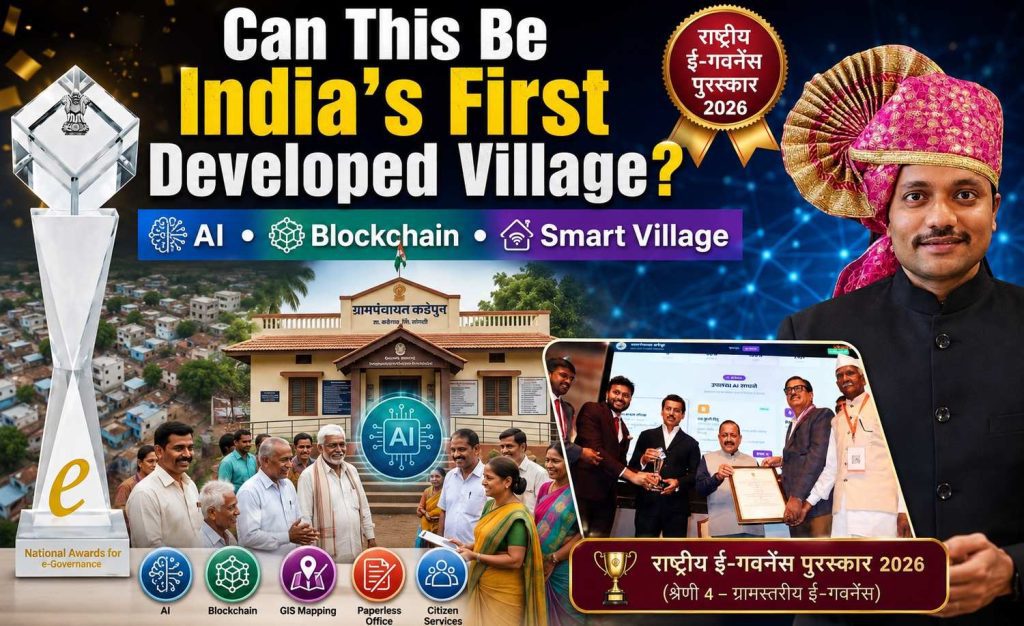
Bureaucracy has often been criticised for moving slowly, but when visionary leadership is combined with innovation and determined implementation, it has the power to transform lives and rewrite the destiny of entire communities. The remarkable transformation of Kadepur Gram Panchayat in Maharashtra’s Sangli district stands as one such inspiring example. What was once a conventional village administration dependent on paper records, manual processes and long queues has today emerged as one of India’s most advanced digitally governed villages – earning national recognition and setting a benchmark for more than 2.5 lakh Gram Panchayats across the country.
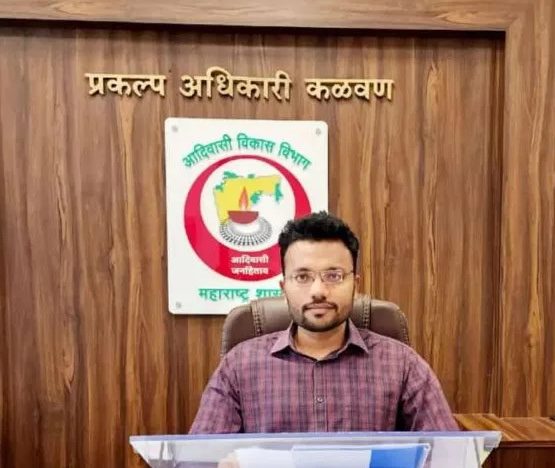
Behind this transformation is 2020-batch IAS officer Vishal Narwade, Chief Executive Officer (CEO) of Sangli Zilla Parishad, who assumed charge on September 1, 2025. In just ten months, under his leadership, Kadepur Gram Panchayat implemented cutting-edge technologies like artificial intelligence, blockchain, GIS mapping, robotics and a completely paperless e-office system. The result was not only improved governance and transparency but also a significant enhancement in citizens’ quality of life.
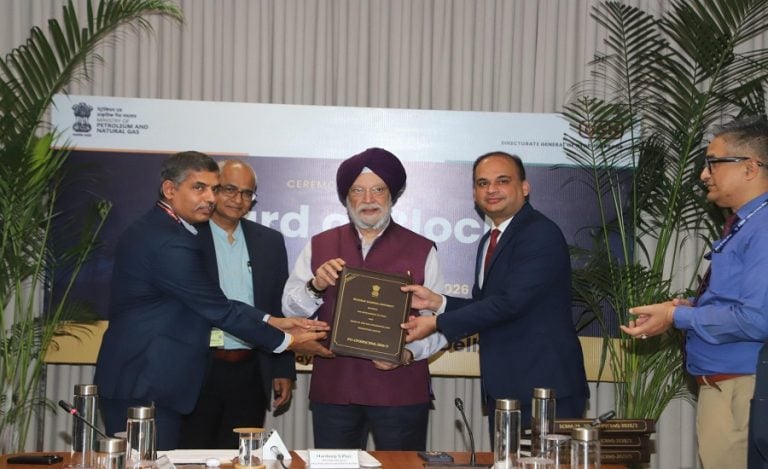
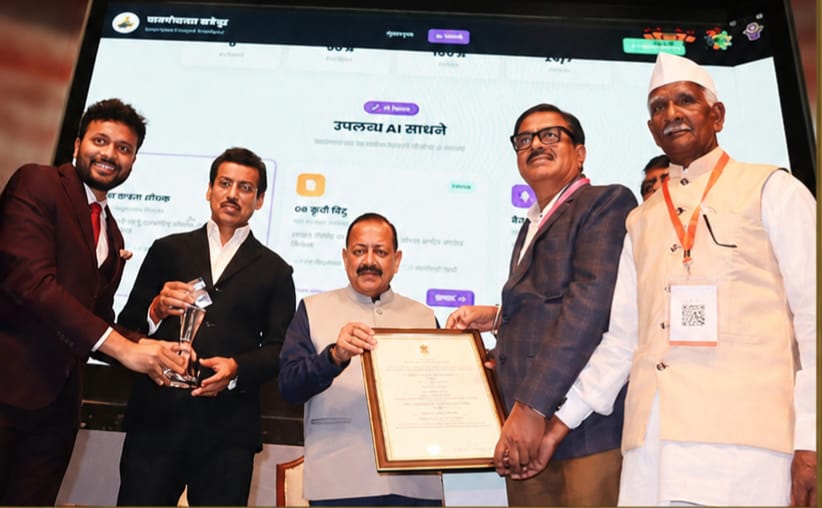
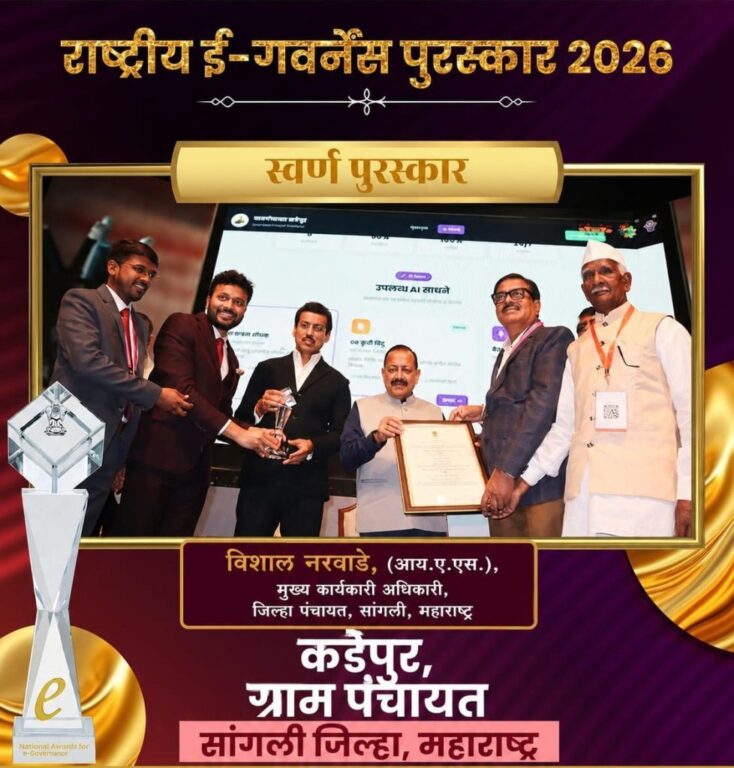
The efforts have now been recognised nationally. Kadepur Gram Panchayat received the National Award for e-Governance 2026 (Category 4 – Grassroots e-Governance) during the 29th National Conference on e-Governance held in Jaipur. The award was presented by Union Minister Dr. Jitendra Singh and Rajasthan Home Minister Rajyavardhan Rathore. Interestingly, this marks Narwade’s second consecutive National e-Governance Award, having won the top honour last year while serving in another district – demonstrating that good governance is driven by leadership rather than geography.
Speaking to Indian Masterminds, IAS officer Narwade shared the vision, planning and implementation behind this extraordinary initiative.
‘Technology Should Not Be Limited to Cities’
For Narwade, digital governance should not remain confined to urban India.
“This was the 29th National e-Governance Conference. Only recently was a separate Gram Panchayat category introduced. My question has always been—why should the use of modern technology be limited to urban areas? Rural India deserves the same recognition and the same technological advancement,” he said.
He pointed out that while he changed districts after receiving last year’s award, he replicated the same governance philosophy in Sangli.
“Last year I received the first prize in another district. This year I was transferred, but I implemented the same vision here as well. That proves leadership matters. Good governance should not depend on one location—it should be replicable.”
Read Also: From AI to Gram Panchayats: India Celebrates 17 Digital Governance Breakthroughs at NAeG 2026
The Dream: India’s First Developed Village
While many speak about making India a developed nation, Narwade believes that transformation must begin from the grassroots.
“When we talk about Viksit Bharat, why shouldn’t we dream of creating the country’s first developed village? Nobody has yet defined what a ‘developed village’ truly means. But one thing is certain—if a village is using the latest technologies for governance and public service, that has to be part of the definition.”
That vision became the foundation of Kadepur’s transformation.
From Paper Files to Digital Governance
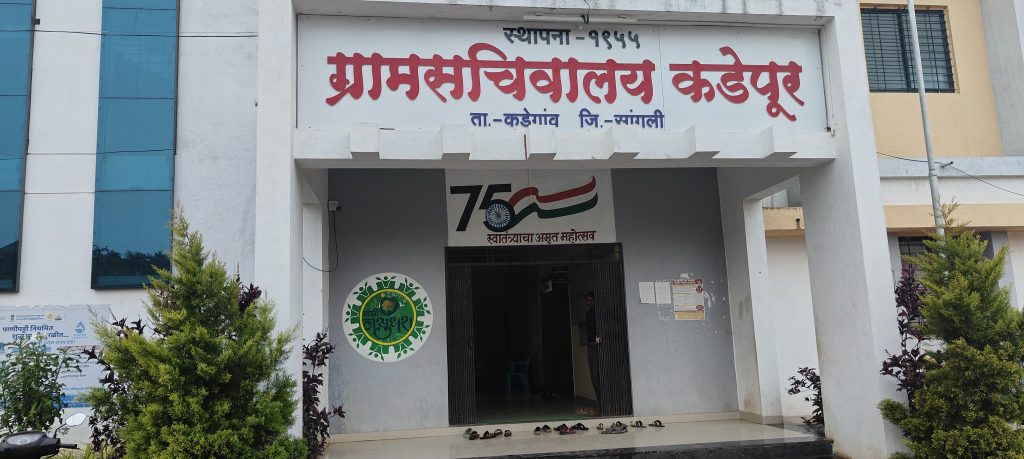
Kadepur Gram Panchayat, located in Kadegaon Taluka of Sangli district, has a population of 5,735 spread across more than 2,826 households in five wards. Until recently, governance here looked much like any other village – paper registers, manual records, cash-based tax collection, delays in issuing certificates, leakages, record tampering and exclusion of vulnerable citizens.
Residents often travelled nearly 65 kilometres to the taluka office just to obtain certificates, losing an entire day’s wages in the process. Farmers frequently missed government schemes because of documentation delays. Senior citizens, women and persons with disabilities found accessing services particularly difficult.
Mr Narwade and his team adopted a simple mission –“Bring every government service to the citizen instead of making the citizen run after the government.”
Building the Country’s First Fully Paperless Gram Panchayat
One of the most remarkable achievements was converting Kadepur into India’s first Gram Panchayat to operate through a completely paperless e-Office system.
While many state departments are still transitioning towards digital file movement, every administrative file in Kadepur is processed electronically.
The Panchayat also adopted an ambitious policy framework backed by a ₹21 lakh budget (2024–2029). Instead of waiting for state-level policies, the village formulated its own governance policies after consulting residents through a village-level e-Governance conference.
The Panchayat now has dedicated policies covering:
- Artificial Intelligence
- Blockchain
- GIS
- e-Governance
- Cyber Security
- Robotics
- e-Waste Management
- Digital Administration
“Policies shouldn’t exist only at the national or state level. A village also knows its own needs. That’s why we created our own policies after listening to our citizens,” Mr Narwade explained.
Zero-Visit Governance: Government Services from Anywhere
Perhaps the most citizen-friendly innovation is the complete digitisation of public services.
IAS Narwade explained how thousands of villagers now living outside Kadepur no longer need to return home for official work.
“People leave villages for education, jobs or marriage. Earlier they had to physically come back just to obtain a birth certificate or marriage certificate. Now they simply visit our website, choose the service, upload the required information, pay the authorised government fee online through PhonePe or QR code, and receive the certificate on WhatsApp and email within the stipulated time.”
Applications reach the Gram Panchayat Secretary electronically, verification is completed digitally, and certificates are issued online.
Today, Kadepur delivers over 1,355 online government services, making governance available 24×7 from anywhere in the country.
Owning Its Own Technology Stack
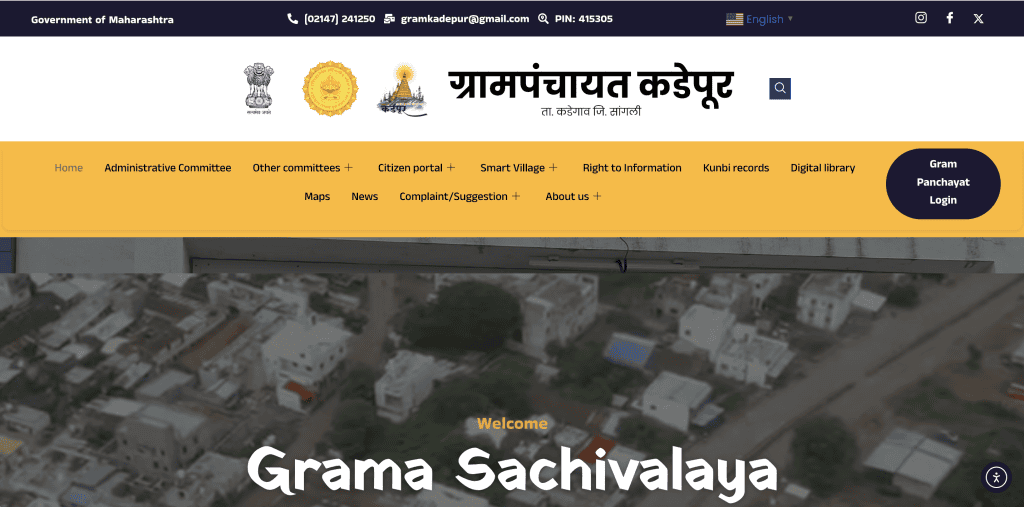
Unlike most Panchayats that depend entirely on state portals, Kadepur owns its digital ecosystem.
Its official website, dedicated service portal (gpkadepur.in), Android tax application, digital payment system, citizen service centres, ICT laboratory and integrated digital platforms work together to deliver seamless governance.
More than 1,300 online services and 1,200 blockchain-verified certificates have already been delivered.
The Panchayat’s Android tax application, available on the Google Play Store, maps every household with mobile numbers, enabling over 2,000 digital tax transactions annually through Razorpay while handling collections exceeding ₹15 lakh with instant digital receipts.
Using Artificial Intelligence at the Grassroots
One of the most striking aspects of Kadepur’s transformation is the extensive use of Artificial Intelligence.
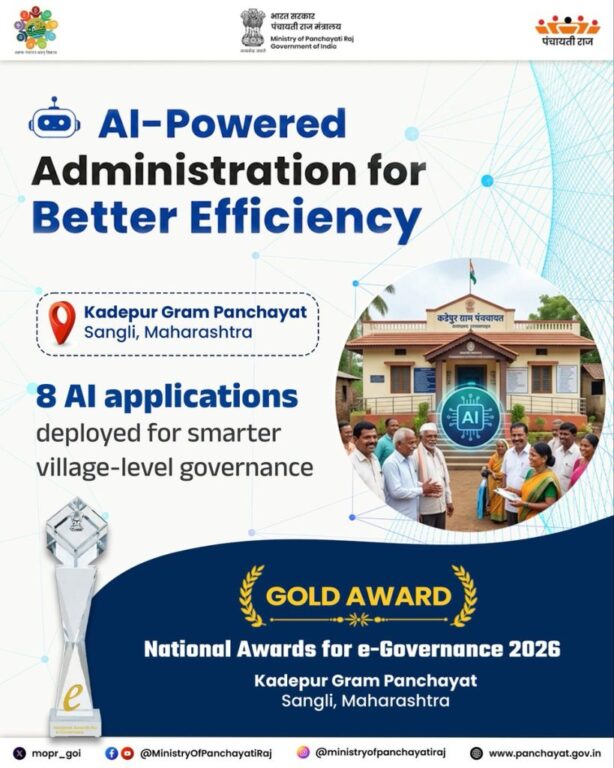
Eight AI-based applications have been introduced, including:
- Scheme Eligibility Finder
- Government Resolution Action Extractor
- Meeting Summariser
- Data Analytics Tools
- AI-based Administrative Assistance
- Gaaatha multilingual chatbot
- Citizen guidance tools
- Workflow automation
The Marathi-speaking AI chatbot operates round the clock, helping citizens access information without visiting government offices.
According to Narwade, AI has reduced administrative workload by nearly 50 percent, allowing officials to focus more on public service.
Blockchain Makes Records Tamper-Proof
Kadepur has become one of the first villages in India to introduce blockchain-backed governance.
Using SHA-256 hashing and blockchain architecture, over 1,266 certificates have been secured through more than 1,133 blockchain blocks, making document tampering virtually impossible.
Citizens can instantly verify certificates online without depending on manual verification.
GIS Mapping Increased Revenue
Technology was not used merely for digitisation—it also improved governance outcomes.
Through high-resolution drone-based GIS surveys, every property in the village was geo-tagged.
The survey identified more than 350 previously unrecorded houses, which were subsequently added to the tax database.
This increased Gram Panchayat revenue by approximately ₹7.5 lakh, while also creating a publicly accessible GIS portal for better planning.
Digital Inclusion: Ensuring Nobody Is Left Behind
Recognising that digital governance should be inclusive rather than exclusive, Kadepur introduced 12 accessibility measures.
Every household received an NFC-enabled smart card allowing tap-and-access services without requiring digital literacy.
Other initiatives include:
- Self-service digital kiosks
- AI chatbot assistance
- Screen-reader compatibility
- Font and contrast accessibility
- Trilingual interfaces
- Assisted service delivery
- Free services for vulnerable groups
As IAS Narwade proudly noted, “No citizen should be denied services because of technology. Technology must bridge gaps—not create new ones.”
Empowering Farmers Through Technology
Farmers also became beneficiaries of digital governance.
The Krushi Mitra Portal provides information on:
- Soil health
- Weather forecasts
- Crop advisory
- Market prices
- Government schemes
- Agricultural calculators
This has helped improve awareness and access to schemes such as PM-KISAN and PMFBY.
Transparent Governance Through Citizen Participation
Kadepur has also emerged as one of India’s most participative Gram Panchayats.
It recorded the country’s highest usage of the Government of India’s Meri Panchayat App, with 1,839 grievances and suggestions successfully addressed.
Similarly, the Panchayat has uploaded proceedings, photographs and videos of all 64 Gram Sabha meetings on the Panchayat Nirnay App since its launch in October 2022.
These records have collectively received over 1.2 lakh views, making village governance transparent and accessible.
“Transparency should not be a slogan. Citizens should actually be able to see every decision taken by their Gram Panchayat,” he said.
Improving Ease of Living
The transformation has fundamentally changed everyday life.
Earlier, villagers travelled long distances, spent money on transport and lost daily wages simply to obtain certificates or government approvals.
Today, most services – from birth certificates and marriage registrations to electricity bill payments, tax payments, licences and mobile recharges – can be completed digitally from home.
This has significantly improved both ease of living and ease of governance.
A Learning Centre for Rural India
Kadepur is no longer just a successful Gram Panchayat – it has become a national learning centre.
The village has already hosted more than 1,000 physical study visits and 2,895 virtual learning sessions involving representatives from nine states.
It has also been recognised by YASHADA Pune as a Panchayat Learning Centre, allowing officials, researchers and administrators from across the country to study its governance model.
Partnerships with Adarsh College, NGOs and Quantox Technologies have strengthened knowledge-sharing, technological sustainability and innovation.
Recognition Beyond Awards
Narwade believes awards are only milestones, not the destination.
Reflecting on the recognition received in Jaipur, he said senior bureaucrats from the Government of India were impressed by the level of innovation taking place in a village.
“When we presented our work, several senior IAS officers appreciated that technologies like AI, blockchain, robotics and GIS – sometimes not fully implemented even in government departments – were being used at the Gram Panchayat level. That appreciation was deeply encouraging.”
A Blueprint for India’s 2.5 Lakh Panchayats
Kadepur’s journey demonstrates that digital transformation is not about expensive infrastructure but about visionary leadership, citizen participation and purposeful implementation.
In just ten months, a village administration once dependent on paper files has become a national model of digital sovereignty, transparent governance and inclusive service delivery.
As India moves towards its vision of a developed nation, the Kadepur model offers a compelling reminder that true transformation begins at the grassroots—and sometimes, the road to a developed India starts with a single village daring to dream differently.
Read Also: How Two IAS Officers Reunited A Missing Maharashtra Grandma with Her Family After Two Years