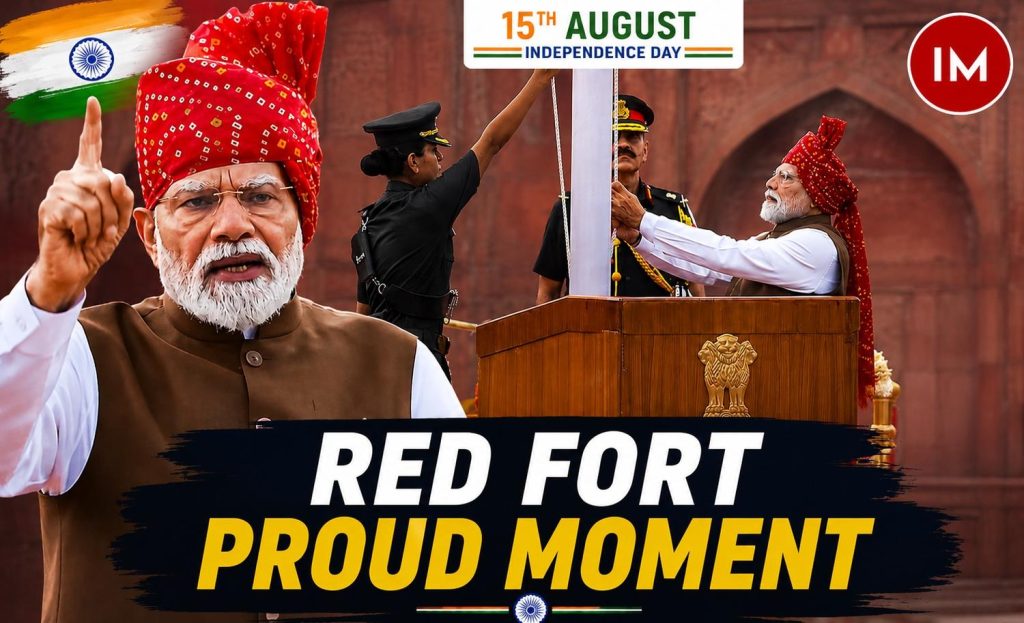
New Delhi: Prime Minister Narendra Modi hoisted the national flag from the ramparts of the Red Fort on August 15, 2026, marking India’s 80th Independence Day. But alongside the Prime Minister during the ceremonial proceedings, Captain Sonia Singh Chauhan of the Indian Army also became a centre of attention.
Images of Captain Sonia standing behind PM Modi and assisting with the flag-hoisting procedure quickly attracted public attention. Her composed presence during one of the country’s most significant national ceremonies has also highlighted the growing visibility of women officers in the Indian Armed Forces.
Captain Sonia Singh Chauhan is a commissioned officer of the Indian Army. She was assigned duties connected with the Independence Day ceremony at the Red Fort, where she was seen assisting the Prime Minister with the ceremonial flag-hoisting procedure.
What Was Captain Sonia Singh Chauhan’s Role?
Captain Sonia was part of the military protocol associated with the Prime Minister’s flag-hoisting ceremony.
As PM Modi arrived at the Red Fort ramparts and proceeded with the Independence Day ceremony, Captain Sonia was positioned close to him and was seen handling the flag’s cord during the formal proceedings.
Read Also: Indian Army to Get ₹1,577 Crore Loitering Munitions in Major Tata-Nibe Defence Deal
The role requires precision, discipline and familiarity with ceremonial military procedures, as the sequence of events at the Red Fort is carefully coordinated.
The ceremony involves several synchronised elements, including the arrival of the Prime Minister, unfurling of the national flag, the National Anthem and the ceremonial 21-gun salute.
Her presence in the frame alongside the Prime Minister therefore reflected an assigned ceremonial responsibility rather than simply a symbolic appearance.
Who Is Captain Sonia Singh Chauhan?
Captain Sonia Singh Chauhan is a commissioned officer in the Indian Army.
However, detailed information about her personal background, service history and current posting is not publicly available at this stage. Her regiment or unit has also not been officially disclosed in the information currently available.
Therefore, claims circulating about her education, family background, exact unit or previous operational postings should be treated cautiously unless confirmed through official sources.
What is established is that she was entrusted with a role in the 80th Independence Day celebrations at the Red Fortand assisted PM Modi during the flag-hoisting ceremony.
Why Her Red Fort Appearance Became Significant
The Independence Day ceremony at the Red Fort is among India’s most prestigious national events. The Prime Minister’s flag-hoisting is watched by millions of people across the country and is accompanied by carefully planned military and civil protocols.
Captain Sonia’s appearance alongside the Prime Minister consequently attracted considerable attention, particularly among young Indians and women aspiring to join the armed forces.
Her presence also comes at a time when women are increasingly taking on a wider range of responsibilities within India’s military institutions.
From combat and aviation roles to leadership, training and ceremonial responsibilities, women officers are becoming increasingly visible across the defence establishment.
How Does the Red Fort Flag-Hoisting Ceremony Work?
The Independence Day ceremony at the Red Fort involves extensive coordination between the Ministry of Defence and the armed forces.
The flag-hoisting procedure is not an improvised event. Every element is rehearsed and coordinated in advance to ensure that the national flag is unfurled at the appropriate moment and that the subsequent ceremonial sequence proceeds precisely.
The military component includes the ceremonial arrangements around the Prime Minister, the flag and the National Anthem, followed by the traditional gun salute.
Officers selected for specific ceremonial duties therefore have to maintain strict discipline and precision throughout the proceedings.
Captain Sonia and the Growing Role of Women in the Army
Captain Sonia’s presence at the Red Fort has also become a prominent example of the increasing visibility of women in India’s military establishment.
The Indian Armed Forces have expanded opportunities for women across several branches and professional roles over the years. Women officers are now serving in increasingly diverse assignments, contributing to operational, technical, administrative, training and ceremonial duties.
Her appearance during the Independence Day ceremony has consequently resonated with many young women who aspire to pursue careers in the armed forces.
How Can Women Become Officers in the Indian Army?
For graduates aspiring to join the Indian Army as officers, one of the established routes is the Combined Defence Services (CDS) examination conducted by the Union Public Service Commission (UPSC), subject to the applicable eligibility requirements.
Candidates who qualify through the relevant entry route undergo the Services Selection Board (SSB) assessment and medical examination. Those selected subsequently undergo military training at the designated training academy.
Another route is the NCC Special Entry Scheme for eligible candidates holding the required NCC ‘C’ Certificate and meeting the prescribed criteria. This route has its own selection process and eligibility conditions.
Women can also enter the Army through other notified officer-entry schemes depending on their educational qualifications and the recruitment notifications issued from time to time.
Captain Sonia Singh Chauhan’s Viral Moment
The image of Captain Sonia Singh Chauhan standing alongside PM Modi during the Independence Day ceremony has become one of the notable visuals from the August 15, 2026 celebrations.
While her personal and professional profile remains relatively undisclosed, her ceremonial role at the Red Fort has brought attention to an Indian Army officer who was entrusted with an important responsibility during one of the country’s most watched national events.
Her appearance has also provided a powerful visual representation of Nari Shakti and the expanding role of women in India’s defence services.