NEW DELHI: The Indian Army is set to receive a major boost to its precision-strike and battlefield capabilities with the Ministry of Defence signing a ₹1,577 crore contract with Tata Advanced Systems Limited and Nibe Private Limited for the procurement of advanced loitering munition systems and associated accessories.
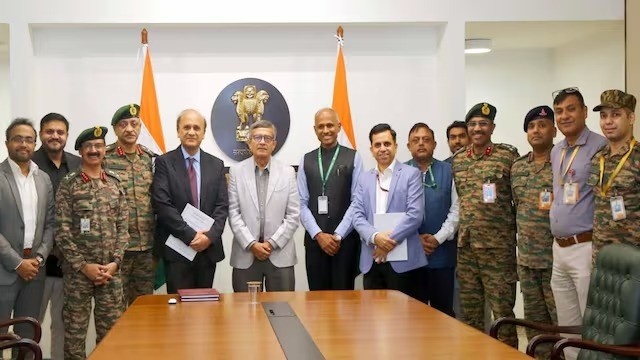
The agreement was signed in New Delhi on August 14, 2026, in the presence of Defence Secretary Rajesh Kumar Singh.
The procurement is being executed under the Buy (Indian) category through the Fast Track Procedure (FTP), reinforcing the government’s focus on rapidly strengthening the armed forces while promoting indigenous defence manufacturing.
The contract is also expected to provide a significant push to the Atmanirbhar Bharat initiative by placing a major defence order with Indian private-sector companies.
Major Boost to Indian Army’s Precision Strike Capability
The new procurement will equip the Indian Army with loitering munition systems capable of locating and engaging designated targets with precision.
Read Also: Indian Army Loses Major General Sunil Kumar Razdan, First Wheelchair-Borne General
Loitering munitions have emerged as an important category of modern battlefield weaponry because they combine capabilities associated with drones, surveillance systems and precision-guided weapons.
Unlike conventional artillery ammunition, a loitering munition can remain airborne while searching for or waiting for a suitable target before conducting a precision strike.
The acquisition is therefore expected to enhance the Army’s ability to engage time-sensitive and high-value targets while improving situational awareness and precision engagement capabilities.
What Are Loitering Munitions?
Loitering munitions are unmanned aerial systems designed to loiter or remain over an area for a period of time before engaging a target.
They are sometimes informally described as “suicide drones” because the munition itself is designed to strike and destroy its target rather than return to base.
The system typically combines several capabilities in a single platform, including surveillance, target identification, navigation and precision engagement.
Once a suitable target is identified and the engagement decision is made, the munition can conduct a precision strike.
This ability to observe an area before engaging a target distinguishes loitering munitions from conventional ammunition that is fired towards a predetermined location.
Why the New System Matters for the Indian Army
Modern warfare increasingly places a premium on precision, speed, surveillance and the ability to engage targets at tactical ranges.
Loitering munitions can provide commanders with an additional option for dealing with targets that may be difficult to engage using conventional systems.
Their ability to remain airborne while searching for targets can potentially improve the response against mobile or fleeting targets.
For the Indian Army, integrating such systems into its combat formations can strengthen its layered strike capabilities and complement existing artillery, missile and unmanned systems.
Tata and Nibe to Strengthen Indigenous Defence Manufacturing
A significant aspect of the agreement is that the contract has been awarded under the Buy (Indian) category to domestic companies.
Tata Advanced Systems Limited has emerged as one of India’s major private-sector defence and aerospace manufacturers, while Nibe Private Limited is involved in defence manufacturing and related technologies.
The contract is therefore expected to strengthen India’s domestic industrial base for advanced unmanned and precision-strike systems.
By sourcing the systems from Indian companies, the procurement supports the government’s broader objective of reducing dependence on imported defence equipment and developing domestic design, manufacturing and supply-chain capabilities.
Contract Executed Through Fast Track Procedure
The Ministry of Defence has processed the procurement under the Fast Track Procedure, reflecting the operational importance of quickly equipping the armed forces with emerging technologies.
The FTP mechanism is intended to accelerate procurement in situations where operational requirements demand faster acquisition.
The move comes amid India’s broader efforts to rapidly modernise its armed forces and introduce technologies that are increasingly becoming important on contemporary battlefields.
Atmanirbhar Bharat Gets Another Defence Push
The ₹1,577 crore agreement is also significant from the perspective of India’s defence self-reliance drive.
Over the past few years, the government has increasingly sought to shift defence procurement towards Indian manufacturers and encourage private-sector participation in military production.
The latest contract strengthens this approach by placing a substantial order for advanced weapon systems with domestic defence companies.
Such procurements can help create demand for Indian defence products while encouraging companies to invest in manufacturing capacity, research and development, supply chains and advanced technologies.
Loitering Munitions and the Changing Battlefield
The growing use of unmanned systems is transforming modern warfare.
Drones and loitering munitions can provide armed forces with relatively flexible tools for surveillance, target acquisition and precision engagement.
Their increasing importance has been demonstrated by conflicts around the world, where unmanned aerial systems have become an integral part of battlefield operations.
For India, developing and inducting such systems is part of a wider effort to ensure that the armed forces remain equipped to operate in increasingly technology-intensive combat environments.
Indian Defence Modernisation Goes Beyond Drones
The latest loitering munition contract is part of a much broader modernisation effort underway across India’s armed forces.
The Ministry of Defence has also been pursuing advanced capabilities in fighter aircraft, ballistic missiles, air defence systems and other emerging military technologies.
The country’s long-term air-power plans include the development of the Advanced Medium Combat Aircraft (AMCA), India’s indigenous fifth-generation fighter aircraft programme.
India is also exploring opportunities to participate in advanced international fighter-aircraft development programmes, including discussions surrounding France’s Future Combat Air System (FCAS).
These initiatives reflect India’s efforts to build capabilities across multiple technological domains rather than relying on a single category of weapon system.
Agni-4 Adds to India’s Strategic Missile Capability
India has also continued to strengthen its missile capabilities.
On August 6, 2026, India successfully conducted a test of the Agni-4 medium-range ballistic missile from the Integrated Test Range at Chandipur, Odisha, under the supervision of the Strategic Forces Command.
The test represented another step in India’s continuing efforts to validate and strengthen its strategic missile capabilities.
The country has also conducted trials involving other missile and air-defence systems, including the Agni-1 and the long-range air-defence system Kusha.
Building a Multi-Layered Defence Capability
Taken together, these developments point towards a broader transformation of India’s military capabilities.
The Indian armed forces are simultaneously expanding their capabilities in:
- Unmanned aerial and loitering munition systems
- Indigenous fighter aircraft
- Ballistic and cruise missile systems
- Long-range air defence
- Precision-strike technologies
- Advanced surveillance and battlefield systems
The objective is to create a more integrated and technology-driven military capable of responding to a wide range of operational challenges.
Why the ₹1,577 Crore Deal Is Significant
The latest contract has significance on both operational and industrial fronts.
For the Indian Army, the procurement adds an advanced precision-strike capability that can complement conventional artillery and other weapon systems.
For India’s defence industry, the contract represents another major opportunity for domestic manufacturers to develop and supply sophisticated military technologies.
And for the government’s Atmanirbhar Bharat objective, it demonstrates the increasing role of Indian private companies in meeting the technology requirements of the armed forces.
A Major Step in India’s Defence Technology Push
The ₹1,577 crore Tata-Nibe contract comes at a time when India is rapidly expanding its focus on next-generation defence technologies.
From loitering munitions and unmanned systems to fighter aircraft, missiles and air defence, the country is seeking to develop a broader ecosystem of indigenous military capabilities.
The latest agreement is therefore more than just an equipment procurement. It is part of India’s larger effort to combine operational modernisation with domestic defence manufacturing.
With Tata Advanced Systems and Nibe set to supply the loitering munition systems, the Indian Army will gain an additional precision-strike capability while India’s domestic defence industrial base receives another significant boost.