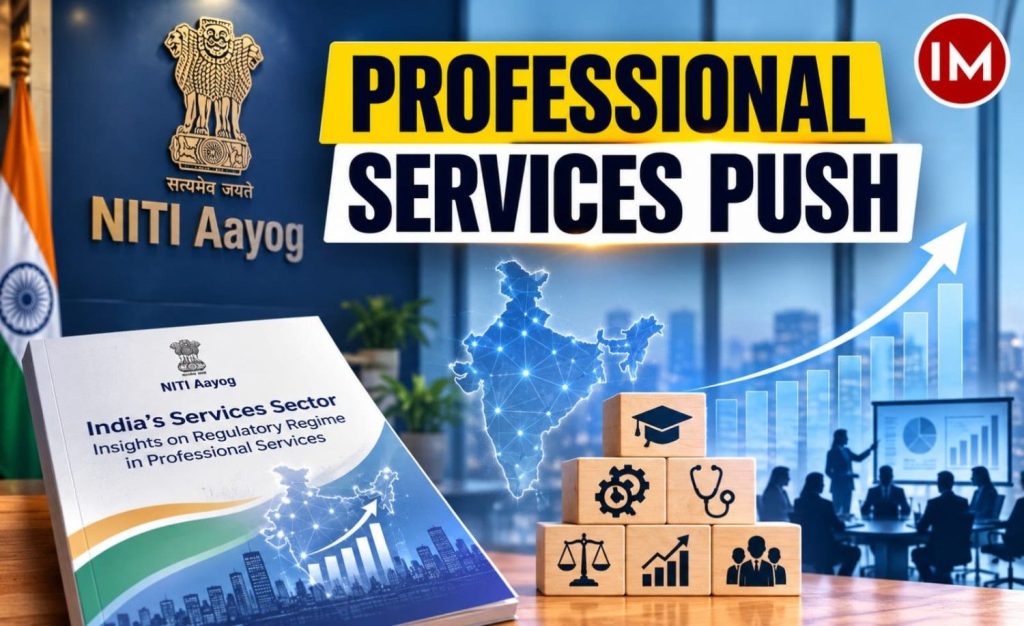
NEW DELHI: NITI Aayog has released its latest report on India’s services economy, examining the regulatory framework governing professional services and identifying opportunities to strengthen the sector’s contribution to exports, employment and economic growth.
Titled “India’s Services Sector: Insights on Regulatory Regime in Professional Services”, the report was launched by Ashok Kumar Lahiri, Vice Chairman, NITI Aayog, on August 10, 2026.
The launch took place at the forum of the High-Powered ‘Education to Employment and Enterprise’ Standing Committee, in the presence of Nidhi Chhibber, CEO, NITI Aayog, and Dr. Saurabh Garg, Secretary, Ministry of Statistics and Programme Implementation (MoSPI).
Senior officials from Union ministries and departments, state governments, industry associations, as well as experts and academics who are members of the High-Powered Committee attended the event.
Report Examines Regulatory Framework for Professional Services
The report provides a detailed factual assessment of India’s regulatory framework for professional services and benchmarks the country’s approach against selected foreign jurisdictions.
Read Also: NITI Aayog Identifies Four Key Sectors to Position India as Global Manufacturing Hub
It draws upon extensive consultations with stakeholders and examines the challenges affecting the growth and efficiency of professional services.
Based on these consultations and comparative assessment, the report identifies key regulatory and structural challenges and proposes a way forward to improve the functioning of the sector.
The exercise is aimed at supporting future policy discussions around professional services and creating a regulatory environment that can enable the sector to realise its full potential.
Professional Services Account for Nearly a Quarter of Services Exports
Professional services constitute an important segment of India’s rapidly expanding services economy.
According to the report, the sub-sector accounts for nearly one-fourth of India’s total services exports, underlining its importance to India’s external sector and economic growth.
Professional services are generally high-value and knowledge-intensive activities. They play an important role in enabling the efficient delivery of downstream services while contributing to employment generation, entrepreneurship and remittance inflows.
They also form a critical part of the wider services value chain, making the regulatory environment governing these activities an important factor in determining the sector’s future competitiveness.
Why Regulatory Framework Matters
As professional services become increasingly integrated into global markets, regulatory systems can have a direct bearing on their ability to compete internationally.
A well-designed regulatory ecosystem can help improve the ease of doing business, facilitate cross-border movement of professionals and strengthen India’s position in global services trade.
The NITI Aayog report therefore focuses not merely on existing regulations but also on how the regulatory framework can evolve in response to technological, economic and demographic changes.
The report seeks to provide an evidence-based foundation for examining how regulations can support growth without compromising professional standards and public interest.
Four-Pronged Strategy for Professional Services
The report outlines a four-pronged strategy aimed at improving the efficiency, productivity and output of India’s professional services sector.
The proposed approach focuses on:
- Harnessing emerging trends to transform professional services and enable them to adapt to changing market conditions.
- Elevating professional services within the services value chain to increase their economic contribution and improve value creation.
- Adopting best practices in professional services to enhance efficiency, quality and global competitiveness.
- Continuous professional development to ensure that professionals remain equipped with relevant skills and knowledge.
Together, these measures are intended to strengthen the foundations of India’s professional services ecosystem while improving its ability to respond to emerging domestic and global opportunities.
Emerging Trends Could Transform the Sector
One of the report’s key strategic areas is the need to harness emerging trends that are reshaping professional services.
Technological advancement, changing business models and growing international demand are creating new opportunities for knowledge-intensive service providers.
India’s large pool of skilled professionals gives the country a strong foundation to benefit from these developments.
The report emphasises the importance of ensuring that professionals and service providers are equipped to respond to changing market requirements while maintaining quality and competitiveness.
Moving Professional Services Up the Value Chain
Another key component of the strategy is to elevate professional services within the services value chain.
Professional services such as consulting, legal services, accounting, financial services, architecture, engineering and other specialised knowledge-based activities can play a critical role in enabling higher-value economic activity.
Strengthening these capabilities could help India capture a larger share of global value creation and further diversify its services exports.
A stronger professional services ecosystem can also support other sectors by providing specialised expertise needed for investment, business expansion, innovation and international operations.
Learning from Global Best Practices
The report benchmarks India’s regulatory framework against select foreign jurisdictions to identify areas where international practices could offer useful lessons.
The objective is not simply to replicate overseas models but to identify approaches that can be adapted to India’s institutional and economic context.
Such benchmarking can help policymakers identify regulatory practices that improve efficiency while maintaining appropriate standards and safeguards.
Continuous Professional Development
The fourth pillar of the proposed strategy focuses on continuous professional development.
As technology and business models evolve rapidly, professionals need to regularly update their skills and knowledge.
Continuous learning can help ensure that India’s professional workforce remains competitive in both domestic and international markets.
This is particularly important as professional services become increasingly technology-driven and globally integrated.
Opportunity for High-Skilled Employment and Entrepreneurship
The report comes at a time when India is approaching its demographic peak, creating a significant opportunity to expand high-skilled employment.
Professional services can become an important avenue for absorbing India’s growing pool of educated and skilled workers.
Beyond conventional employment, the sector can also encourage entrepreneurship, innovation and new business models, particularly in knowledge-intensive industries.
A supportive regulatory ecosystem could help unlock these opportunities while strengthening India’s position as a global services hub.
Potential to Boost Service Exports and Professional Mobility
India has emerged as a major global player in services exports, and professional services represent an important component of this strength.
The report notes that a well-designed regulatory environment can contribute to further growth in service exports and facilitate the cross-border mobility of professionals.
Improved regulatory conditions could make it easier for Indian professionals and professional service firms to compete internationally while also attracting global opportunities and investments to India.
Such reforms could also contribute to improving the country’s overall ease of doing business.
Report Provides Pathway for Future Policy Dialogue
NITI Aayog has positioned the report as an indicative pathway for future policy discussions rather than a final regulatory blueprint.
The report provides a factual and comparative foundation for deeper examination of the regulatory structures governing different professional services.
Its findings can support further engagement between policymakers, regulators, industry bodies, professional organisations and other stakeholders.
The approach is intended to encourage evidence-based discussions on how regulations can evolve alongside the changing nature of India’s services economy.
Contribution to Viksit Bharat @2047
The strengthening of professional services has broader implications for India’s long-term development ambitions.
As India works towards the Viksit Bharat @2047 vision, building a globally competitive, inclusive and future-ready services sector will be an important part of the country’s economic transformation.
Professional services, given their knowledge-intensive nature, export potential and ability to create high-skilled employment, can play a significant role in this transition.
The NITI Aayog report therefore places regulatory reform within the wider objective of strengthening India’s services ecosystem and enabling it to compete more effectively in global markets.
NITI Aayog’s Services Thematic Series
The report is the third report under NITI Aayog’s Services Thematic Series, reflecting the institution’s continuing focus on examining different dimensions of India’s services economy.
Through sector-specific analysis and stakeholder consultations, the thematic series seeks to identify opportunities and constraints affecting the growth of India’s services sector.
The latest report’s focus on professional services highlights the importance of regulatory foundations in determining the efficiency and international competitiveness of knowledge-intensive activities.
Aiming for a Globally Competitive Services Sector
With professional services already contributing nearly a quarter of India’s total services exports, reforms in the sector could have implications well beyond individual professions.
Improving regulatory efficiency, encouraging innovation, strengthening professional skills and adopting global best practices could help India expand its role in the international services economy.
The NITI Aayog report provides a framework for taking this discussion forward, particularly as India seeks to leverage its demographic advantage, skilled workforce and expanding global services footprint.
As the country moves towards Viksit Bharat @2047, strengthening the regulatory ecosystem for professional services could become an important component of efforts to build a more competitive, inclusive and future-ready economy.
Read Also: Anurag Jain to Join NITI Aayog as CEO on Aug 17; 1989-Batch IAS Officer’s Key Career Highlights