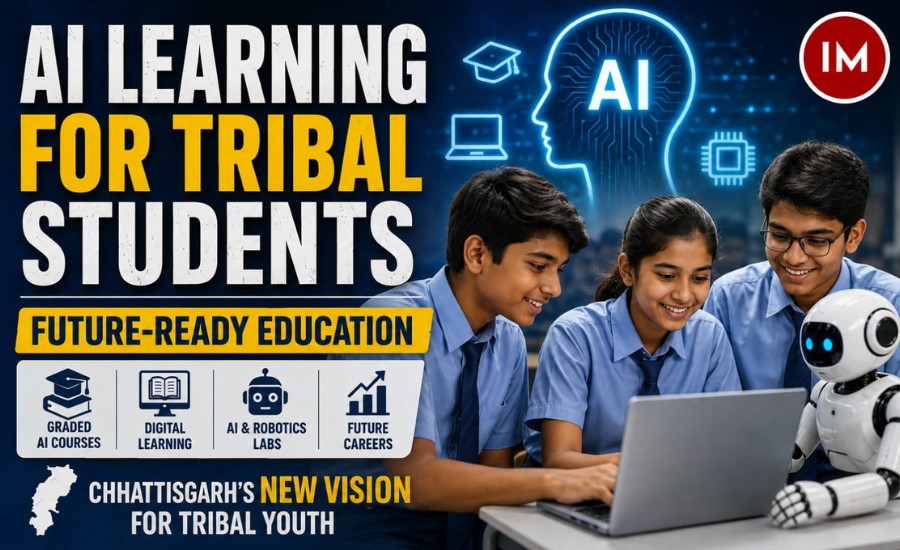
Raipur: The Chhattisgarh government is planning to introduce AI-enabled learning modules for tribal students in government schools, open schools and colleges across the state, with the aim of equipping young learners with skills suited to emerging technologies and future employment opportunities.
The initiative is being pursued by the Department of Tribal, Scheduled Caste, Other Backward Class and Minority Development as part of efforts to expand the state’s Prayas residential-school model beyond its traditional focus on competitive examinations.
According to the department, the proposed courses will be structured according to students’ educational levels, allowing them to progress from foundational concepts to more advanced applications of artificial intelligence and digital technologies.
From Competitive Exams to Future-Ready Skills
The Prayas programme already focuses on providing quality education and competitive-exam preparation to meritorious students from Scheduled Caste, Scheduled Tribe and OBC communities, as well as students from Naxal-affected areas.
Read Also: Chhattisgarh Women Empowerment: Sai Government Puts Women IAS Officers in Charge of 12 Districts
The proposed technology-focused expansion seeks to add another dimension to this model by preparing students for sectors shaped by AI, automation and other emerging technologies.
Key elements of the proposed initiative include:
- Graded and certified AI learning modules.
- Digital literacy and AI-based learning support.
- Courses tailored to different academic levels.
- Advanced AI courses for college-going students.
- Proposed AI and robotics laboratories.
- Greater exposure to emerging technology careers.
AI and Robotics Labs in the Pipeline
The department is also planning modern AI and robotics laboratories as part of the broader technology-learning ecosystem. For college students, officials are exploring intensive specialised AI courses that can be pursued alongside regular academic programmes.
Principal Secretary of the Tribal, SC, OBC and Minority Development departments Sonmoni Borah said digital literacy is already being taught through instructor-led, AI-enabled learning in schools, with the department now looking to introduce structured learning modules at different stages.
Strengthening the Prayas Education Model
The technology push comes alongside efforts to strengthen academics at Prayas residential schools. The state has been bringing in faculty and experts from IITs, coaching institutions and other specialised organisations to support students preparing for examinations such as JEE and NEET.
Government records also show that Prayas schools continue to be expanded and supported through dedicated admission and coaching programmes for the 2026–27 academic year.
Focus on Students From Remote Tribal Areas
The broader objective is to ensure that students from remote tribal areas have access not only to conventional academic opportunities but also to digital skills, emerging technologies and new career pathways.
The initiative could help bridge the technology gap between students in remote regions and those with greater access to advanced educational resources, while creating exposure to fields such as AI, robotics, quantum computing and semiconductor technologies.
A Wider Push for AI in Tribal Education
The Chhattisgarh initiative comes amid a wider push to incorporate AI into education for tribal students nationally. The Ministry of Tribal Affairs has already introduced the Medha AI digital platform as a two-year programme across functional Eklavya Model Residential Schools (EMRSs).
The platform provides teachers with AI-assisted tools for lesson planning and assessments, while students can access personalised learning support, practice exercises and doubt-solving tools.
Chhattisgarh’s proposed modules would therefore add a state-level technology and skills component, with a particular focus on making tribal students better prepared for a rapidly changing, technology-driven economy.
Read Also: Chhattisgarh Gets ₹3,942 Crore Digital Push as BharatNet Agreement Targets 11,682 Gram Panchayats