Partnered Content
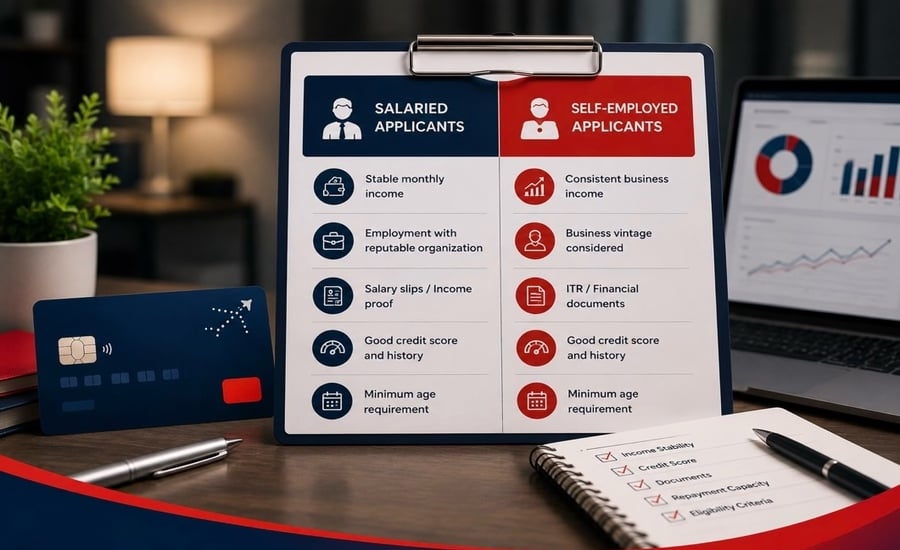
Credit card eligibility is not only about income. Banks also look at repayment history, age, employment type, existing loans, credit score and documents. Two people with the same income can receive different decisions if their credit behaviour or documentation differs.
This is why applicants should check the basics before submitting an application. A declined application can be disappointing, and repeated applications may create unnecessary credit enquiries.
The process becomes easier when salaried and self-employed applicants understand how their profiles are usually assessed. The goal is not to apply everywhere. It is to apply where the profile is likely to fit.
Key Takeaways
- Income is important, but repayment history and documentation matter too.
- Salaried applicants are usually assessed through salary slips, bank statements and employer details.
- Self-employed applicants may need income tax returns and business proof.
- Applying selectively is better than sending multiple applications together.
Why Profiles Are Assessed Differently
A salaried applicant usually has predictable monthly income. A self-employed applicant may earn more in some months and less in others. That does not make one profile better than the other. It only changes the documents used to understand repayment capacity.
For example, a consultant may not have salary slips but may have stable bank credits, invoices and income tax returns. A salaried employee may have a regular salary credit but high existing loan obligations. Banks look at the full picture.
Standard Eligibility Criteria
Most issuers check whether the applicant meets the minimum age, income, residency and documentation requirements. The applicant generally needs a Permanent Account Number (PAN), address proof, identity proof and income proof.
Credit history is also important. A person who has paid loans and bills on time may be assessed differently from someone with recent delays or high utilisation. Utilisation means how much of the available credit limit is being used.
For Salaried Applicants
A salaried person has a relatively straightforward income trail. The bank may check salary slips, Form 16, bank statements and employer details. Stable employment can support the application because it shows regular income.
However, salary alone does not guarantee approval. Existing equated monthly instalments (EMIs), credit score, residence stability and repayment record can affect the decision. A high salary with missed payments may still weaken the application.
For Self-employed Applicants
Self-employed professionals and business owners may not have a fixed monthly salary. Their income may vary across months. Banks therefore look at a broader set of documents such as income tax returns, bank statements, Goods and Services Tax (GST) records where applicable, business registration proof or professional certificates.
The aim is to understand income consistency and repayment capacity. A business with seasonal income can still be eligible if records are clear and banking behaviour is stable.
Documents Required For Both Categories
| Applicant Type | Common Documents To Keep Ready |
| Salaried applicant | PAN, identity proof, address proof, salary slips, bank statements and employer details. |
| Self-employed applicant | PAN, identity proof, address proof, income tax returns, bank statements and business or professional proof. |
| Existing cardholder | Existing card statement, repayment record and updated income details, if requested. |
Income Stability Is Not The Same As High Income
A high income may not help if the records do not support it. A moderate but steady income, supported by clean bank statements and timely repayment history, may be easier to assess. This is especially important for self-employed applicants whose earnings may not look uniform every month.
Existing Debt Matters
Banks may also look at existing personal loans, vehicle loans, home loans or card dues. If too much monthly income is already going towards repayment, fresh approval can become harder. Closing small overdue amounts and reducing utilisation before applying can improve the application quality.
Common Reasons Applications Need More Review
Applications may require more review when address proof does not match records, income documents are incomplete, business income is irregular, existing dues are high or recent credit enquiries are too frequent. These are not always rejection reasons, but they can slow down the process.
Applicants can reduce friction by keeping documents updated before applying. If the name, address or mobile number differs across records, correct it early. If income is seasonal, keep bank statements and tax documents ready to explain the pattern.
Do A Quick Self-check
Before applying, ask three questions. Is income stable enough to manage monthly bills? Are existing dues under control? Are documents updated and consistent? If the answer is yes, the application is likely to be cleaner. If not, waiting for a month or two and correcting records may be better than applying in a hurry.
Before Applying
Check whether the card suits the applicant’s spending pattern. A premium travel card may not be useful for someone who rarely travels. A simple rewards or cashback card may be more practical for first-time users. Eligibility and usefulness should be checked together before starting the credit card apply online process.
Conclusion
Eligibility is a fitment exercise. The bank checks whether the applicant has the income, records and repayment behaviour to handle a revolving credit product responsibly. Salaried and self-employed applicants may submit different documents, but the principle is the same: clear income, clean repayment history and complete paperwork improve the quality of the application.
(This is third-party “Partnered Content.” All such content is for informational purposes only, and we do not claim ownership or responsibility for it)