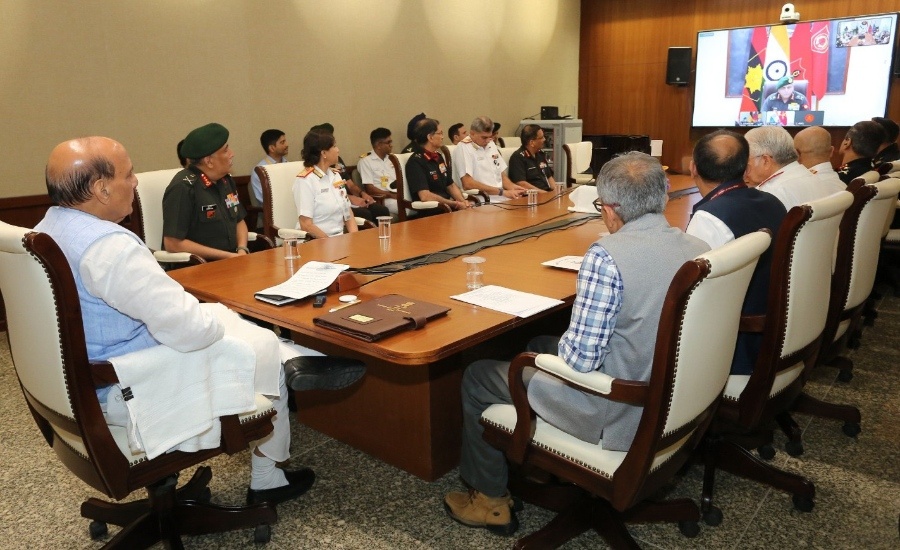
Lucknow: The Department of Military Medicine was officially inaugurated at Command Hospital (Central Command), Lucknow, by Defence Minister Rajnath Singh through a virtual event. The new department is India’s first dedicated academic and operational centre focused entirely on military medicine. It has been created to improve battlefield healthcare, strengthen combat medical readiness, promote advanced research, and prepare the Armed Forces Medical Services (AFMS) for future security challenges.
India Gets Its First Dedicated Department of Military Medicine
The newly launched Department of Military Medicine has been established under the Directorate General of Medical Services (Army).
Read also: India Launches New Defence Digital Platform to Connect Armed Forces With Domestic Manufacturers
It will serve as a national centre for education, research, doctrine development, and specialised training in military medicine. The department is expected to play a major role in improving healthcare support for soldiers during war, humanitarian missions, disasters, and emergencies.
Why the Department of Military Medicine Is Important
Speaking during the inauguration, Rajnath Singh said that economic and social development are important, but national security ultimately depends on the strength and morale of the armed forces.
He said the new department will ensure that Indian soldiers receive advanced medical support during operations, increasing both operational readiness and troop confidence. According to him, stronger military healthcare directly contributes to national security.
What are the Key Focus Areas of the Department
The Department of Military Medicine will work in several specialised fields, including:
- Military trauma and damage control
- Combat psychiatry and mental resilience
- Environmental and operational medicine
- Military medical logistics
- Chemical, Biological, Radiological, Nuclear and Explosive (CBRNE) medical response
- Emergency medicine and critical care
- Disaster management and humanitarian assistance
- Medical research, audits and healthcare data analytics
The department will also promote simulation-based battlefield training, telemedicine, prolonged field care, and advanced medical decision-support systems.
Phased Development Plan
The department will be developed in multiple phases. Initially, it will begin academic programmes and structured training. Later, specialised Centres of Excellence in Humanitarian Assistance and Disaster Relief (HADR) and CBRNE medicine will be established.
The long-term goal is to develop the institution into a nationally and internationally recognised centre for military medicine.
Rajnath Singh Highlights Changing Nature of Warfare
The Defence Minister said that modern warfare is rapidly changing. Besides traditional weapons, countries now face emerging threats from advanced technologies and weapons of mass destruction. Therefore, India needs specialised research, innovation and medical preparedness to respond effectively.
He said the department will function as a research and development hub that will prepare the country to tackle future battlefield challenges.
Department of Military Medicine: Better Care for Soldiers in Extreme Conditions
Rajnath Singh explained that military medicine is different from civilian healthcare because soldiers often operate in high-altitude areas, deserts, forests, extreme climates and conflict zones. The department will develop treatment protocols designed specifically for these unique operational environments. It will also strengthen trauma care, battlefield surgery and rehabilitation for injured personnel.
New Academic and Career Opportunities
The department has also been designed as a centre of excellence for Armed Forces Medical Services. It will provide structured education, postgraduate programmes and super-specialisation in military medicine. Areas such as combat medicine, combat surgery, trauma care and operational medicine will receive special attention.
Young doctors joining the Army Medical Corps will get advanced career opportunities and specialised training while contributing to India’s defence healthcare system.
Department of Military Medicine: Greater Focus on Preventive Healthcare
The Defence Minister stressed that preventive healthcare should become the first line of defence. He called for early disease detection through surveillance, vaccination, sanitation, nutrition, regular health screenings and physical fitness programmes.
He also highlighted the role of artificial intelligence, wearable health devices, predictive analytics and advanced diagnostic technologies in monitoring soldiers’ health and identifying health risks before they become serious.
Supporting UN Missions and Disaster Response
India is one of the world’s largest contributors to United Nations peacekeeping operations. According to Rajnath Singh, the new department will also strengthen India’s capability in humanitarian assistance, disaster response, epidemic control, field hospital deployment and mass casualty management, making the Armed Forces Medical Services better prepared for both military and civilian emergencies.
Department of Military Medicine: Part of India’s Defence Modernisation Vision
The Department of Military Medicine supports the Government’s broader plan to modernise the Armed Forces Medical Services. It also complements the proposed Global Military Medicine Centre under the Raksha Shakti Vision 2026–30. Officials believe the initiative will transform military healthcare into a modern, technology-driven and operationally relevant system capable of meeting future defence and national security needs.
Senior Officials Present
The inauguration was attended by Chief of the Army Staff General Dhiraj Seth, Defence Secretary Rajesh Kumar Singh, Vice Chief of the Army Staff Lieutenant General Sandeep Jain, Central Command GOC-in-C Lieutenant General Anindya Sengupta, DG AFMS Surgeon Vice Admiral Arti Sarin, senior Army Medical Corps officers and officials from the Ministry of Defence.