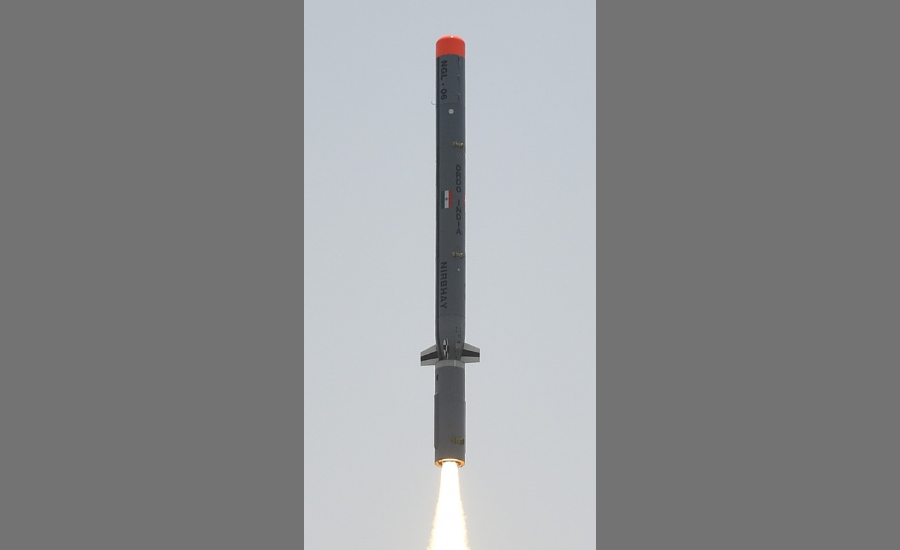
New Delhi: Nirbhay cruise missile is one of India’s most important indigenous long-range precision strike weapons. Developed by the Defence Research and Development Organisation (DRDO), the missile has been designed to fly at very low altitude, avoid enemy radar, and accurately hit high-value targets up to around 1,000 km away. It plays a key role in strengthening India’s long-range conventional strike capability and supports the country’s goal of defence self-reliance.
What Is The Nirbhay Cruise Missile
Nirbhay is a subsonic, all-weather, terrain-hugging cruise missile developed by DRDO’s Aeronautical Development Establishment (ADE). Unlike ballistic missiles that travel on a high arc, Nirbhay flies close to the ground, making it difficult for enemy radar systems to detect and intercept.
Read also: DRDO Hybrid AIP System: Key Features, Benefits and Project-76 Submarine Impact Explained
Designed For Multiple Military Services
The missile has been developed for use by the Indian Army, Indian Navy, and Indian Air Force. Its multi-platform design allows deployment from mobile land launchers today, while future versions can support additional launch platforms.
What are the Features Of The Nirbhay Cruise Missile
Long Operational Range
Nirbhay can strike targets at a distance of around 1,000 kilometres, allowing India to engage important military infrastructure deep inside hostile territory without crossing the border.
Low-Altitude Terrain-Hugging Flight
The missile follows the natural shape of the terrain while flying at very low altitude. This reduces the chances of detection by enemy air-defence radars and improves its ability to reach the target safely.
High Precision Navigation
Nirbhay combines inertial navigation, satellite navigation, and advanced guidance systems to maintain high accuracy throughout its flight. Depending on mission requirements, terminal guidance can include radar or electro-optical seekers for precise target engagement.
Conventional Strike Capability
The missile is designed to carry different types of conventional warheads, including high-explosive and penetration warheads. This makes it suitable for attacking command centres, airfields, logistics hubs, bunkers, and other strategic targets.
Nirbhay Cruise Missile: Indigenous Propulsion Strengthens Self-Reliance
One of the biggest achievements in the Nirbhay programme is the successful integration of India’s Manik Small Turbofan Engine. The indigenous engine reduces dependence on foreign suppliers and supports the government’s “Aatmanirbhar Bharat” initiative in defence manufacturing.
How Nirbhay Cruise Missile Complements India’s Missile Arsenal
India already operates powerful ballistic missiles like Agni and the supersonic BrahMos cruise missile. Nirbhay fills an important capability gap by providing a long-range, low-altitude, subsonic precision strike option that can penetrate enemy air defences and conduct surgical conventional attacks.
Foundation For India’s Future Cruise Missile Programme
Technologies developed during the Nirbhay programme have helped create the Long Range Land Attack Cruise Missile (LRLACM). DRDO successfully flight-tested the LRLACM in June 2026, demonstrating the maturity of indigenous guidance, propulsion, and cruise missile technologies.
Strategic Importance For India
Nirbhay significantly improves India’s conventional deterrence by providing the capability to strike high-value military targets with precision while reducing the risk to frontline forces. Its indigenous development also strengthens India’s defence manufacturing ecosystem and reduces reliance on imported missile technology.
Read also: India’s New Fire-and-Forget Missile Is Ready—Here’s What Makes MP-ATGM Special