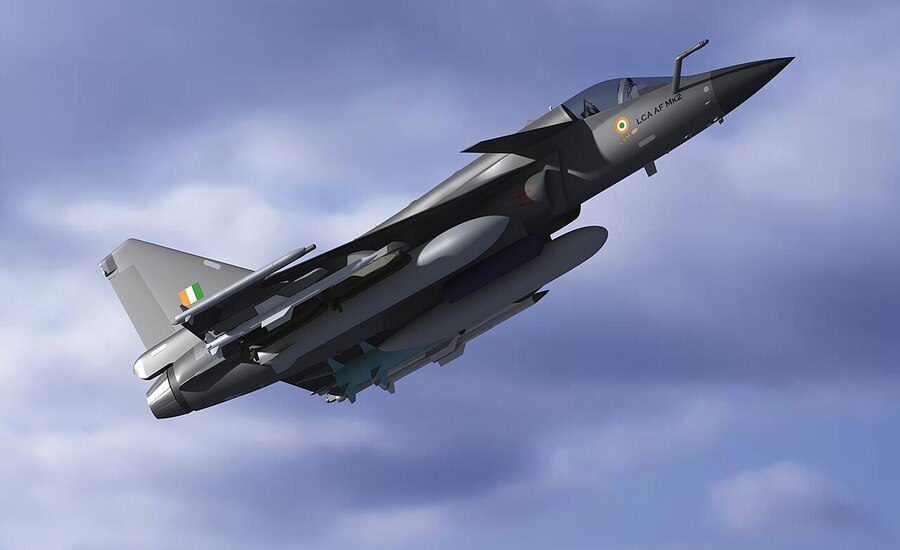
New Delhi: Tejas Mk2 indigenous content is expected to reach an impressive 82% to 85% by value when the fighter jet enters full-scale production. Developed by the Aeronautical Development Agency (ADA) and Hindustan Aeronautics Limited (HAL), the Medium Weight Fighter (MWF) is designed to replace the Indian Air Force’s ageing Mirage 2000, Jaguar, and MiG-29 fleets while significantly advancing India’s self-reliance goals in aerospace technology.
The project represents one of India’s most ambitious indigenous defence aviation programmes and is expected to play a crucial role in strengthening the country’s long-term air combat capabilities.
Why Tejas Mk2 Is Important For India
The Tejas Mk2 is not just a larger version of the existing Tejas fighter. It has been designed as a completely new medium-weight combat aircraft with enhanced range, payload capacity, avionics, and survivability features. The aircraft is expected to bridge the gap between light fighters and heavier multi-role combat jets in the Indian Air Force inventory.
Read also: What Is DRDO’s New Compact Anti-Radiation Missile and Why Can’t Rudram-1 Fit Inside AMCA?
The programme is also focused on ensuring that critical technologies remain under Indian control, reducing dependence on foreign suppliers for key defence systems.
Details of Tejas Mk2 Indigenous Manufacturing Plan
According to programme details, the aircraft’s airframe will be developed almost entirely within India. ADA and HAL are leading the aerodynamic and structural design effort, using advanced carbon-fibre composites and high-strength alloys to create a lightweight yet highly durable fighter platform.
The aircraft is expected to carry a payload of up to 6,500 kg across 11 to 13 hardpoints, significantly improving its combat flexibility compared to earlier Tejas variants.
Advanced Composite Materials To Improve Performance
The extensive use of composite materials will reduce weight while improving strength and fuel efficiency. This design approach is expected to enhance maneuverability, increase mission endurance, and lower maintenance requirements over the aircraft’s operational life.
Indigenous Flight Control And Digital Systems
One of the biggest achievements of the Tejas Mk2 programme is the development of indigenous flight-control technologies. The aircraft will feature a locally engineered quadruplex digital fly-by-wire system and an Indian-developed flight control computer, both considered among the most complex technologies in modern military aviation.
These systems will provide better aircraft stability, improved handling, and enhanced combat performance during demanding missions.
Fully Digital Cockpit Architecture
The cockpit will feature a modern Wide Area Display and advanced mission software developed in India. This digital architecture will provide pilots with real-time battlefield information, mission planning tools, and improved situational awareness during combat operations.
Uttam AESA Radar To Play A Key Role
A major highlight of the programme is the integration of the indigenous Uttam AESA radar. The radar is being developed in India and is expected to provide advanced target detection, tracking, and engagement capabilities while reducing dependence on imported radar technologies.
The aircraft is also expected to feature an Infrared Search And Track (IRST) system for improved threat detection and air combat performance.
Indigenous Sensors Strengthen Strategic Independence
Radar and sensor technologies are among the most sensitive defence technologies worldwide. By integrating indigenous sensors and mission systems, India is strengthening its ability to independently upgrade and maintain future fighter aircraft fleets.
Electronic Warfare Capabilities Receive Major Upgrade
The Tejas Mk2 will include advanced electronic warfare systems developed by Indian defence organisations. The aircraft is expected to carry the Unified Electronic Warfare Suite (UEWS), missile approach warning systems, and modern self-protection equipment developed by DRDO.
These systems will help the fighter detect threats, avoid enemy missiles, and improve survivability in contested airspace.
Foreign Engine Remains The Biggest Imported Component
Despite its high indigenous content, the initial Tejas Mk2 aircraft will use the General Electric F414-GE-INS6 engine. The engine produces approximately 98 kN of thrust and has been selected to power the aircraft’s enhanced performance requirements.
However, India and GE are pursuing a technology-transfer programme that could eventually enable local manufacturing of up to 80% of the engine in India.
Engine Technology Transfer Could Boost Indigenous Value
Once licensed production begins, the domestic content of the Tejas Mk2 programme is expected to rise further. This would significantly strengthen India’s aerospace manufacturing ecosystem and reduce long-term dependence on imported propulsion systems.
Tejas Mk2 Will Replace Several Legacy Fighter Aircraft
The Indian Air Force plans to use the Tejas Mk2 to replace ageing fleets of Mirage 2000, Jaguar, and MiG-29 fighter aircraft. The aircraft is expected to deliver improved operational capability while supporting India’s long-term goal of defence self-reliance. The programme is also expected to serve as an important technology bridge toward the future Advanced Medium Combat Aircraft (AMCA) project.
Read also: What Is Quantum Radar? Why Does AMCA Need to Look Beyond RF Stealth? Former DRDO Director Explains
FAQs
The fighter will initially use the GE F414-GE-INS6 engine, which generates around 98 kN of thrust and may later be manufactured in India through technology transfer agreements.
The Tejas Mk2 aims to achieve approximately 82% to 85% indigenous content by value when it reaches full-scale production.
The Tejas Mk2 is being developed to replace ageing Mirage 2000, Jaguar, and MiG-29 fighter aircraft in the Indian Air Force.