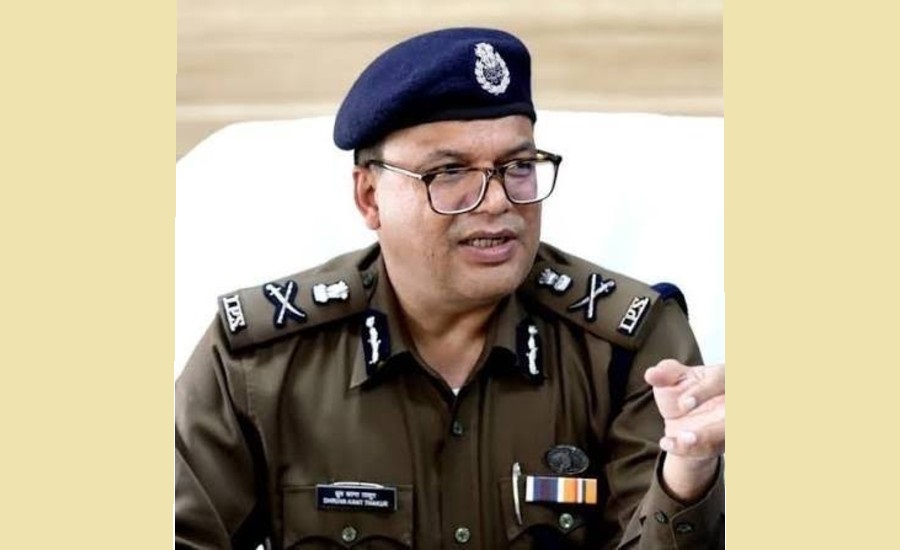
New Delhi: Cybercrime is emerging as one of the biggest challenges for law enforcement, requiring police forces to move beyond traditional security models, according to senior Dhruva Kant Thakur, an IPS officer of 1994 batch from Uttar Pradesh cadre.
Thakur, a 1994-batch Uttar Pradesh cadre IPS officer currently serving as Director General, Home Guards and Civil Defence, Uttar Pradesh, said on Sunday that the rapidly evolving nature of cybercrime demands a comprehensive and multi-layered response.
His remarks came shortly after he was awarded the President’s Medal for Distinguished Service (PSM) for his distinguished career spanning three decades.
According to Thakur, the growing number of digital arrest scams and other cybercrimes demonstrates how quickly criminals are adapting technology to target citizens.
Digital Arrest Scams and AI Spoofing Raise New Risks
Thakur highlighted the emergence of digital arrest scams, in which fraudsters impersonate police officers or other government officials and threaten victims with arrest to extort money or obtain sensitive information.
He also pointed to the increasing use of AI-powered voice and video spoofing, warning that technological advancements could make such frauds even more difficult for ordinary citizens to identify.
With scammers increasingly weaponising digital tools, the risks are expected to rise further, he said.
The senior IPS officer stressed that citizens should not immediately respond to calls or messages received from unfamiliar numbers, particularly when the caller claims to be a police officer, government official or representative of a financial institution.
Instead, individuals should independently verify the communication by contacting official police or bank helplines.
Cybercrime Is No Longer a Conventional Crime
According to Thakur, the nature of cybercrime makes it fundamentally different from many traditional forms of criminal activity.
He described cybercrime as a comprehensive hybrid scam network operating at a transnational level through organised syndicates.
Such networks can operate across jurisdictions, use multiple digital identities and rapidly shift their methods and infrastructure. This makes conventional policing approaches alone insufficient to tackle the threat.
The challenge, therefore, extends beyond simply registering cybercrime complaints. It requires coordination between police agencies, financial institutions, technology platforms and citizens.
Multi-Channel Reporting and Swift Action Needed
Thakur said multiple frameworks have already been developed to tackle cybercrime, including multi-channel reporting mechanisms, public awareness campaigns, swift blocking of suspicious accounts and targeted outreach to vulnerable populations.
However, he stressed that these measures need to be strengthened further as criminals continue to develop new methods.
The emphasis on swift action is particularly important in financial cybercrime, where stolen money can move rapidly through multiple accounts and digital channels.
Early reporting and prompt intervention can therefore play an important role in limiting losses and disrupting fraud networks.
Need for Greater Public Awareness
While police and other agencies have a significant role to play, Thakur underlined the importance of citizen awareness in preventing cybercrime.
Fraudsters frequently exploit fear, urgency and confusion. Digital arrest scams, for instance, depend heavily on convincing victims that they are facing immediate legal consequences.
Independent verification can help break this cycle.
Citizens should avoid sharing sensitive financial or personal information with unknown callers and should independently contact the relevant police or bank through verified channels rather than using contact details provided by suspicious callers.
Jantar Mantar Protest Shows Need for People-Friendly Policing
Thakur also referred to the Jantar Mantar protest, saying it demonstrated the importance of a people-friendly approach to law enforcement.
He suggested that maintaining public trust requires police forces to engage with citizens in a manner that is sensitive, accessible and responsive.
The observation comes against the broader backdrop of policing in a rapidly changing society, where maintaining law and order increasingly requires balancing enforcement with communication and public confidence.
A people-friendly policing model, according to this approach, can help strengthen the relationship between police forces and the communities they serve.
President’s Medal Adds to Three-Decade Career
Thakur’s comments came shortly after he was honoured with the President’s Medal for Distinguished Service.
The award recognises his distinguished career of around three decades in the Indian Police Service.
As a senior Uttar Pradesh cadre officer, Thakur has served in several important policing and administrative roles during his career and is currently heading Home Guards and Civil Defence in Uttar Pradesh as Director General.
His recent recognition and his comments on emerging security challenges highlight the changing nature of policing, where threats are increasingly moving from physical spaces into the digital domain.
Police Response Must Evolve With Technology
The growing sophistication of cybercriminal networks means that police forces cannot rely solely on traditional investigation and enforcement methods.
From digital arrests and financial fraud to AI-generated voices and manipulated videos, technology is giving criminals new tools to deceive victims.
Thakur’s warning therefore points towards the need for a broader policing strategy combining technology, intelligence, public awareness, rapid response and inter-agency coordination.
As cybercriminals increasingly operate through organised and transnational networks, strengthening these mechanisms will be critical to protecting citizens and maintaining trust in law enforcement.
Read also: UP DGP Rajeev Krishna Urges Bollywood to ‘Reset Narrative’, Showcase Modern Face of Police