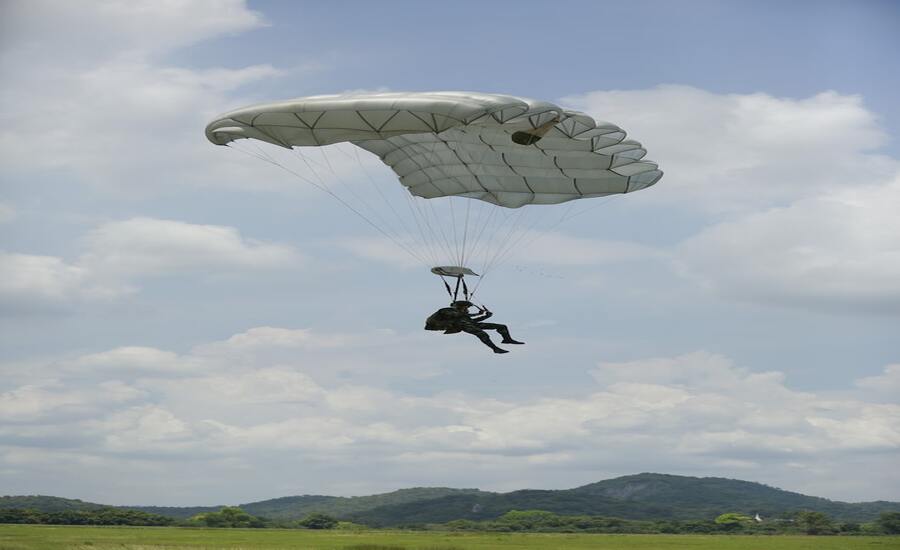
New Delhi: India’s Defence Research and Development Organisation (DRDO) has achieved a remarkable milestone in indigenous defence technology with the successful testing of the Military Combat Parachute System (MCPS) at an unprecedented altitude of 32,000 feet.
The combat freefall jump, executed by skilled test jumpers from the Indian Air Force, showcased the efficiency, reliability, and advanced design capabilities of this homegrown system. This achievement positions India among an elite group of nations with high-altitude parachute deployment capabilities.
India’s First Indigenous Parachute System Above 25,000 Feet
The MCPS has created history by becoming the only parachute system currently operational with the Indian Armed Forces that can be deployed above 25,000 feet. This breakthrough significantly enhances India’s tactical aerial deployment capabilities in high-altitude terrains.
Achieving major milestone in critical defence technologies, Military Combat Parachute System (MCPS), indigenously developed by DRDO has successfully undergone a combat freefall jump from an altitude of 32,000 feet. The parachute system was deployed at an altitude of 30,000 ft,… pic.twitter.com/VPApxpYO3x
— DRDO (@DRDO_India) October 15, 2025
According to the Ministry of Defence, the parachute was deployed at 30,000 feet during the test, demonstrating exceptional performance under extreme atmospheric conditions.
Indigenous Military Combat Parachute System: Elite Team Behind the Success
The high-risk test jump was executed by three highly trained IAF personnel: Wing Commander Vishal Lakhesh, VM (G), Master Warrant Officer R J Singh, and Master Warrant Officer Vivek Tiwari. Their expertise and courage played a crucial role in validating the system’s operational readiness.
Indigenous Military Combat Parachute System: Advanced Technical Features Set New Standards
The MCPS incorporates several cutting-edge tactical features that make it superior to conventional parachute systems:
Enhanced Safety Mechanisms: The system features a lower rate of descent, ensuring safer landings for paratroopers even in challenging conditions.
Superior Steering Control: Advanced navigation capabilities enable accurate maneuvering and precision landing at designated zones.
NavIC Integration: The parachute system is compatible with Navigation with Indian Constellation (NavIC), India’s indigenous satellite navigation system. This integration provides operational independence and eliminates vulnerability to interference or denial of service by foreign nations.
Indigenous Military Combat Parachute System: Developed by DRDO’s Premier Laboratories
The MCPS is a product of collaborative excellence between two specialized DRDO laboratories:
The Aerial Delivery Research and Development Establishment in Agra brought expertise in parachute engineering and aerial delivery mechanisms.
The Defence Bioengineering and Electromedical Laboratory in Bengaluru contributed critical bioengineering insights to ensure human safety during high-altitude operations.
This collaboration exemplifies India’s growing capabilities in complex defence technologies.
Indigenous Military Combat Parachute System: Strategic Advantages for National Defence
The successful indigenization of the military combat parachute system brings multiple strategic benefits to India’s defence preparedness:
Operational Independence: The system eliminates dependency on foreign suppliers for critical aerial delivery equipment, especially crucial during conflicts.
Rapid Maintenance: Indigenous development ensures minimal turnaround time for routine maintenance and repairs compared to imported systems.
Cost Efficiency: Local production significantly reduces lifecycle costs and foreign exchange expenditure.
Tactical Flexibility: NavIC integration allows unrestricted use against any adversary without risk of system interference.
Defence Minister Hails Historic Achievement
Defence Minister Rajnath Singh congratulated DRDO, the Armed Forces, and the defence industry on this successful demonstration. He described the achievement as a “significant milestone for India’s indigenous defence capability.”
This endorsement underscores the government’s commitment to the Atmanirbhar Bharat initiative in the critical defence sector.
DRDO Chairman Terms It Major Step Towards Self-Reliance
Secretary, Department of Defence R&D and Chairman DRDO, Dr. Samir V Kamat, complimented the entire DRDO team associated with the demonstration. He termed the successful test a “major step towards self-reliance in the field of aerial delivery systems.”
Dr. Kamat emphasized that this achievement opens doors for inducting more indigenous parachute systems into the armed forces.
Opening Doors for Future Indigenous Systems
The success of MCPS has paved the way for inducting a complete range of indigenous parachute systems across all service branches. This includes systems for different altitudes, payload capacities, and specialized military operations.
The demonstrated reliability at extreme altitudes gives confidence to expand indigenous aerial delivery solutions for various operational requirements.
Strategic Impact on India’s Defence Ecosystem
This achievement reinforces India’s growing capabilities in critical defence technologies. The successful high-altitude testing demonstrates that Indian scientists and engineers can develop world-class military equipment matching or exceeding international standards.
The MCPS success story is expected to inspire similar indigenous development initiatives across other defence technology domains, contributing to India’s vision of becoming a global defence manufacturing hub.