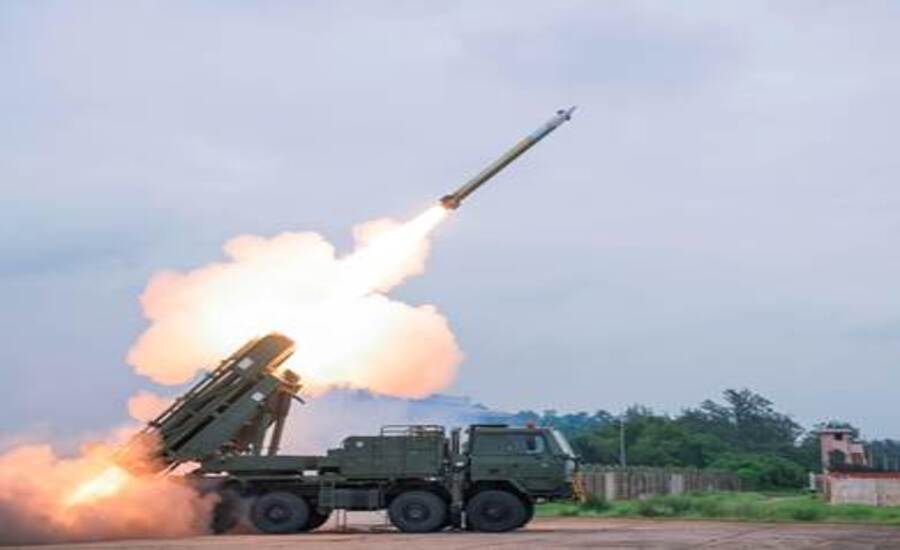
Chandipur (Odisha): The Defence Research and Development Organisation (DRDO) has successfully conducted the flight-test of the Pinaka Long Range Guided Rocket (LRGR), marking another significant milestone in India’s indigenous defence capabilities. The test was carried out at the Integrated Test Range (ITR), Chandipur, on July 8, 2026, where the rocket successfully demonstrated its precision strike capability over a user-defined minimum range of 60 kilometres.
The successful trial showcased the rocket’s accuracy, versatility, and compatibility with the in-service Pinaka launcher, reinforcing India’s growing self-reliance in advanced weapon systems under the indigenous defence development programme.
Rocket Demonstrates Precision and Planned Flight Performance
According to DRDO, the Pinaka Long Range Guided Rocket successfully executed all the planned in-flight manoeuvres during the test.
The rocket accurately followed its predicted trajectory and struck the designated target with textbook precision after covering the user-defined minimum range of 60 km.
Throughout the flight, all deployed range instrumentation continuously tracked the rocket’s performance, validating its guidance, navigation, and flight characteristics.
Launched from Existing Pinaka Launcher
A key highlight of the trial was that the LRGR was fired from the in-service Pinaka launcher, demonstrating that different variants of the Pinaka rocket system with varying operational ranges can be launched using the same platform.
This capability enhances operational flexibility for the Indian Army while reducing the need for separate launcher systems for different rocket variants.
Developed by Multiple DRDO Laboratories
The Pinaka Long Range Guided Rocket has been designed and developed by the Armament Research and Development Establishment (ARDE) in collaboration with the High Energy Materials Research Laboratory (HEMRL).
The programme also received technical support from the Defence Research and Development Laboratory (DRDL)and Research Centre Imarat (RCI).
The flight trial was coordinated by the Integrated Test Range (ITR) and the Proof & Experimental Establishment (PXE).
The collaborative effort among multiple DRDO laboratories highlights India’s integrated approach towards developing advanced indigenous defence technologies.
Rajnath Singh Congratulates DRDO and Indian Army
Defence Minister Rajnath Singh congratulated DRDO, the Indian Army, and the industry partners involved in the successful test.
He described the achievement as a major milestone in India’s indigenous design and development capability for long-range guided rockets, underscoring the country’s continued progress in strengthening self-reliance in defence technology.
DRDO Chairman Monitors the Trial
Defence Secretary and Secretary, Department of Defence R&D, as well as Chairman of DRDO, Rajesh Kumar Singh, closely monitored the flight-test.
Following the successful trial, he complimented all the scientists, engineers, and teams associated with the development and testing of the Pinaka Long Range Guided Rocket.
Strengthening India’s Indigenous Defence Capability
The successful flight-test adds another significant achievement to India’s indigenous missile and rocket development programme. By combining enhanced range, precision guidance, and compatibility with existing launch systems, the Pinaka Long Range Guided Rocket is expected to further strengthen the operational capabilities of the Indian Army’s artillery forces while reinforcing the country’s vision of achieving greater self-reliance in defence manufacturing.