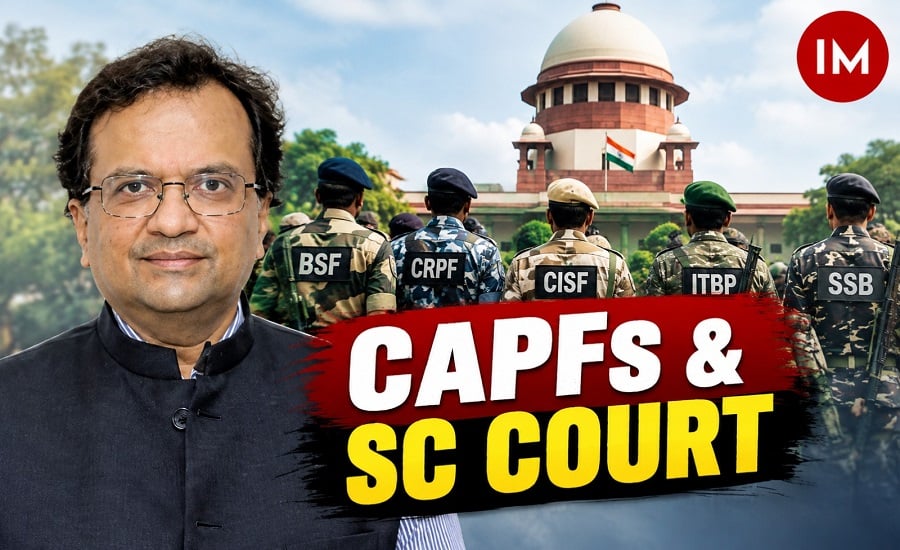
New Delhi: Union Home Secretary Govind Mohan, a 1989-batch IAS officer of the Sikkim cadre, has explained before the Supreme Court why 46 IPS officers were deputed to five Central Armed Police Forces (CAPFs) after the court directed the Centre to progressively reduce such deputations at senior levels.
The government has maintained that the Supreme Court’s May 23, 2025 order was not a blanket prohibition on IPS deputation to the CAPFs and that the appointments were made within the existing administrative and statutory framework. According to the Centre’s position, the deputations were made on the basis of requisitions received from the concerned CAPF chiefs.
The development comes in proceedings arising from a contempt petition filed by serving and retired CAPF cadre officers, who have challenged the continuation of IPS deputations to senior posts in the forces.
The Supreme Court had specifically sought an explanation from the Union Home Secretary after being informed that 46 IPS officers had joined the five CAPFs on deputation after the May 23, 2025 judgment.
Why Did the Supreme Court Seek an Explanation?
The issue stems from the Supreme Court’s judgment in Sanjay Prakash & Ors. v. Union of India & Ors., delivered on May 23, 2025.
The case involved long-standing grievances of Group-A executive officers of the CAPFs concerning career stagnation and the occupation of senior positions by officers brought in on deputation, particularly from the IPS.
The court recognised the CAPFs as Organised Group-A Services (OGAS) for cadre-related purposes and directed the government to undertake cadre reviews and review the recruitment/service rules of the forces.
While considering the balance between career progression of CAPF cadre officers and the operational requirements of the forces, the court said that the number of posts earmarked for deputation in the CAPF cadres up to the Senior Administrative Grade (SAG) should be progressively reduced over a period of time, with an outer limit of two years.
The court did not, however, order an immediate or absolute abolition of IPS deputation. Its judgment acknowledged the Centre’s position that the presence of IPS officers in the CAPFs had been considered necessary for operational and functional reasons.
46 IPS Officers Deputed After the May 2025 Judgment
The controversy intensified after the Ministry of Home Affairs informed the Supreme Court that 46 IPS officers had been brought on deputation to the five CAPFs up to the SAG level after May 23, 2025.
The force-wise break-up submitted before the court was:
- BSF: 13 officers — 8 DIGs and 5 IGs
- CISF: 11 officers — 9 DIGs and 2 IGs
- CRPF: 9 officers — 4 DIGs and 5 IGs
- ITBP: 6 officers — 3 DIGs and 3 IGs
- SSB: 7 officers — 2 SPs, 2 DIGs and 3 IGs
Together, the 46 officers comprised 2 SPs, 26 DIGs and 18 IGs.
The figures became significant because the Supreme Court was monitoring the implementation of its May 2025 directions on reducing deputation at the senior levels.
Court Asked Whether CAPFs Had Requisitioned the Officers
On September 2, 2026, the Supreme Court directed the Union Home Secretary to explain the circumstances in which the 46 IPS officers were brought into the CAPFs.
The Bench specifically wanted to know what procedure was followed before the deputations were made and whether the borrowing department or CAPF had formally requisitioned the officers.
The court also sought reasons for continuing to make such appointments after its May 2025 judgment, which had called for a progressive reduction in the number of deputation posts up to the SAG level.
The matter was listed for September 22, 2026, for further consideration, with the court making it clear that it would continue monitoring compliance with its earlier judgment.
Centre’s Explanation: No Blanket Ban on IPS Deputation
In the subsequent affidavit, Govind Mohan explained the Centre’s position on the continued deputation of IPS officers.
The government’s interpretation is that the May 23, 2025 judgment called for progressive reduction in deputation posts but did not completely prohibit the government from making IPS appointments to CAPF positions during the transition period.
The Centre has also maintained that the deputations were not made arbitrarily. According to the government’s explanation, the appointments followed the established framework and were made after requisitions from the respective CAPF chiefs.
This distinction is central to the ongoing proceedings: the government is treating the court’s direction as requiring a gradual reduction over the prescribed period, rather than as an immediate bar on every fresh deputation.
Five CAPFs at the Centre of the Dispute
The issue concerns five major Central Armed Police Forces under the Ministry of Home Affairs:
Central Reserve Police Force (CRPF), Border Security Force (BSF), Central Industrial Security Force (CISF), Indo-Tibetan Border Police (ITBP) and Sashastra Seema Bal (SSB).
These forces perform different responsibilities ranging from border guarding and internal security to protection of critical installations and infrastructure.
The dispute has arisen primarily around their Group-A executive cadres and senior-level command positions, where CAPF officers have argued that extensive deputation of IPS officers can affect their own promotional avenues and career progression.
What the Supreme Court Said in May 2025
The May 23, 2025 judgment was not limited to the question of IPS deputation.
The Supreme Court dealt extensively with the status of CAPFs as organised services and the career stagnation faced by their cadre officers. It noted that the officers had raised concerns about senior posts being occupied through lateral entry by deputationists, affecting opportunities for promotion within the CAPF hierarchy.
The court also acknowledged the Centre’s argument that IPS officers had a functional role in the CAPFs and that the government considered their presence important for the operational character of the forces.
After considering both aspects, the court directed the government to undertake cadre review, review of recruitment/service rules and progressive reduction of deputation posts up to SAG level.
The court’s formulation therefore attempted to address two competing considerations — career mobility of CAPF cadre officers and the operational requirements cited by the government.
Centre Had Earlier Sought Review of the Judgment
The Union government subsequently challenged the May 2025 judgment through a review petition.
The Supreme Court dismissed the government’s review petition in October 2025, leaving the May 2025 directions in place. Reports on the continuing proceedings have noted that the Centre thereafter proceeded with cadre-review exercises and other administrative measures concerning the CAPFs.
The dispute nevertheless continued because IPS officers continued to be deputed to senior CAPF positions.
This eventually became the subject of contempt proceedings filed by CAPF officers and veterans, who alleged that the May 2025 judgment was not being implemented in its intended form.
CAPF (General Administration) Act, 2026 Adds Another Layer
The issue has become more complex following the enactment of the Central Armed Police Forces (General Administration) Act, 2026.
The legislation provides a statutory framework governing senior-level appointments in the CAPFs, including provisions concerning deputation of IPS officers.
Reports on the legislation have stated that it provides for 50% of posts at the Inspector General level to be filled by IPS officers on deputation, a minimum 67% at the Additional Director General level, and all posts at the Special Director General and Director General levels.
The legislation has itself been challenged before the Supreme Court. The court issued notice on petitions questioning its validity, adding a separate constitutional dimension to the dispute over CAPF cadre structure and IPS deputation.
Thus, two related but distinct questions are now before the judiciary: how the government’s actions comply with the May 2025 judgment, and whether the subsequent statutory framework is legally sustainable.
Why the CAPF Cadre Officers Object
The underlying service dispute is about career progression within the CAPFs.
The Group-A executive officers of the five forces have argued that officers who spend decades serving in their respective organisations face stagnation when senior positions are occupied by deputationists from the IPS.
The Supreme Court itself recorded this concern in its 2025 judgment, noting that the CAPF cadre officers had served under demanding conditions, including border and internal-security duties, and that prolonged stagnation could affect the morale of the forces.
The court also noted that the government had a policy position that IPS officers were necessary for the operational and functional requirements of the CAPFs.
Consequently, the May 2025 judgment sought to balance the two considerations rather than treating either as irrelevant.
Government Points to Existing Administrative Framework
The latest explanation from the Home Secretary puts the focus on the procedure followed for individual deputations.
According to the Centre’s position, the officers were deputed after requests from the concerned CAPF leadership. This is significant because the Supreme Court had specifically asked whether the borrowing organisations had made requisitions before the officers were brought in.
The government is therefore placing the individual appointments within the existing deputation mechanism while maintaining that the May 2025 judgment does not prohibit all deputations during the two-year period.
The precise legal implications of this position remain part of the proceedings before the Supreme Court.
What Happens Next?
The Supreme Court is continuing to monitor implementation of its May 23, 2025 judgment.
The latest proceedings have brought the 46 IPS deputations into sharp focus, particularly because they took place after the court directed a progressive reduction in deputation posts at the SAG level.
At the same time, the Centre has explained that the appointments were made within the established framework and on the requisition of the concerned CAPFs.
The larger dispute now involves three interconnected issues: implementation of the Supreme Court’s 2025 directions, the career progression and cadre structure of CAPF officers, and the legal framework introduced through the CAPF (General Administration) Act, 2026.
The Supreme Court’s continuing oversight and the separate challenge to the 2026 legislation are therefore likely to keep the question of IPS deputation versus CAPF cadre progression before the judiciary and the government in the months ahead.
Read also: Why 46 IPS Officers Were Deputed to CAPFs? Supreme Court Seeks Home Secretary’s Reply