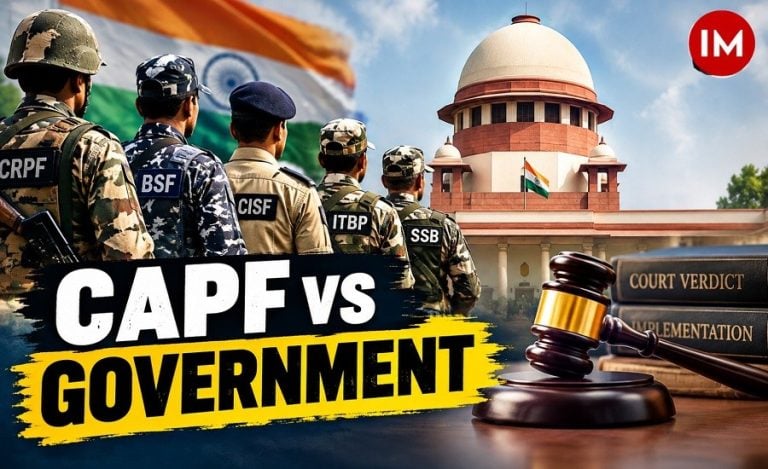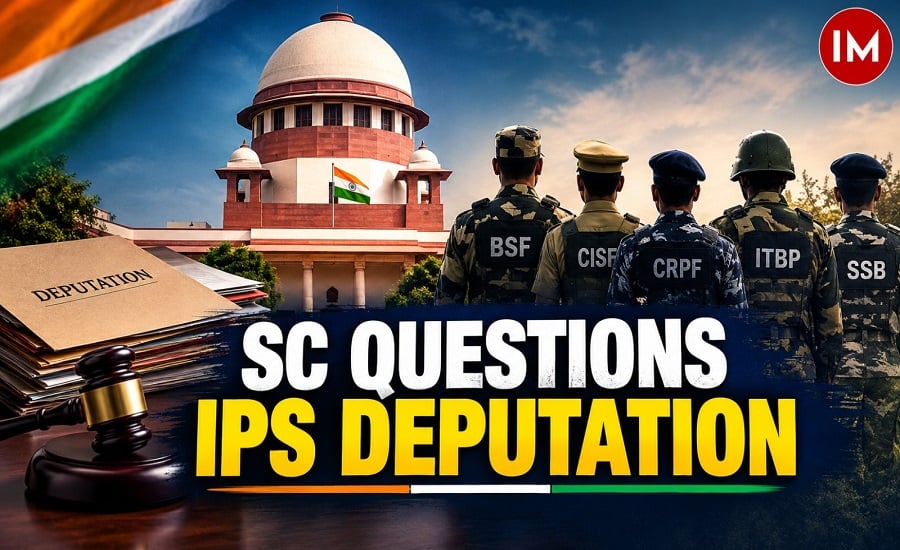
New Delhi: The Supreme Court is examining the deployment of Indian Police Service (IPS) officers to the Central Armed Police Forces (CAPFs) after recording that 46 IPS officers were brought on deputation to five CAPFs following its May 23, 2025 judgment.
The development has put the Ministry of Home Affairs (MHA) under scrutiny because the Court’s 2025 judgment had directed that the number of posts earmarked for deputation in the CAPF cadres up to the Senior Administrative Grade (SAG) should be progressively reduced over a period of time, with an upper limit of two years.
In its September 2, 2026 order, the Court directed the MHA Secretary to explain the procedure followed for bringing the officers on deputation, including whether requisitions were made by the borrowing organisations, and why the deputations continued despite the earlier direction.
The matter has been listed for further hearing on September 22, 2026, at 2 pm. The Court said it would continue monitoring implementation of its May 23, 2025 judgment.
MHA Reports 46 IPS Officers on Deputation Since May 2025
According to the affidavit filed by the MHA Secretary, 46 IPS officers up to the SAG level were brought on deputation to five CAPFs after the May 23, 2025 judgment.
The force-wise break-up recorded by the Supreme Court is:
- BSF: 13 officers — 8 DIGs and 5 IGs
- CISF: 11 officers — 9 DIGs and 2 IGs
- CRPF: 9 officers — 4 DIGs and 5 IGs
- ITBP: 6 officers — 3 DIGs and 3 IGs
- SSB: 7 officers — 2 SPs, 2 DIGs and 3 IGs
The figures add up to 46 officers, comprising 2 SPs, 26 DIGs and 18 IGs.
The Border Security Force (BSF) accounts for the largest number of these deputations, followed by the Central Industrial Security Force (CISF), Central Reserve Police Force (CRPF), Sashastra Seema Bal (SSB) and Indo-Tibetan Border Police (ITBP).
Read also: Why 46 IPS Officers Were Deputed to CAPFs? Supreme Court Seeks Home Secretary’s Reply
Why Has the Supreme Court Asked MHA to Explain?
The Court’s concern is linked to the directions issued in its May 23, 2025 judgment in Sanjay Prakash & Ors. v. Union of India & Ors.
The judgment dealt with the status of CAPFs as Organised Group-A Services and related cadre matters. While considering the issue of IPS deputation, the Court directed that the number of posts earmarked for deputation in CAPF cadres up to the SAG level should be progressively reduced, preferably within an upper limit of two years.
The subsequent compliance proceedings have now brought the number of post-judgment deputations into focus.
The Court had earlier directed the Secretaries of the MHA and the Department of Personnel and Training (DoPT) to submit affidavits detailing the steps taken to implement the May 2025 judgment. The MHA was also specifically asked to provide cadre-wise information on IPS officers brought on deputation to the CAPFs after the judgment.
After receiving the MHA’s figures, the Court sought further clarification.
SC Wants Details of Deputation Procedure
The Supreme Court has asked the MHA Secretary to explain how the 46 deputations were processed.
Among the specific questions is whether the concerned borrowing department or CAPF had made a formal requisition for deputation before the IPS officers were brought in.
The Court has also asked the MHA to explain the reasons for making these appointments despite the May 2025 direction regarding progressive reduction of deputation posts.
The Court’s September 2 order therefore focuses not simply on the number of officers deputed but also on the procedure followed and the administrative justification for the appointments.
The MHA Secretary has been given two weeks to file the explanatory affidavit.
What Did the May 2025 Judgment Say About IPS Deputation?
The May 2025 judgment arose from a dispute concerning the treatment of CAPFs as Organised Group-A Services and their cadre-related benefits.
During the proceedings, the Union government had argued that IPS officers play an important role in the functioning of CAPFs, including coordination between the Centre and state governments. It was also argued that the recruitment rules of different CAPFs provide for deputation of IPS officers and that their functional and operational requirements justify such deputations.
The Court nevertheless directed that the number of posts earmarked for deputation in CAPF cadres up to the SAG level should be progressively reduced over a period of time, with an upper limit of two years.
The present proceedings concern implementation of that direction.
Five CAPFs Covered by the Latest Figures
The 46 officers referred to in the MHA affidavit were deputed to five major CAPFs — BSF, CISF, CRPF, ITBP and SSB.
The MHA’s Police-II Division deals with policy, personnel, operational and financial matters relating to the CAPFs. The division’s responsibilities include matters concerning the BSF, CISF, CRPF, ITBP and SSB, among other forces.
The latest Supreme Court proceedings do not, by themselves, declare the 46 deputations illegal. Rather, the Court has sought an explanation regarding the procedure and reasons behind the appointments in light of its earlier directions.
September 22 to Be the Next Judicial Checkpoint
The Supreme Court has directed the MHA Secretary to file the additional affidavit within two weeks and has fixed September 22, 2026, for the next hearing.
The Court has also made clear that it will continue monitoring compliance with the May 23, 2025 judgment.
The September 22 hearing could therefore provide further clarity on the MHA’s explanation for the 46 deputations, the procedure followed for making them and how the Centre proposes to implement the Court’s direction on progressively reducing IPS deputation posts in CAPFs.
Read also: MHA Allots 2016 IPS Cadre to 7 MP Police Officers After 27 Years of Service – List Inside